

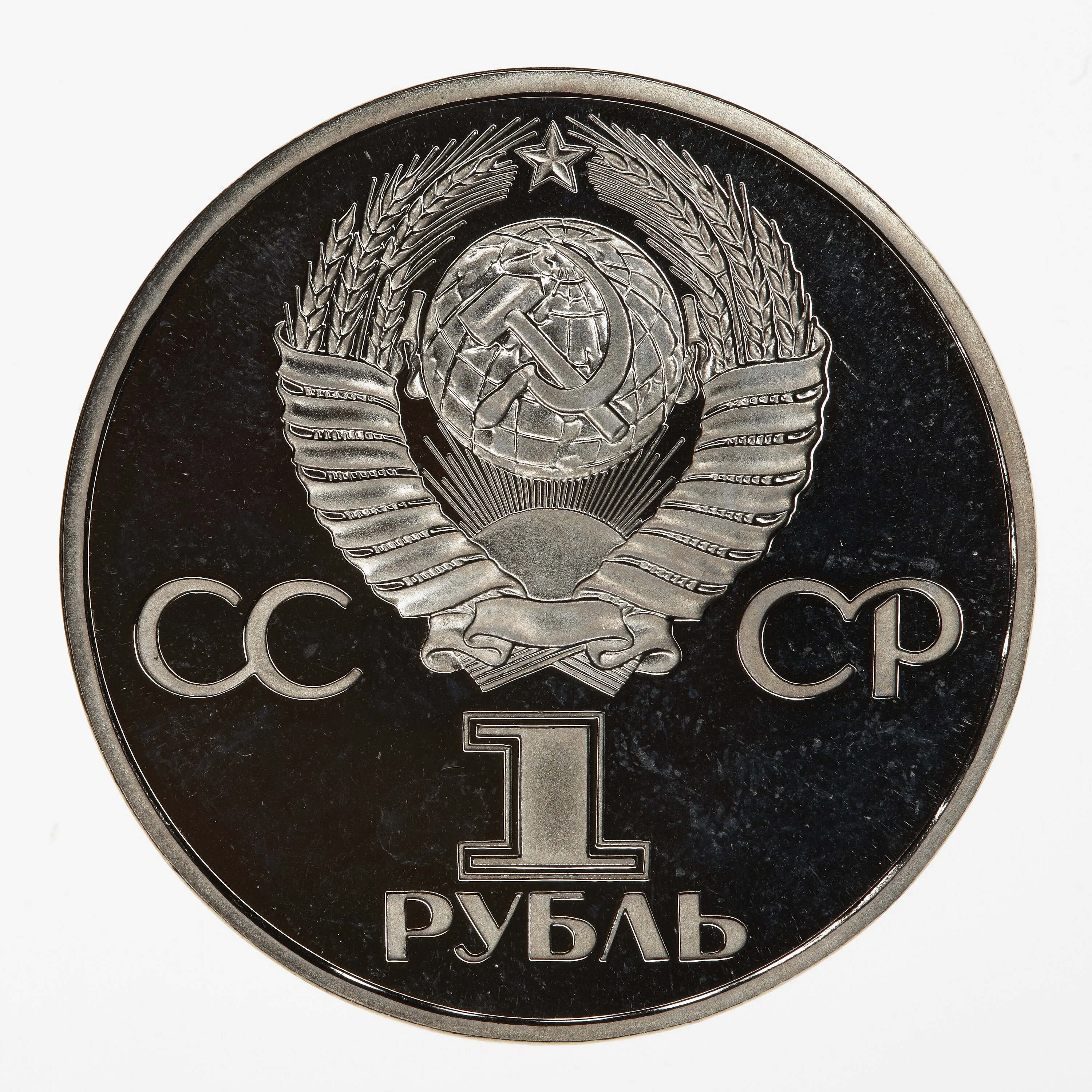
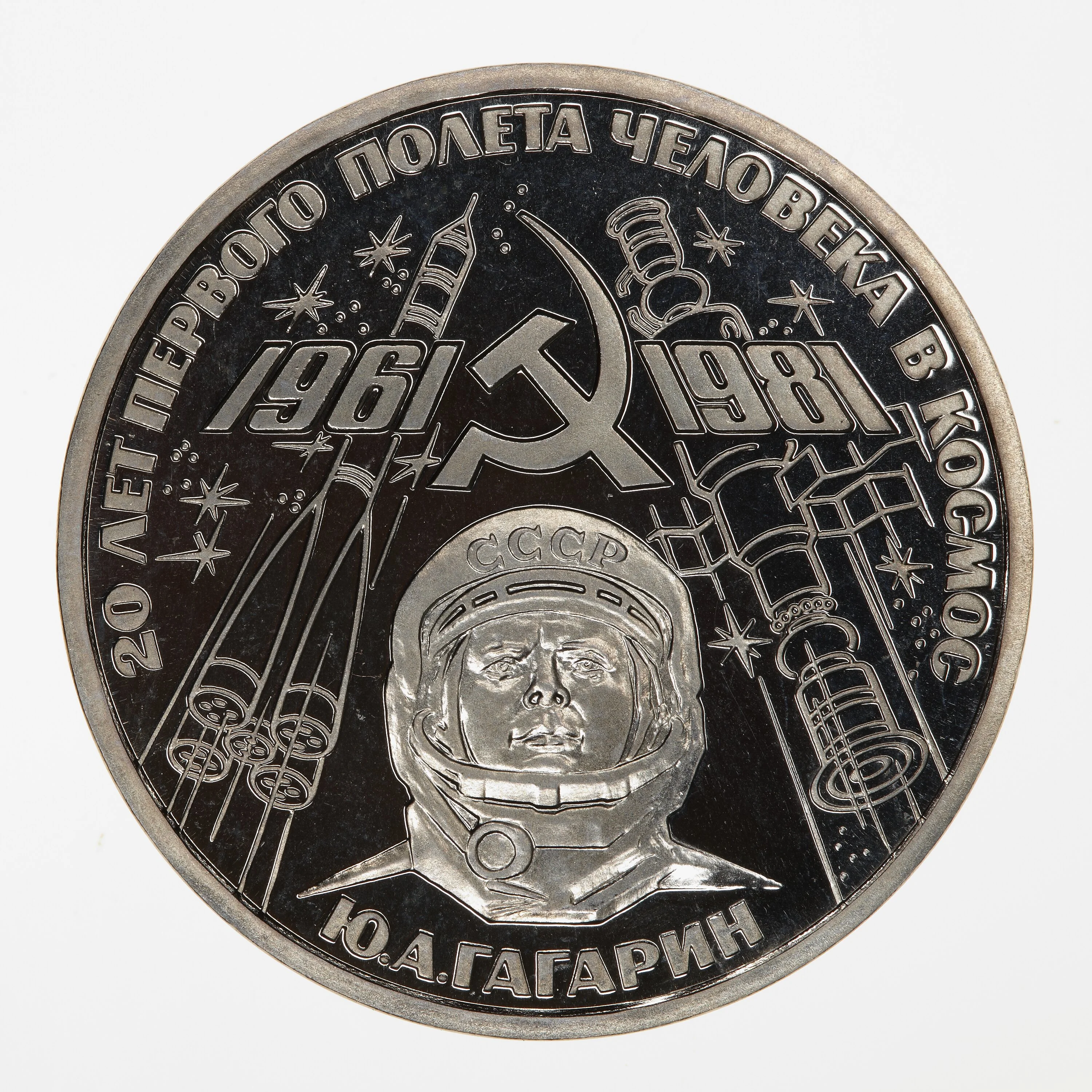
1 Ruble (Yuri Gagarin's Spaceflight) – Soviet Union
Circulating commemorative coins
Commemoration: 20th Anniversary of Yuri Gagarin's Spaceflight
Russia
Context
Years: 1981–1988
Country: Russia 
Issuer: Soviet Union 
Period:
(1922—1991)
Currency:
(1961—1991)
Demonetization: 1991
Total mintage: 4,017,000
Material
Diameter: 31 mm
Weight: 12.8 g
Thickness: 2.3 mm
Shape: Round
Composition: Copper-nickel
Technique: Milled
Alignment: Medal alignment
flip
References
Y: #Click to copy to clipboard188.1
Numista: #10402
Value
Exchange value: 1 SUR
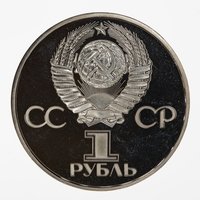
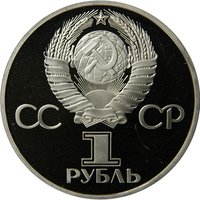
Obverse
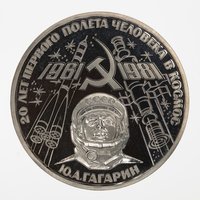
Reverse
Description:
Yuri Gagarin, the first human in space, with a Vostok rocket on the left and the Salyut station with docked Soyuz spacecraft on the right; a hammer, sickle, and dates are centered above.
Inscription:
20 ЛЕТ ПЕРВОГО ПОЛЕТА ЧЕЛОВЕКА В КОСМОС
1961 1981
Ю.А.ГАГАРИН
1961 1981
Ю.А.ГАГАРИН
Translation:
20 YEARS OF THE FIRST FLIGHT OF MAN INTO SPACE
1961 1981
YU.A. GAGARIN
1961 1981
YU.A. GAGARIN
Script: Cyrillic
Language: Russian
Edge
Legend:
ОДИН РУБЛЬ • ОДИН РУБЛЬ •
ОДИН РУБЛЬ • 1988 • Н •
ОДИН РУБЛЬ • 1988 • Н •
Translation:
ONE RUBLE • ONE RUBLE • ONE RUBLE • 1988 • N •
Language: Russian
Categories
| Symbols> Coat of Arms |
| Space |
Mints
| Name | Mark |
|---|---|
| Saint Petersburg | — |
Mintings
| Year | Mint Mark | Mintage | Quality | Collection |
|---|---|---|---|---|
| 1981 | — | 3,962,000 | ||
| 1981 | — | — | Proof | |
| 1988 | — | 55,000 | Proof |
Historical background
By 1981, the Soviet Union's currency situation was defined by a profound and growing duality. Officially, the ruble was a stable, state-controlled currency, insulated from international markets and not subject to inflation—a point of ideological pride. Citizens used it for all domestic transactions, from buying basic groceries to paying rent, within the rigid framework of the state-planned economy. However, this stability was artificial and masked severe underlying problems, primarily chronic goods shortages. Having rubles did not guarantee access to quality or even basic consumer goods, leading to the infamous "queue economy" where money's value was secondary to one's ability to find and secure products.
This internal facade contrasted sharply with the ruble's complete inconvertibility on the global stage. A separate, non-transferable "foreign trade ruble" was used for accounting in international deals, but it held no value outside the Council for Mutual Economic Assistance (COMECON) bloc. For meaningful foreign trade, the USSR desperately needed hard currencies like US dollars or Deutsche Marks to purchase vital Western technology and grain. This need created a vast black market where the official exchange rate (approximately 0.60-0.70 rubles to the dollar) was a fiction; on the illegal street market, the ruble traded for a fraction of its face value, often 5-10 rubles per dollar, reflecting its true purchasing power and lack of international confidence.
The situation in 1981 was thus one of mounting strain, exacerbated by external pressures. The combination of falling global oil prices (which reduced hard currency earnings), the costly war in Afghanistan, and renewed Cold War tensions following the Soviet invasion of Afghanistan and the subsequent Western sanctions, placed intense pressure on state finances. While the average citizen experienced the currency crisis as empty shelves and a thriving black market for goods and currency, the Politburo faced a silent hemorrhage of hard currency reserves. This unsustainable gap between the ruble's domestic pretense and international reality was a critical, though often hidden, symptom of the systemic economic decay that would culminate in the coming decade.
This internal facade contrasted sharply with the ruble's complete inconvertibility on the global stage. A separate, non-transferable "foreign trade ruble" was used for accounting in international deals, but it held no value outside the Council for Mutual Economic Assistance (COMECON) bloc. For meaningful foreign trade, the USSR desperately needed hard currencies like US dollars or Deutsche Marks to purchase vital Western technology and grain. This need created a vast black market where the official exchange rate (approximately 0.60-0.70 rubles to the dollar) was a fiction; on the illegal street market, the ruble traded for a fraction of its face value, often 5-10 rubles per dollar, reflecting its true purchasing power and lack of international confidence.
The situation in 1981 was thus one of mounting strain, exacerbated by external pressures. The combination of falling global oil prices (which reduced hard currency earnings), the costly war in Afghanistan, and renewed Cold War tensions following the Soviet invasion of Afghanistan and the subsequent Western sanctions, placed intense pressure on state finances. While the average citizen experienced the currency crisis as empty shelves and a thriving black market for goods and currency, the Politburo faced a silent hemorrhage of hard currency reserves. This unsustainable gap between the ruble's domestic pretense and international reality was a critical, though often hidden, symptom of the systemic economic decay that would culminate in the coming decade.
🌱 Very Common