

8 Rigsbankskilling – Denmark
Denmark
Context

Material
References
KM: #Click to copy to clipboard737
Numista: #45871
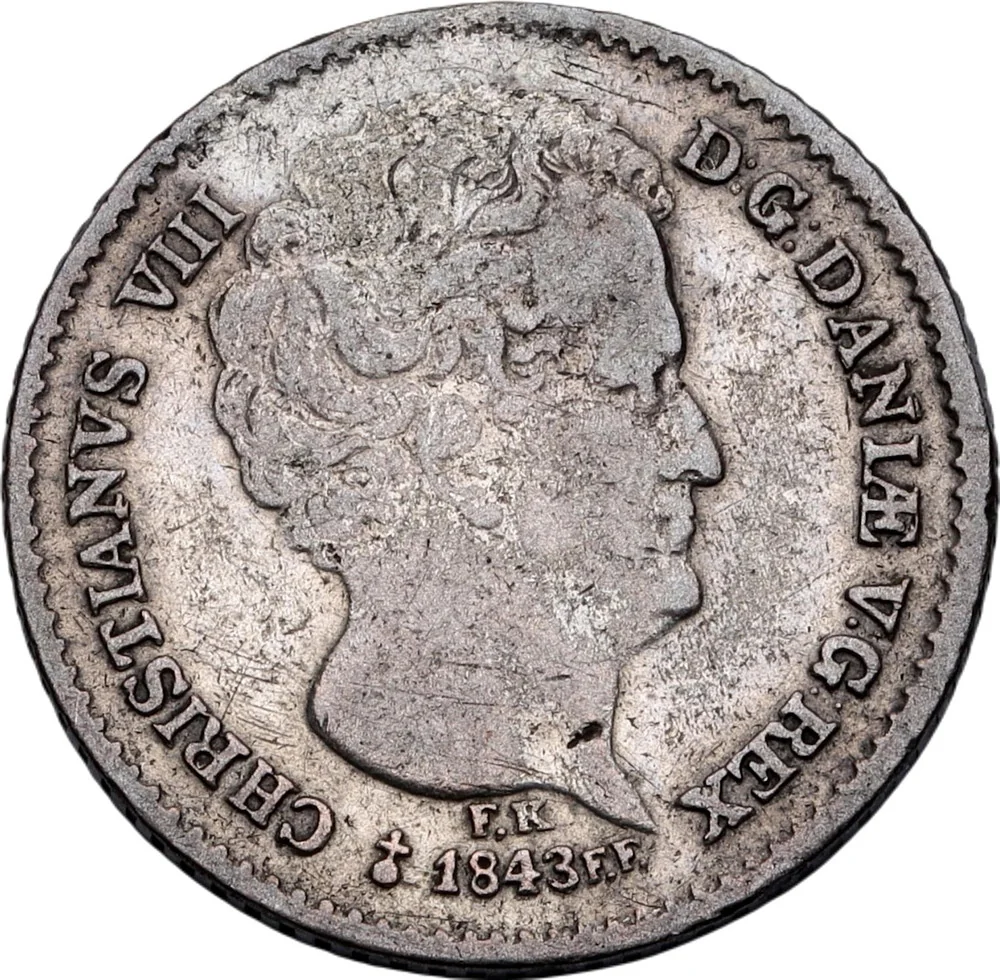
Obverse
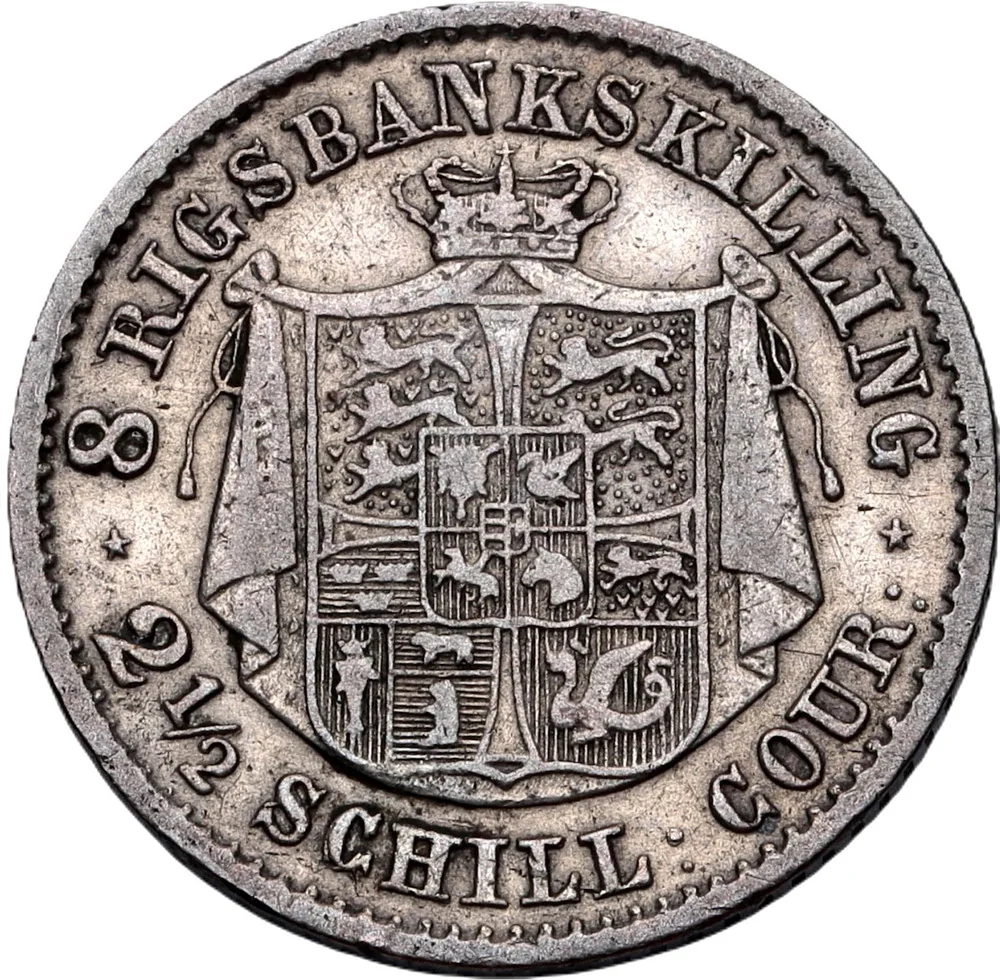
Reverse
Description:
Shield with Danish arms and territories, within a crowned ermine mantle. Value encircles.
Inscription:
* 8 RIGSBANKSKILLING *
2 1/2 SCHILL: COUR:
2 1/2 SCHILL: COUR:
Script: Latin
Edge
Reeded
Mints
| Name | Mark |
|---|---|
| Altona, Schleswig-Holstein | ♁ |
Mintings
| Year | Mint Mark | Mintage | Quality | Collection |
|---|---|---|---|---|
| 1843 | ♁ | — |
Historical background
In 1843, Denmark's currency system was in a state of transition and complexity, caught between old traditions and the pressures of a modernizing economy. The nation operated on a silver standard, with the primary unit being the rigsdaler, subdivided into 96 skilling. However, the system was not unified; a parallel "Courant" system (rigsdaler courant) and a "Species" system (rigsdaler species) existed, with the latter containing more silver and thus being more valuable. This duality, alongside a chronic shortage of small, usable coins in daily circulation, created confusion and inefficiency for both commerce and the public.
The period was marked by significant financial strain following the costly Napoleonic Wars and the state bankruptcy of 1813. To manage debt, the government had introduced the rigsbankdaler, a paper currency that was not fully convertible to silver, leading to periods of depreciation. By the 1840s, there was a strong push for monetary reform to stabilize the currency, simplify the chaotic dual system, and restore full public confidence. The goal was to establish a single, reliable currency firmly anchored to a silver standard to facilitate trade and economic growth.
Consequently, 1843 was a pivotal year just before major reform. The Danish state was actively preparing for the introduction of a new, decimalized currency system. This preparation culminated in the Currency Act of 1845, which created the rigsdaler as a unified decimal currency divided into 100 skilling, finally abolishing the old, cumbersome systems. Therefore, the currency situation in 1843 was one of anticipation, characterized by the final struggles of an outdated monetary framework on the brink of being swept away by a more rational and modern design.
The period was marked by significant financial strain following the costly Napoleonic Wars and the state bankruptcy of 1813. To manage debt, the government had introduced the rigsbankdaler, a paper currency that was not fully convertible to silver, leading to periods of depreciation. By the 1840s, there was a strong push for monetary reform to stabilize the currency, simplify the chaotic dual system, and restore full public confidence. The goal was to establish a single, reliable currency firmly anchored to a silver standard to facilitate trade and economic growth.
Consequently, 1843 was a pivotal year just before major reform. The Danish state was actively preparing for the introduction of a new, decimalized currency system. This preparation culminated in the Currency Act of 1845, which created the rigsdaler as a unified decimal currency divided into 100 skilling, finally abolishing the old, cumbersome systems. Therefore, the currency situation in 1843 was one of anticipation, characterized by the final struggles of an outdated monetary framework on the brink of being swept away by a more rational and modern design.
💎 Very Rare