

1 Dollar – Australia
Australia
Context

Material
Diameter: 36.6 mm
Weight: 31.1 g
Silver weight: 31.07 g
Thickness: 4 mm
Shape: Round
Composition: 99.9% Silver
Standard: Silver ounce
Magnetic: No
Alignment: Medal alignment
flip
References
KM: #Click to copy to clipboard1213
Numista: #148034
Value
Exchange value: 1 AUD = $0.71
Bullion value: $88.32
Inflation-adjusted value: 1.52 AUD
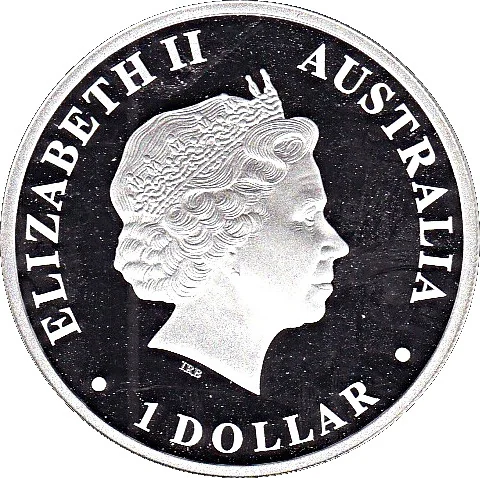
Obverse
Description:
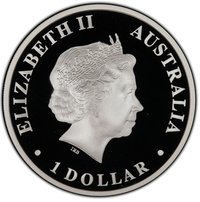
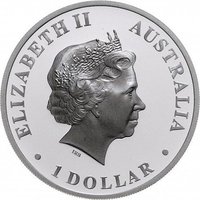
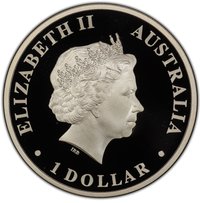
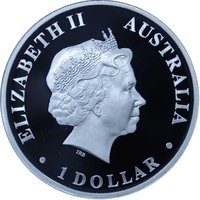
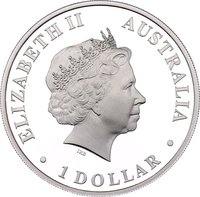
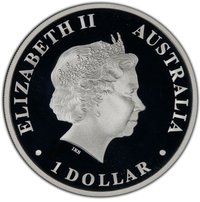
Queen Elizabeth IV, facing right, wearing the Girls of Great Britain and Ireland Tiara.
Inscription:
ELIZABETH II
AUSTRALIA
1 DOLLAR
IRB
AUSTRALIA
1 DOLLAR
IRB
Script: Latin
Designer: Ian Rank-Broadley
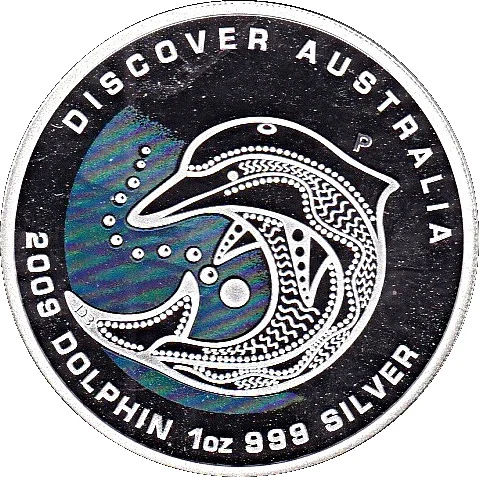
Reverse
Description:
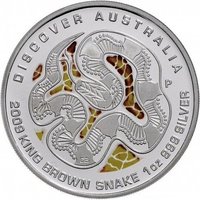
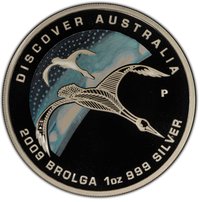
Dreaming dolphin on a colored background.
Inscription:
DISCOVER AUSTRALIA
DB P
2009 DOLPHIN 1oz 999 silver
DB P
2009 DOLPHIN 1oz 999 silver
Script: Latin
Designer: Darryl Bellotti
Edge
Reeded
Categories
| Animal> Marine mammal |
Mints
| Name | Mark |
|---|---|
| Perth Mint | P |
Mintings
| Year | Mint Mark | Mintage | Quality | Collection |
|---|---|---|---|---|
| 2009 | P | 6,651 | Proof |
Historical background
In 2009, Australia's currency situation was defined by its remarkable resilience during the Global Financial Crisis (GFC). Unlike most advanced economies, Australia avoided a technical recession, thanks in large part to a substantial and timely fiscal stimulus package, a robust banking sector largely untouched by toxic subprime assets, and continued strong demand for its commodity exports from China. This relative economic strength positioned the Australian dollar (AUD) for a powerful recovery. After plummeting to a low of around US$0.60 in late 2008, the AUD began a dramatic ascent in 2009, becoming one of the world's best-performing currencies that year.
This surge was driven by two key interrelated factors: a rapid return of global risk appetite and Australia's interest rate advantage. As panic from the GFC subsided, investors sought higher yields, moving capital away from safe-haven currencies like the US dollar and Japanese yen. The Reserve Bank of Australia (RBA), having cut rates aggressively in late 2008, began signalling a tightening cycle as the economy proved its durability. By October and November 2009, the RBA had raised the cash rate three times, making Australian assets highly attractive and fuelling the currency's climb towards parity with the US dollar.
Consequently, by the end of 2009, the AUD was trading above US$0.90, a gain of over 50% from its crisis low. This created a complex environment for policymakers and businesses. While it reflected confidence in the economy, the strong dollar pressured export-oriented industries like tourism and manufacturing, and threatened to dampen the nascent recovery. The RBA therefore faced the delicate balancing act of normalising monetary policy to manage domestic growth while being mindful of the disinflationary and competitiveness impacts of a sharply appreciating currency.
This surge was driven by two key interrelated factors: a rapid return of global risk appetite and Australia's interest rate advantage. As panic from the GFC subsided, investors sought higher yields, moving capital away from safe-haven currencies like the US dollar and Japanese yen. The Reserve Bank of Australia (RBA), having cut rates aggressively in late 2008, began signalling a tightening cycle as the economy proved its durability. By October and November 2009, the RBA had raised the cash rate three times, making Australian assets highly attractive and fuelling the currency's climb towards parity with the US dollar.
Consequently, by the end of 2009, the AUD was trading above US$0.90, a gain of over 50% from its crisis low. This created a complex environment for policymakers and businesses. While it reflected confidence in the economy, the strong dollar pressured export-oriented industries like tourism and manufacturing, and threatened to dampen the nascent recovery. The RBA therefore faced the delicate balancing act of normalising monetary policy to manage domestic growth while being mindful of the disinflationary and competitiveness impacts of a sharply appreciating currency.
Series: Australia Dreaming



✨ Legendary