

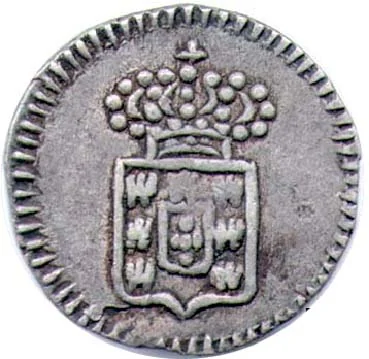
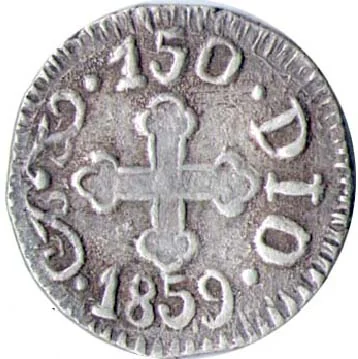
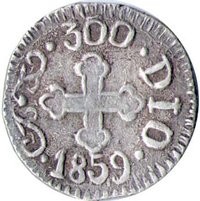
150 reis – Portuguese India
Add to wishlist
India
Context
Year: 1859
Country: India
Issuer: Portuguese India
Issuing organization: Casa da Moeda de Diu
Ruler: Pedro V
Currency:
(1706—1880)
Subdivision: 150 reis = ½ Pardao=¼ Rupia
Demonetized: Yes
Material
Diameter: 15 mm
Weight: 1.9 g
Silver Weight:: 1.74 g
Shape: Irregular round
Composition: 91.7% Silver
Magnetic: No
Technique: Hammered
References
KM: #
Numista: #45593
Value
Bullion value: $4.24
Mintings
| Year | Mint Mark | Mintage | Quality | Collection |
|---|---|---|---|---|
| 1859 | DIO | — |
Historical background
In 1859, the currency situation in Portuguese India was characterized by a complex and often chaotic multiplicity of circulating mediums, a direct legacy of its position as a commercial hub. The official currency was the Portuguese Indian Rupia (divided into 16 tangas or 960 réis), but its dominance was challenged by a plethora of other coins. Most significantly, British Indian rupees and their fractional coins circulated widely due to the territory's extensive trade with British India and the economic influence of the larger neighboring presidencies. Furthermore, older Portuguese colonial coins, such as the Xerafim, and even gold coins like the Cruzado and foreign issues, remained in use, creating a confusing system of exchange.
This monetary pluralism led to persistent problems of valuation and exchange, as the various coins fluctuated in value against each other and against the official standard. The situation was exacerbated by a chronic shortage of small change (escassez de miúdo), which hampered daily transactions and local trade. To function, the economy relied heavily on the practice of cunhagem à martelo (hammered coinage) for small denominations and the acceptance of worn or clipped coins, further undermining monetary stability. The colonial administration's attempts to assert the exclusive legitimacy of the Portuguese Indian rupia were largely ineffective against the entrenched commercial practices and regional economic realities.
Consequently, the monetary landscape of Portuguese India in 1859 was one of de facto bimetallism and foreign coin circulation, marked by administrative frustration and mercantile adaptation. The lack of a uniform, trusted currency system created transaction costs and uncertainty, reflecting the broader challenges of a small colonial enclave trying to maintain its own financial sovereignty within the powerful economic orbit of British-dominated South Asia. This unresolved situation would eventually lead to more concerted, though still complicated, reforms in the following decades.
This monetary pluralism led to persistent problems of valuation and exchange, as the various coins fluctuated in value against each other and against the official standard. The situation was exacerbated by a chronic shortage of small change (escassez de miúdo), which hampered daily transactions and local trade. To function, the economy relied heavily on the practice of cunhagem à martelo (hammered coinage) for small denominations and the acceptance of worn or clipped coins, further undermining monetary stability. The colonial administration's attempts to assert the exclusive legitimacy of the Portuguese Indian rupia were largely ineffective against the entrenched commercial practices and regional economic realities.
Consequently, the monetary landscape of Portuguese India in 1859 was one of de facto bimetallism and foreign coin circulation, marked by administrative frustration and mercantile adaptation. The lack of a uniform, trusted currency system created transaction costs and uncertainty, reflecting the broader challenges of a small colonial enclave trying to maintain its own financial sovereignty within the powerful economic orbit of British-dominated South Asia. This unresolved situation would eventually lead to more concerted, though still complicated, reforms in the following decades.

✨ Legendary