

Obverse
Description:
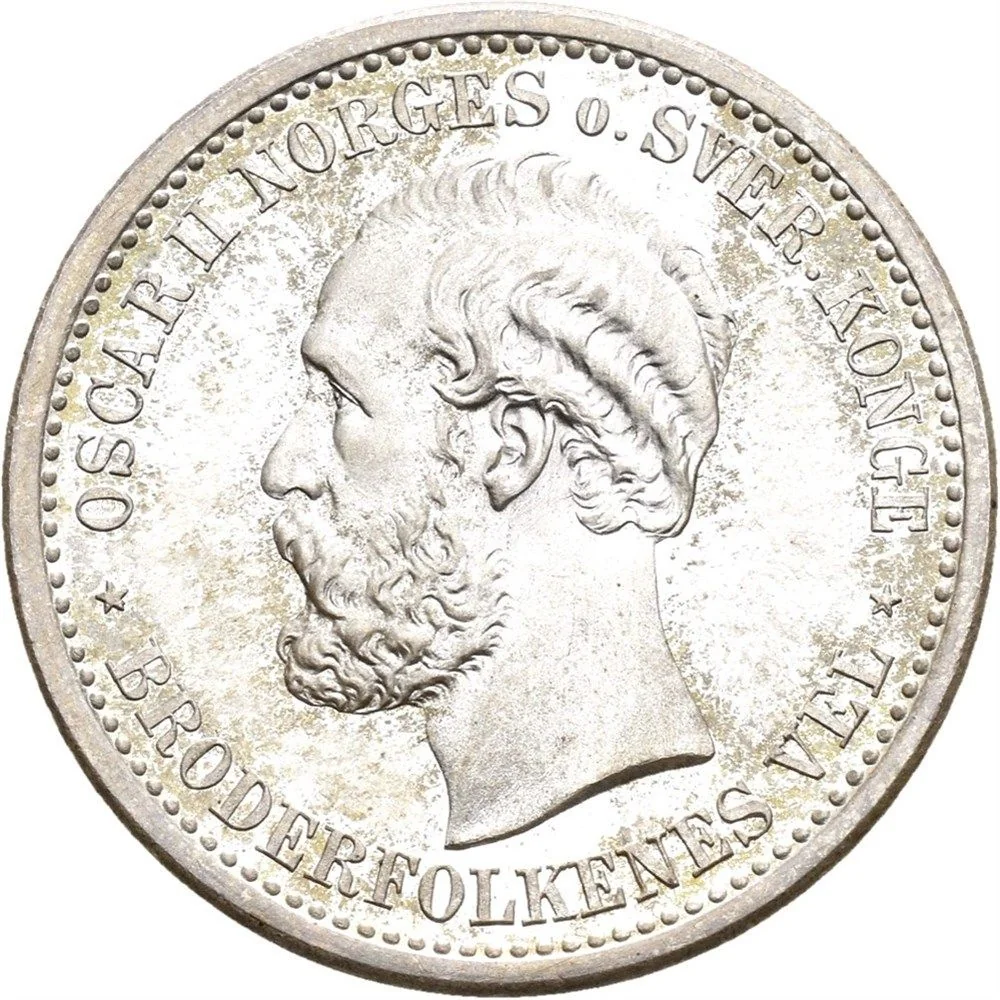
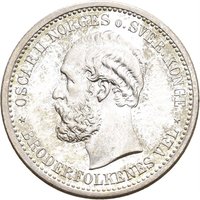
Bust of King Oscar II left, with inscription and beaded rim ring.
Inscription:
OSCAR II NORGES o. SVER. KONGE
⋆ BRODERFOLKENES VEL ⋆
⋆ BRODERFOLKENES VEL ⋆
Translation:
OSCAR II NORWAY'S AND SWEDEN'S KING
⋆ THE BROTHER PEOPLES' WELFARE ⋆
⋆ THE BROTHER PEOPLES' WELFARE ⋆
Script: Latin
Engraver: Lea Ahlborn
Reverse
Description:
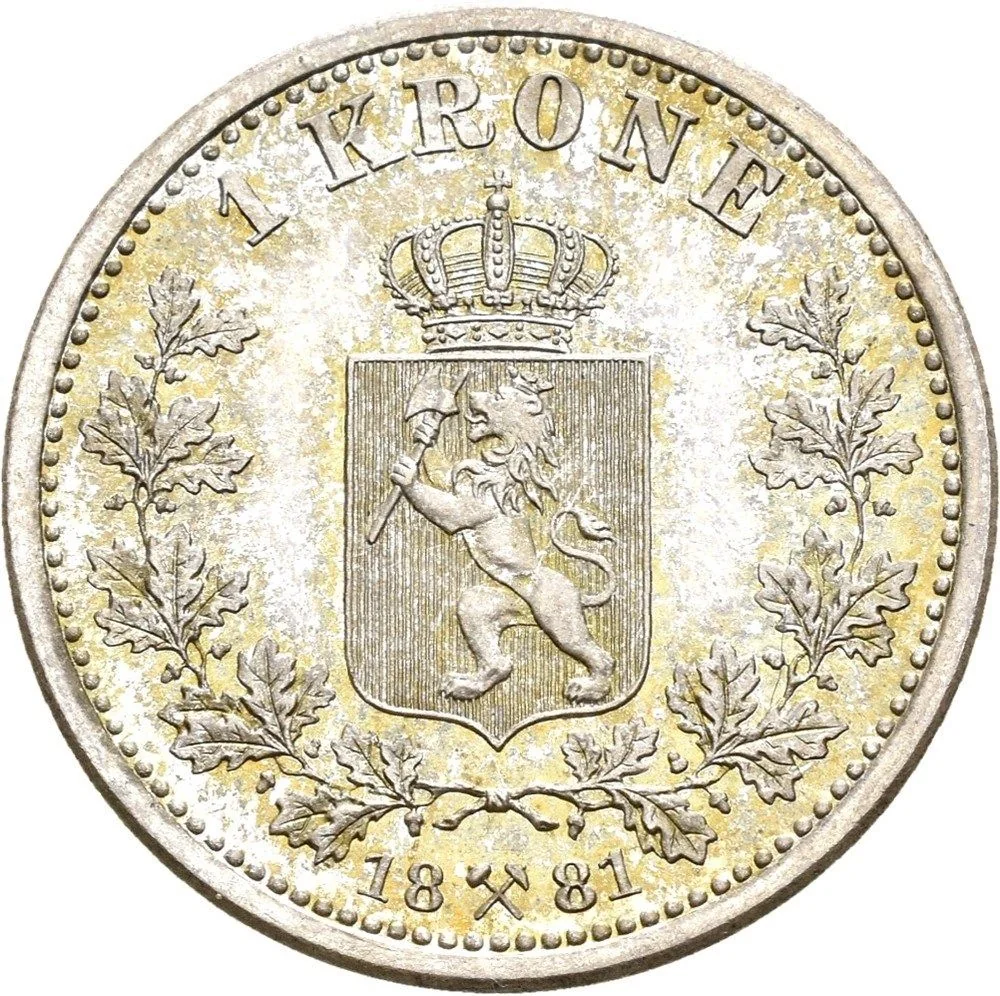
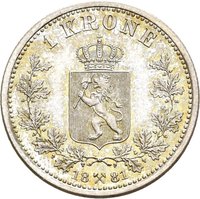
Shield with crowned Norwegian lion holding a halberd, within a wreath. Value above, date and mintmark below. Beaded rim.
Inscription:
1 KRONE
18 ⚒ 81
18 ⚒ 81
Script: Latin
Engraver: Lea Ahlborn
Edge
Reeded
Mints
| Name | Mark |
|---|---|
| Norwegian Mint | — |
Mintings
| Year | Mint Mark | Mintage | Quality | Collection |
|---|---|---|---|---|
| 1877 | — | 1,000,000 | ||
| 1878 | — | 60,000 | ||
| 1879 | — | 140,000 | ||
| 1881 | — | 80,000 | ||
| 1882 | — | 120,000 | ||
| 1885 | — | 100,000 | ||
| 1887 | — | 100,000 | ||
| 1888 | — | 75,000 | ||
| 1889 | — | 200,000 | ||
| 1890 | — | 200,000 | ||
| 1892 | — | 150,000 | ||
| 1893 | — | 100,000 | ||
| 1894 | — | 100,000 | ||
| 1895 | — | 100,000 | ||
| 1897 | — | 250,000 | ||
| 1898 | — | 150,000 | ||
| 1900 | — | 250,000 | ||
| 1901 | — | 151,800 | ||
| 1904 | — | 100,100 |
Historical background
In 1877, Norway was part of the Scandinavian Monetary Union (SMU), established in 1873 with Denmark and later joined by Sweden. This union created a common gold standard, where the Norwegian krone (crown) was defined as containing 0.403226 grams of fine gold and was legally equivalent to the Danish and Swedish kroner. The system allowed the coins of all three nations to circulate freely within the union's borders, facilitating trade and economic integration. Norway's adoption of the gold standard and the SMU marked a decisive move away from the older silver-based speciedaler and represented a modernizing step toward international monetary stability.
However, the union's stability was already being tested by the mid-1870s due to a global economic downturn. Falling prices for Norway's key exports like timber and fish created trade deficits and put pressure on the nation's gold reserves. While not yet in acute crisis in 1877, the underlying fragility was evident. The Norwegian government and the Bank of Norway had to carefully manage monetary policy to maintain the krone's gold parity, balancing the need for domestic liquidity with the strict requirements of the international gold standard. This period was one of cautious navigation between union obligations and national economic pressures.
Consequently, the currency situation in 1877 was one of formal stability within the framework of the Scandinavian Monetary Union, but with growing underlying strains. The Norwegian krone was firmly pegged to gold and its Scandinavian counterparts, ensuring predictability in international finance. Yet, the economic climate of the time highlighted the challenges of maintaining a fixed exchange rate during a period of declining export revenues. This tension would intensify in the following decades, ultimately leading to the SMU's effective dissolution in the early 20th century, though the krone remained Norway's solid and independent currency.
However, the union's stability was already being tested by the mid-1870s due to a global economic downturn. Falling prices for Norway's key exports like timber and fish created trade deficits and put pressure on the nation's gold reserves. While not yet in acute crisis in 1877, the underlying fragility was evident. The Norwegian government and the Bank of Norway had to carefully manage monetary policy to maintain the krone's gold parity, balancing the need for domestic liquidity with the strict requirements of the international gold standard. This period was one of cautious navigation between union obligations and national economic pressures.
Consequently, the currency situation in 1877 was one of formal stability within the framework of the Scandinavian Monetary Union, but with growing underlying strains. The Norwegian krone was firmly pegged to gold and its Scandinavian counterparts, ensuring predictability in international finance. Yet, the economic climate of the time highlighted the challenges of maintaining a fixed exchange rate during a period of declining export revenues. This tension would intensify in the following decades, ultimately leading to the SMU's effective dissolution in the early 20th century, though the krone remained Norway's solid and independent currency.
🌱 Fairly Common