

100 Leones – Sierra Leone
Sierra Leone
Context
Years: 1996–2017
Issuer: Sierra Leone 
Period:
(since 1996)
Currency:
(1964—2023)
Demonetization: 1 January 2024
Material
References
KM: #Click to copy to clipboard46
Numista: #4547
Value
Exchange value: 100 SLL
Obverse
Description:
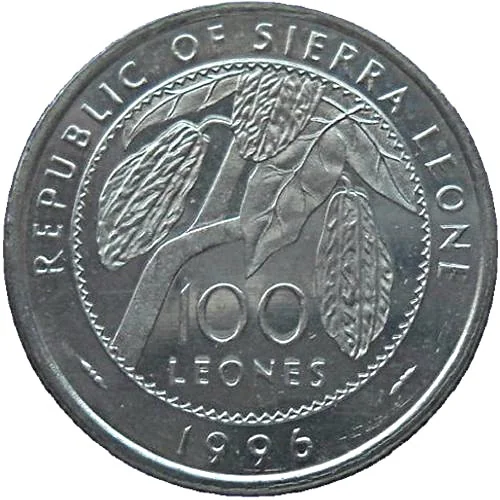
Cacao tree pods (*Theobroma cacao*).
Inscription:
REPUBLIC OF SIERRA LEONE
100 LEONES
1996
100 LEONES
1996
Script: Latin
Engraver: Avril Vaughan
Reverse
Description:
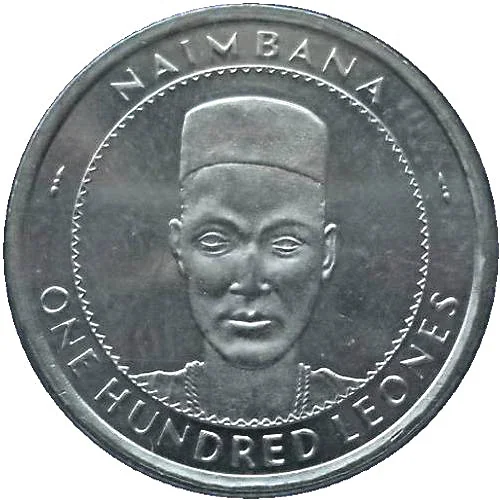
King Naimbana II facing, denomination below.
Inscription:
NAIMBANA
ONE HUNDRED LEONES
ONE HUNDRED LEONES
Script: Latin
Engraver: Avril Vaughan
Edge
Reeded
Mints
| Name | Mark |
|---|---|
| Royal Dutch Mint | — |
Mintings
| Year | Mint Mark | Mintage | Quality | Collection |
|---|---|---|---|---|
| 1996 | — | — | ||
| 2017 | — | — |
Historical background
In 1996, Sierra Leone’s currency, the leone (SLL), was in a state of severe crisis, deeply intertwined with the nation's devastating civil war and economic collapse. The rebel Revolutionary United Front (RUF) controlled key diamond-producing regions, strangling the formal export economy and fueling a vast illicit trade that deprived the government of foreign exchange. Rampant inflation, driven by massive deficit financing and a collapsing productive base, had rendered the leone nearly worthless on the parallel market, where exchange rates diverged wildly from the official, overvalued central bank rate. This period saw the physical use of U.S. dollars and other hard currencies becoming commonplace for major transactions, as public confidence in the leone evaporated.
The currency instability was both a cause and a symptom of the broader governance catastrophe. The National Provisional Ruling Council (NPRC) military government, which had seized power in 1992, failed to stabilize the economy before a pivotal return to multiparty democracy. The central bank had little effective monetary control, and government spending was largely financed by printing money, leading to hyperinflationary pressures. The economic turmoil provided a grim backdrop to the 1996 elections, which aimed to restore civilian rule but were conducted amidst widespread violence and dislocation.
Ultimately, the currency situation in 1996 reflected a failed state economy. The formal financial system was crippled, and the leone’s value was primarily determined by the black market, war dynamics, and the availability of smuggled diamonds and humanitarian aid. The election of President Ahmad Tejan Kabbah in March offered a fragile hope for peace and reform, but his administration would immediately face the monumental task of rebuilding trust in national institutions, including the currency—a process that would be violently interrupted by a military coup in 1997.
The currency instability was both a cause and a symptom of the broader governance catastrophe. The National Provisional Ruling Council (NPRC) military government, which had seized power in 1992, failed to stabilize the economy before a pivotal return to multiparty democracy. The central bank had little effective monetary control, and government spending was largely financed by printing money, leading to hyperinflationary pressures. The economic turmoil provided a grim backdrop to the 1996 elections, which aimed to restore civilian rule but were conducted amidst widespread violence and dislocation.
Ultimately, the currency situation in 1996 reflected a failed state economy. The formal financial system was crippled, and the leone’s value was primarily determined by the black market, war dynamics, and the availability of smuggled diamonds and humanitarian aid. The election of President Ahmad Tejan Kabbah in March offered a fragile hope for peace and reform, but his administration would immediately face the monumental task of rebuilding trust in national institutions, including the currency—a process that would be violently interrupted by a military coup in 1997.
🌱 Common