

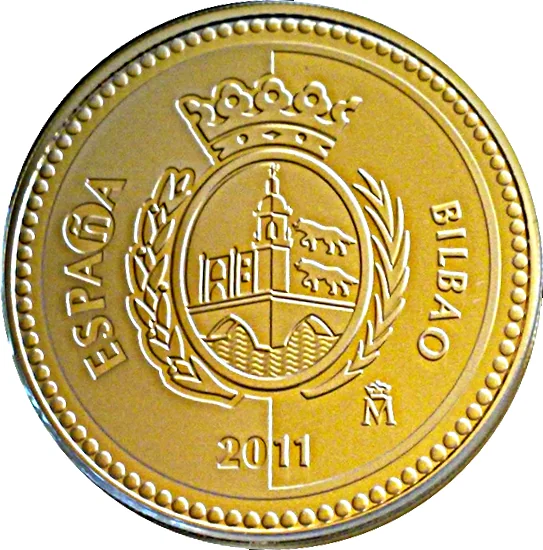
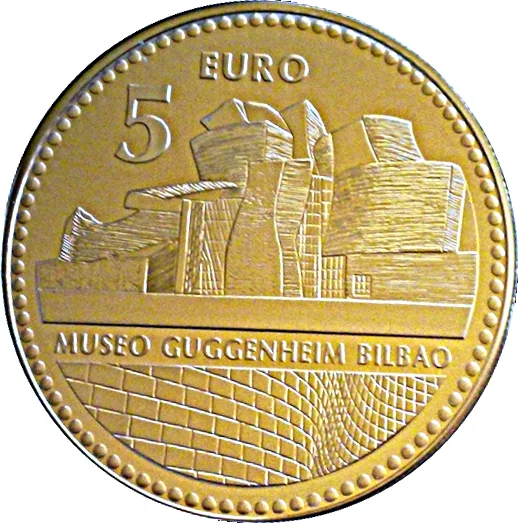
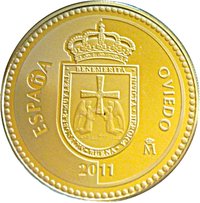
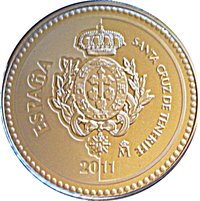
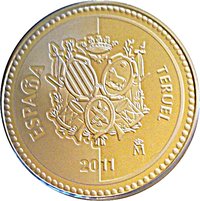
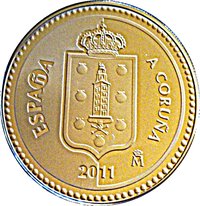
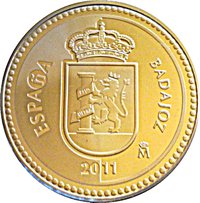
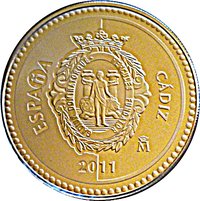
Obverse
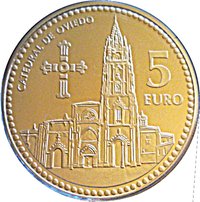
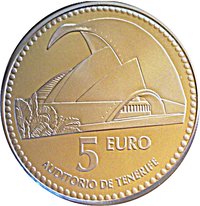
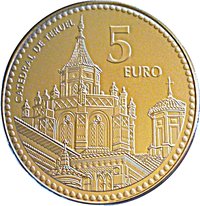
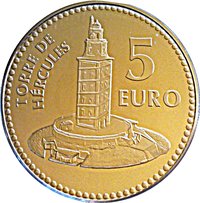
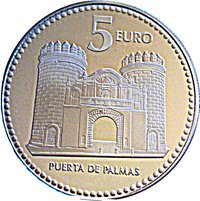
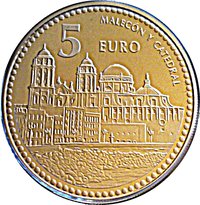
Reverse
Edge
Reeded
Mints
| Name | Mark |
|---|---|
| Royal Mint of Madrid | (M) |
Mintings
| Year | Mint Mark | Mintage | Quality | Collection |
|---|---|---|---|---|
| 2011 | M | 20,000 | Proof |
Historical background
In 2011, Spain was in the throes of a severe sovereign debt crisis, deeply entangled in the wider Eurozone turmoil. As a member of the Eurozone, Spain did not control its own currency or monetary policy, which was set by the European Central Bank (ECB). This lack of monetary sovereignty proved critical; Spain could not devalue its currency to regain competitiveness or directly finance its government deficits, leaving it reliant on financial markets and European institutions. The crisis was fundamentally a consequence of the bursting of a massive property bubble, which left its banking sector saddled with toxic assets and triggered a deep recession, soaring unemployment, and a rapidly widening budget deficit.
The currency situation manifested as a loss of market confidence in Spanish sovereign debt, driving borrowing costs to unsustainable levels. The yield on Spain's 10-year government bonds surged perilously close to 7% in late 2011, a threshold widely seen as requiring a bailout. This reflected investor fears of a potential default or even a breakup of the Eurozone, which would force a return to a devalued national currency, the peseta. Consequently, Spain faced a vicious cycle where bank bailouts strained public finances, which in turn heightened doubts about state solvency, further increasing the risk premium demanded by bond markets.
The response involved aggressive interventions at the European level to preserve the single currency. The ECB, under President Mario Draghi, initiated its Securities Markets Programme to purchase Spanish and Italian bonds, providing temporary relief. More definitively, in mid-2012, Draghi's famous "whatever it takes" pledge marked a turning point, preceding the announcement of the Outright Monetary Transactions (OMT) program. While Spain ultimately requested and received a €100 billion European bailout specifically for its banking sector in June 2012, it avoided a full sovereign bailout. These actions, combined with stringent domestic austerity and structural reforms, ultimately calmed the markets and preserved Spain's place within the Euro, though at a high social cost of prolonged economic hardship.
The currency situation manifested as a loss of market confidence in Spanish sovereign debt, driving borrowing costs to unsustainable levels. The yield on Spain's 10-year government bonds surged perilously close to 7% in late 2011, a threshold widely seen as requiring a bailout. This reflected investor fears of a potential default or even a breakup of the Eurozone, which would force a return to a devalued national currency, the peseta. Consequently, Spain faced a vicious cycle where bank bailouts strained public finances, which in turn heightened doubts about state solvency, further increasing the risk premium demanded by bond markets.
The response involved aggressive interventions at the European level to preserve the single currency. The ECB, under President Mario Draghi, initiated its Securities Markets Programme to purchase Spanish and Italian bonds, providing temporary relief. More definitively, in mid-2012, Draghi's famous "whatever it takes" pledge marked a turning point, preceding the announcement of the Outright Monetary Transactions (OMT) program. While Spain ultimately requested and received a €100 billion European bailout specifically for its banking sector in June 2012, it avoided a full sovereign bailout. These actions, combined with stringent domestic austerity and structural reforms, ultimately calmed the markets and preserved Spain's place within the Euro, though at a high social cost of prolonged economic hardship.
💎 Extremely Rare