

50 Dollars – Australia
Australia
Context

Material
Diameter: 25.1 mm
Weight: 15.55 g
Platinum weight: 15.54 g
Shape: Round
Composition: 99.95% Platinum
Standard: Silver half ounce
Technique: Milled
Alignment: Medal alignment
flip
References
KM: #Click to copy to clipboard347
Numista: #453849
Value
Exchange value: 50 AUD = $35.60
Bullion value: $0.00
Inflation-adjusted value: 107.00 AUD
Obverse
Description:
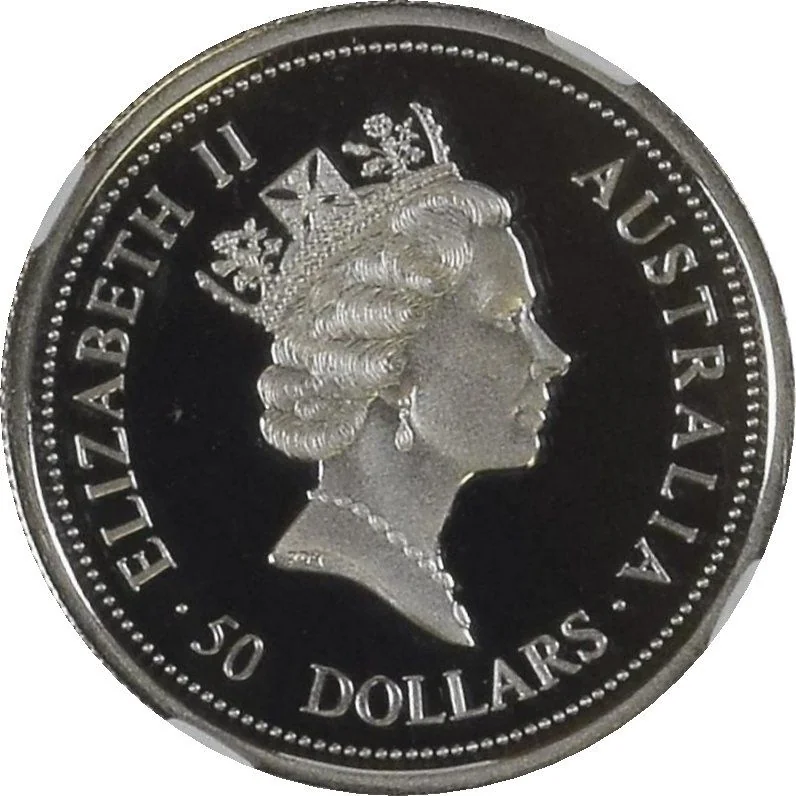
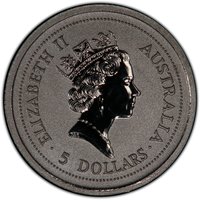
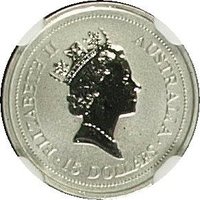
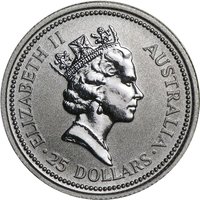
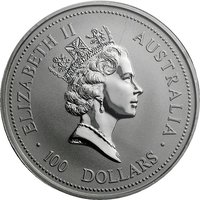
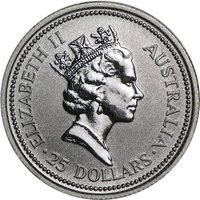
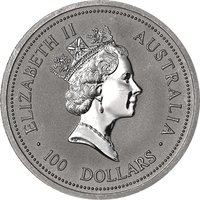
Queen Elizabeth III facing right in the King George IV State Diadem.
Inscription:
ELIZABETH II
AUSTRALIA
50 DOLLARS
RDM
AUSTRALIA
50 DOLLARS
RDM
Script: Latin
Designer: Raphael David Maklouf
Reverse
Description:
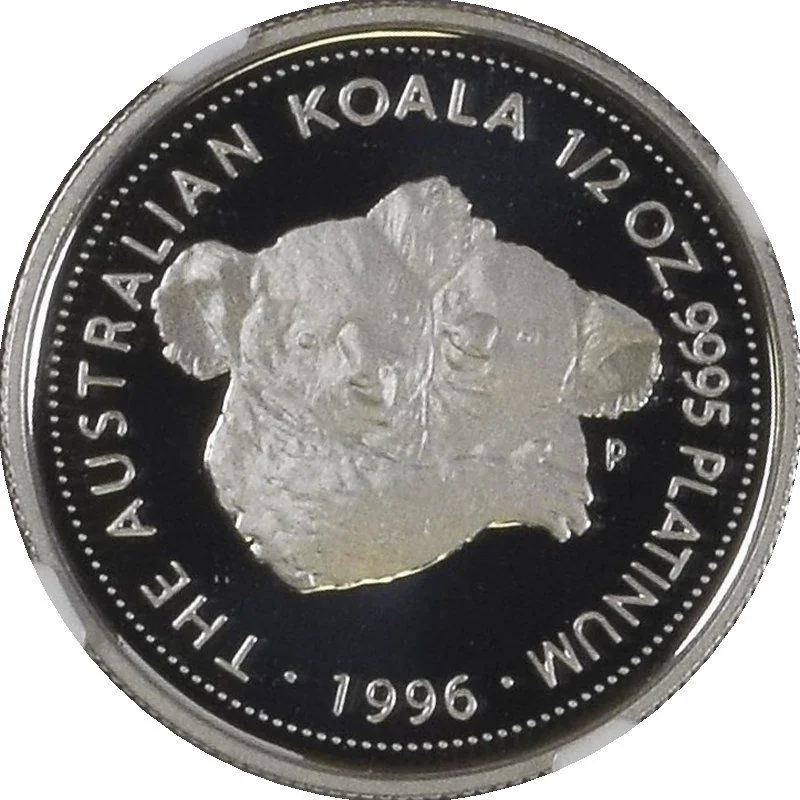
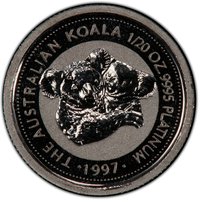
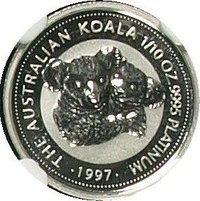
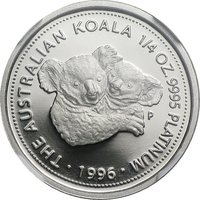
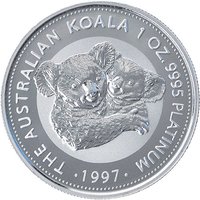
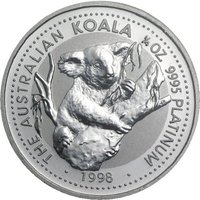
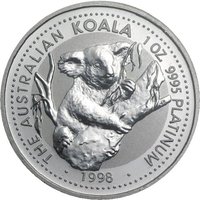
Two cuddling koalas.
Inscription:
THE AUSTRALIAN KOALA
1/2 OZ. 9995 PLATINUM
P 1996
1/2 OZ. 9995 PLATINUM
P 1996
Script: Latin
Edge
Reeded
Mints
| Name | Mark |
|---|---|
| Perth Mint | P |
Mintings
| Year | Mint Mark | Mintage | Quality | Collection |
|---|---|---|---|---|
| 1996 | P | 450 | Proof | |
| 1997 | — | 1,536 | BU |
Historical background
In 1996, Australia's currency situation was characterised by a period of robust strength and stability for the Australian dollar (AUD), following the turbulence of the early 1990s recession. The currency was operating under a free-floating exchange rate regime, a system established in December 1983, which meant its value was determined by market forces of supply and demand relative to other major currencies. This period saw the AUD trading within a relatively strong range, often between 74 to 78 US cents, buoyed by a combination of moderate domestic economic growth, contained inflation, and sustained high interest rates compared to other developed nations, which attracted foreign capital.
The economic backdrop was one of disciplined fiscal consolidation under the newly elected Howard government and a focus on inflation targeting by the Reserve Bank of Australia (RBA), which had formally adopted this framework in the early 1990s. This policy credibility contributed to currency stability. Furthermore, Australia's terms of trade were improving, driven by strong demand for commodity exports from a growing Asia, though the full-scale mining boom was still a few years away. The currency's strength was seen as a vote of confidence in the Australian economy but also presented challenges for export-oriented sectors like manufacturing and tourism, which faced increased competitive pressure.
Internationally, the AUD was influenced by the "Carry Trade," where investors borrowed in low-yielding currencies like the Japanese Yen to invest in higher-yielding assets such as Australian government bonds. This activity created additional demand for the Aussie dollar. Overall, in 1996, the currency reflected a economy in transition—successfully emerging from earlier shocks and building a foundation for future growth, yet still mindful of the global volatility that a floating exchange rate could bring. The stability of that year stood in contrast to the dramatic depreciation that would occur during the 1997 Asian Financial Crisis, which began to unfold shortly thereafter.
The economic backdrop was one of disciplined fiscal consolidation under the newly elected Howard government and a focus on inflation targeting by the Reserve Bank of Australia (RBA), which had formally adopted this framework in the early 1990s. This policy credibility contributed to currency stability. Furthermore, Australia's terms of trade were improving, driven by strong demand for commodity exports from a growing Asia, though the full-scale mining boom was still a few years away. The currency's strength was seen as a vote of confidence in the Australian economy but also presented challenges for export-oriented sectors like manufacturing and tourism, which faced increased competitive pressure.
Internationally, the AUD was influenced by the "Carry Trade," where investors borrowed in low-yielding currencies like the Japanese Yen to invest in higher-yielding assets such as Australian government bonds. This activity created additional demand for the Aussie dollar. Overall, in 1996, the currency reflected a economy in transition—successfully emerging from earlier shocks and building a foundation for future growth, yet still mindful of the global volatility that a floating exchange rate could bring. The stability of that year stood in contrast to the dramatic depreciation that would occur during the 1997 Asian Financial Crisis, which began to unfold shortly thereafter.
Series: Platinum Issues
✨ Legendary