

1 Euro – France
France
Context
Years: 1999–2006
Issuer: France 
Period:
(since 1958)
Currency:
(since 2002)
Total mintage: 778,727,985
Material
References
KM: #Click to copy to clipboard1288
Numista: #103
Value
Exchange value: 1 EUR = $1.18
Inflation-adjusted value: 1.57 EUR
Obverse
Description:
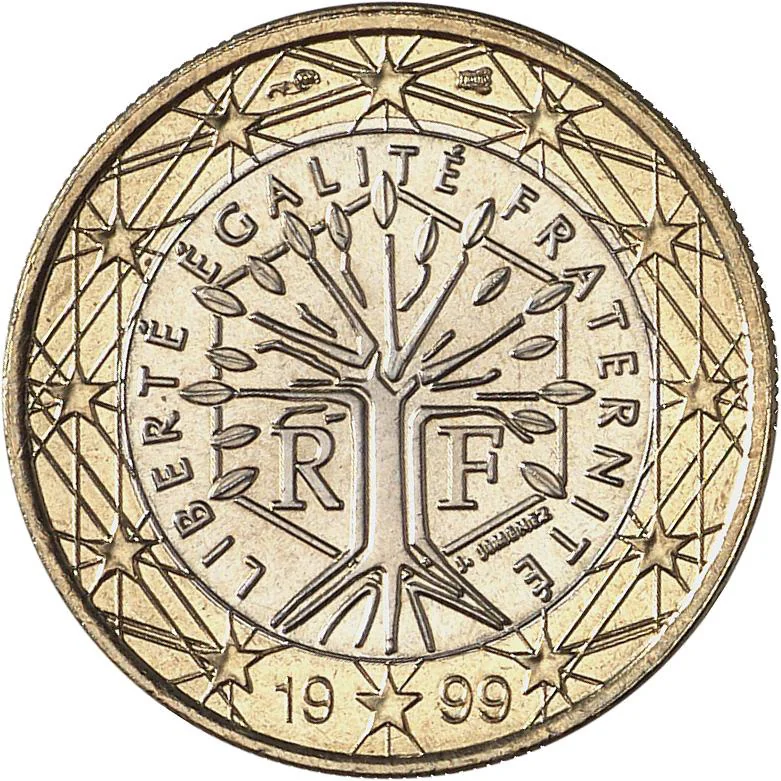
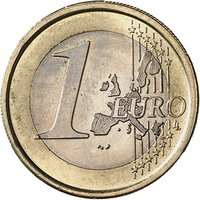
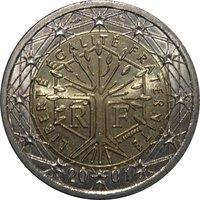
A tree of life within a hexagon, encircled by "LIBERTÉ ÉGALITÉ FRATERNITÉ" and the twelve European stars.
Inscription:
LIBERTÉ ÉGALITÉ FRATERNITÉ
RF
J. JIMENEZ
19 99
RF
J. JIMENEZ
19 99
Translation:
LIBERTY EQUALITY FRATERNITY
RF
J. JIMENEZ
19 99
RF
J. JIMENEZ
19 99
Script: Latin
Language: French
Engraver: Joaquin Jimenez
Reverse
Edge
Segmented reeding
Mints
| Name | Mark |
|---|---|
| Monnaie de Paris | — |
Mintings
| Year | Mint Mark | Mintage | Quality | Collection |
|---|---|---|---|---|
| 1999 | — | 35,000 | BU | |
| 1999 | — | 301,050,000 | ||
| 1999 | — | 15,000 | Proof | |
| 2000 | — | 15,000 | Proof | |
| 2000 | — | 197,270,000 | ||
| 2000 | — | 35,000 | BU | |
| 2001 | — | 150,216,624 | ||
| 2001 | — | 35,000 | BU | |
| 2001 | — | 15,000 | Proof | |
| 2002 | — | 129,324,013 | ||
| 2002 | — | 21,453 | Proof | |
| 2002 | — | 165,290 | BU | |
| 2003 | — | 132,139 | BU | |
| 2003 | — | 40,000 | Proof | |
| 2004 | — | 129,103 | BU | |
| 2004 | — | 11,033 | Proof | |
| 2005 | — | 120,000 | BU | |
| 2005 | — | 8,519 | Proof | |
| 2006 | — | 80,000 | BU | |
| 2006 | — | 9,811 | Proof |
Historical background
In 1999, France stood at the historic threshold of a new monetary era, fully participating in the launch of the euro as a virtual currency for electronic payments and financial markets. This moment was the culmination of a decade of intense economic preparation and political commitment, driven by the 1992 Maastricht Treaty. To qualify, France had to meet strict convergence criteria on inflation, interest rates, budget deficits, and public debt, requiring significant fiscal discipline throughout the 1990s. The French franc, a symbol of national sovereignty for centuries, was now irrevocably fixed to the euro at a rate of 6.55957 francs, marking a profound transfer of monetary policy authority to the new European Central Bank.
Domestically, the situation was characterized by a unique dual circulation period. While the euro existed as "scriptural money" in bank accounts and for non-cash transactions, the familiar franc coins and banknotes remained the sole physical legal tender in daily life. This created a curious hybrid economy where citizens and businesses began thinking in both currencies, with prices often displayed in both units to ease the transition. The Banque de France and financial institutions worked diligently behind the scenes to prepare for the physical switchover, which was scheduled for the beginning of 2002.
The mood in France was a complex mix of pragmatic acceptance and underlying nostalgia. The government and much of the business community championed the euro as essential for deeper European integration, price stability, and enhanced trade. However, a segment of the public and some political factions viewed the abandonment of the franc with apprehension, fearing a loss of identity and covert price increases. Thus, the currency situation in 1999 was one of technical readiness and psychological adjustment, setting the stage for the final, tangible arrival of euro notes and coins three years later.
Domestically, the situation was characterized by a unique dual circulation period. While the euro existed as "scriptural money" in bank accounts and for non-cash transactions, the familiar franc coins and banknotes remained the sole physical legal tender in daily life. This created a curious hybrid economy where citizens and businesses began thinking in both currencies, with prices often displayed in both units to ease the transition. The Banque de France and financial institutions worked diligently behind the scenes to prepare for the physical switchover, which was scheduled for the beginning of 2002.
The mood in France was a complex mix of pragmatic acceptance and underlying nostalgia. The government and much of the business community championed the euro as essential for deeper European integration, price stability, and enhanced trade. However, a segment of the public and some political factions viewed the abandonment of the franc with apprehension, fearing a loss of identity and covert price increases. Thus, the currency situation in 1999 was one of technical readiness and psychological adjustment, setting the stage for the final, tangible arrival of euro notes and coins three years later.
Series: 1999 France circulation coins
🌱 Very Common