

5 euro – Italy
Add to wishlist
Non-circulating coins
Commemoration: FIFA World Cup 2006 - Germany 2006 (first issue)
Italy
Context
Material
References
KM: #
Numista: #45345
Value
Exchange value: 5 EUR
Bullion value: $41.79
Inflation-adjusted value: 7.43 EUR
Obverse
Description:
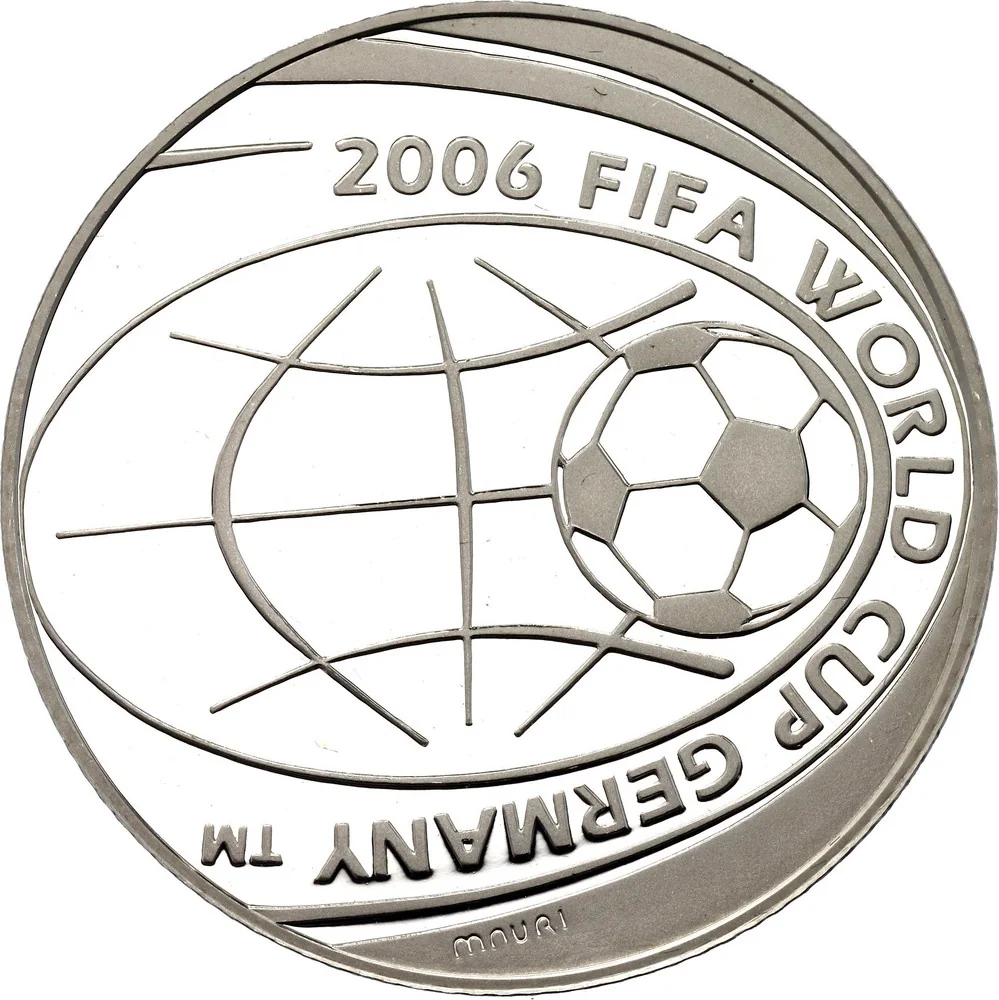
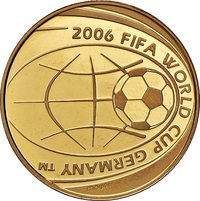
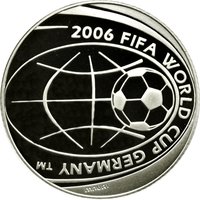
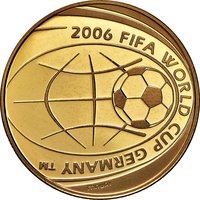
Globe with soccer ball on Asia, legend around, author below.
Inscription:
2006 FIFA WORLD CUP GERMANY TM
mauri
mauri
Translation:
2006 FIFA WORLD CUP GERMANY TM
mauri
mauri
Script: Latin
Engraver: Roberto Mauri
Reverse
Description:
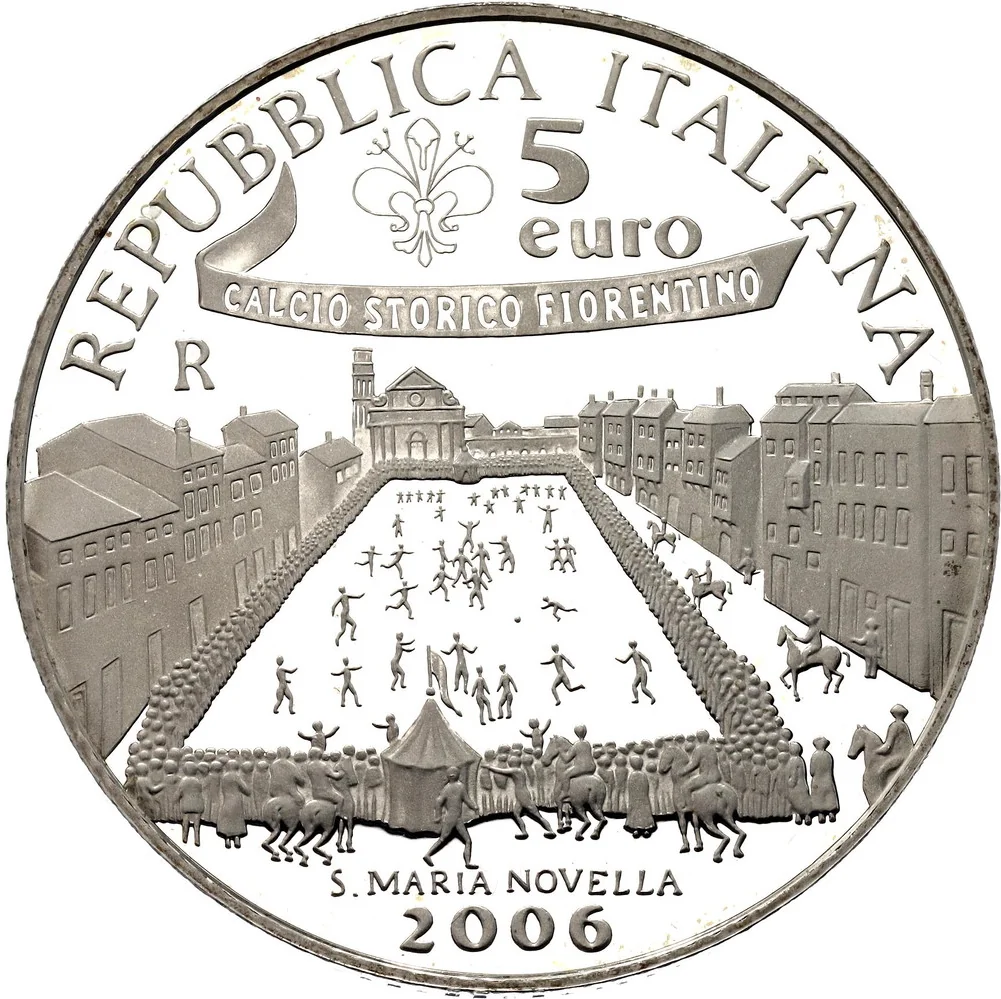
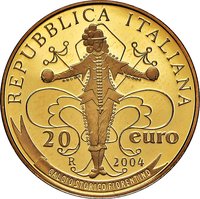
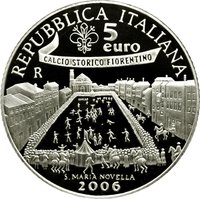
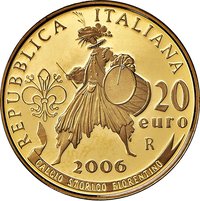
Santa Croce Square in Florence, from an old painting, showing a historic football match within a wooden fence. The design includes the date below, the sport's name in a banner above, and the fleur-de-lys of Florence beside the mintmark and value.
Inscription:
REPUBBLICA ITALIANA
5 R
EURO
CALCIO STORICO FIORENTINO
SANTA CROCE
2004
5 R
EURO
CALCIO STORICO FIORENTINO
SANTA CROCE
2004
Translation:
Italian Republic
5 R
Euro
Historic Florentine Football
Santa Croce
2004
5 R
Euro
Historic Florentine Football
Santa Croce
2004
Script: Latin
Language: Italian
Engraver: Roberto Mauri
Edge
Reeded
Categories
| Sport> Football> FIFA World Cup |
Mints
| Name | Mark |
|---|---|
| Rome | R |
Mintings
| Year | Mint Mark | Mintage | Quality | Collection |
|---|---|---|---|---|
| 2004 | R | 34,750 | Proof |
Historical background
In 2004, Italy was a full member of the Eurozone, having adopted the euro as its physical currency in 2002. The period was characterized by the ongoing adjustment to the single currency, which had replaced the historic Italian lira. While the transition was largely complete in daily transactions, a psychological and economic adjustment was still underway. Consumers and businesses continued to mentally convert prices back to lire, often perceiving the new currency as having caused significant price increases, a phenomenon widely referred to as "lira illusion" or perceived "euro-inflation." This sentiment was particularly strong in Italy, where the rounding-up of prices during the cash changeover was believed to have fueled inflation more than in other member states.
Economically, Italy faced significant challenges under the constraints of the Eurozone's Stability and Growth Pact. The country struggled with low economic growth, high public debt (exceeding 100% of GDP), and persistent concerns over its loss of monetary policy sovereignty. The inability to devalue its own currency or set independent interest rates highlighted structural weaknesses in the Italian economy, including rigid labor markets and sluggish productivity growth. The euro's strength in this period also put pressure on Italy's export-oriented manufacturing sectors, such as textiles and machinery, which were now competing globally without the tool of a flexible exchange rate.
Politically, the currency situation was a point of contention. The center-right government of Prime Minister Silvio Berlusconi, while officially pro-European, occasionally faced internal pressure from factions and coalition partners like the Lega Nord, which was more eurosceptic and sometimes nostalgically referenced the lira. However, there was no serious political movement to leave the euro. The broader consensus remained that, despite the short-term pains of adjustment and the loss of traditional economic levers, euro membership was irreversible and essential for Italy's place at the core of European integration and financial stability. The focus in 2004 was therefore on the difficult domestic reforms required to thrive within the single currency's fixed framework.
Economically, Italy faced significant challenges under the constraints of the Eurozone's Stability and Growth Pact. The country struggled with low economic growth, high public debt (exceeding 100% of GDP), and persistent concerns over its loss of monetary policy sovereignty. The inability to devalue its own currency or set independent interest rates highlighted structural weaknesses in the Italian economy, including rigid labor markets and sluggish productivity growth. The euro's strength in this period also put pressure on Italy's export-oriented manufacturing sectors, such as textiles and machinery, which were now competing globally without the tool of a flexible exchange rate.
Politically, the currency situation was a point of contention. The center-right government of Prime Minister Silvio Berlusconi, while officially pro-European, occasionally faced internal pressure from factions and coalition partners like the Lega Nord, which was more eurosceptic and sometimes nostalgically referenced the lira. However, there was no serious political movement to leave the euro. The broader consensus remained that, despite the short-term pains of adjustment and the loss of traditional economic levers, euro membership was irreversible and essential for Italy's place at the core of European integration and financial stability. The focus in 2004 was therefore on the difficult domestic reforms required to thrive within the single currency's fixed framework.
⭐ Rare