

⅕ Crown – Isle of Man
Context
Year: 2000
Country: British Crown dependencies
Issuer: Isle of Man 
Ruler: Elizabeth II
Currency:
(since 1970)
Total mintage: 2,000
Material

References
KM: #Click to copy to clipboard987
Numista: #451136
Value
Bullion value: $1036.98
Obverse
Description:
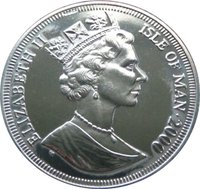
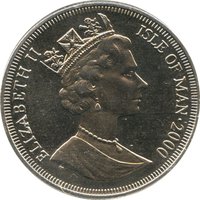
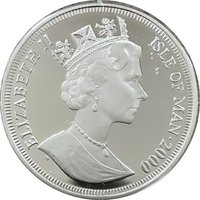
Queen Elizabeth II facing right, wearing the George IV State Diadem, surrounded by legend and date.
Inscription:
ELIZABETH II
ISLE OF MAN · 2000
RDM
ISLE OF MAN · 2000
RDM
Translation:
ELIZABETH II
ISLE OF MAN · 2000
RDM
ISLE OF MAN · 2000
RDM
Script: Latin
Designer: Raphael David Maklouf
Reverse
Description:
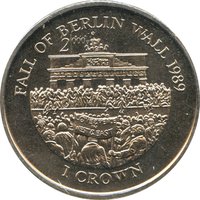
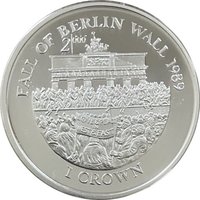
Crowd at Brandenburg Gate
Inscription:
FALL OF BERLIN WALL 1989
2000
1/5 CROWN
2000
1/5 CROWN
Script: Latin
Edge
Reeded
Categories
| Building |
Mints
| Name | Mark |
|---|---|
| Pobjoy Mint | (PM) |
Mintings
| Year | Mint Mark | Mintage | Quality | Collection |
|---|---|---|---|---|
| 2000 | PM | 2,000 | Proof |
Historical background
In 2000, the Isle of Man's currency situation was defined by its unique constitutional position as a British Crown Dependency, which granted it a high degree of autonomy in monetary matters. The primary circulating currency was the Manx pound, issued by the Isle of Man Government Treasury. This currency was not legal tender in the United Kingdom but was pegged at par with sterling, meaning one Manx pound equaled one British pound sterling. This parity was a cornerstone of economic stability, ensuring seamless trade and financial integration with its largest partner, the UK. British coins and Bank of England notes also circulated freely on the island and were accepted as legal tender, creating a de facto dual-currency system where Manx and sterling existed side-by-side.
The year 2000 saw the continued circulation of a distinct series of Manx banknotes, featuring local landmarks and historical figures, which served as both a practical medium of exchange and a symbol of national identity. These notes were backed pound-for-pound by sterling reserves held by the Isle of Man Government, a requirement that ensured full convertibility and maintained confidence in the currency. The island's banking and finance sector, a key pillar of its economy, operated effectively within this framework, using sterling as its core accounting unit while handling Manx notes for local transactions.
This stable monetary environment was crucial as the Isle of Man navigated the early 21st century, focusing on developing its economy as an international offshore financial centre. The fixed link to sterling provided a predictable foundation for investment and commerce, free from exchange rate risk with the UK. There were no significant currency crises or redenomination debates in 2000; instead, the system functioned as a well-established mechanism that balanced the Isle of Man's political autonomy with the economic necessities of its close relationship with Britain.
The year 2000 saw the continued circulation of a distinct series of Manx banknotes, featuring local landmarks and historical figures, which served as both a practical medium of exchange and a symbol of national identity. These notes were backed pound-for-pound by sterling reserves held by the Isle of Man Government, a requirement that ensured full convertibility and maintained confidence in the currency. The island's banking and finance sector, a key pillar of its economy, operated effectively within this framework, using sterling as its core accounting unit while handling Manx notes for local transactions.
This stable monetary environment was crucial as the Isle of Man navigated the early 21st century, focusing on developing its economy as an international offshore financial centre. The fixed link to sterling provided a predictable foundation for investment and commerce, free from exchange rate risk with the UK. There were no significant currency crises or redenomination debates in 2000; instead, the system functioned as a well-established mechanism that balanced the Isle of Man's political autonomy with the economic necessities of its close relationship with Britain.
Series: Millennium 2000

✨ Legendary