

25 schilling – Austria
Add to wishlist
Austria
Obverse
Description:
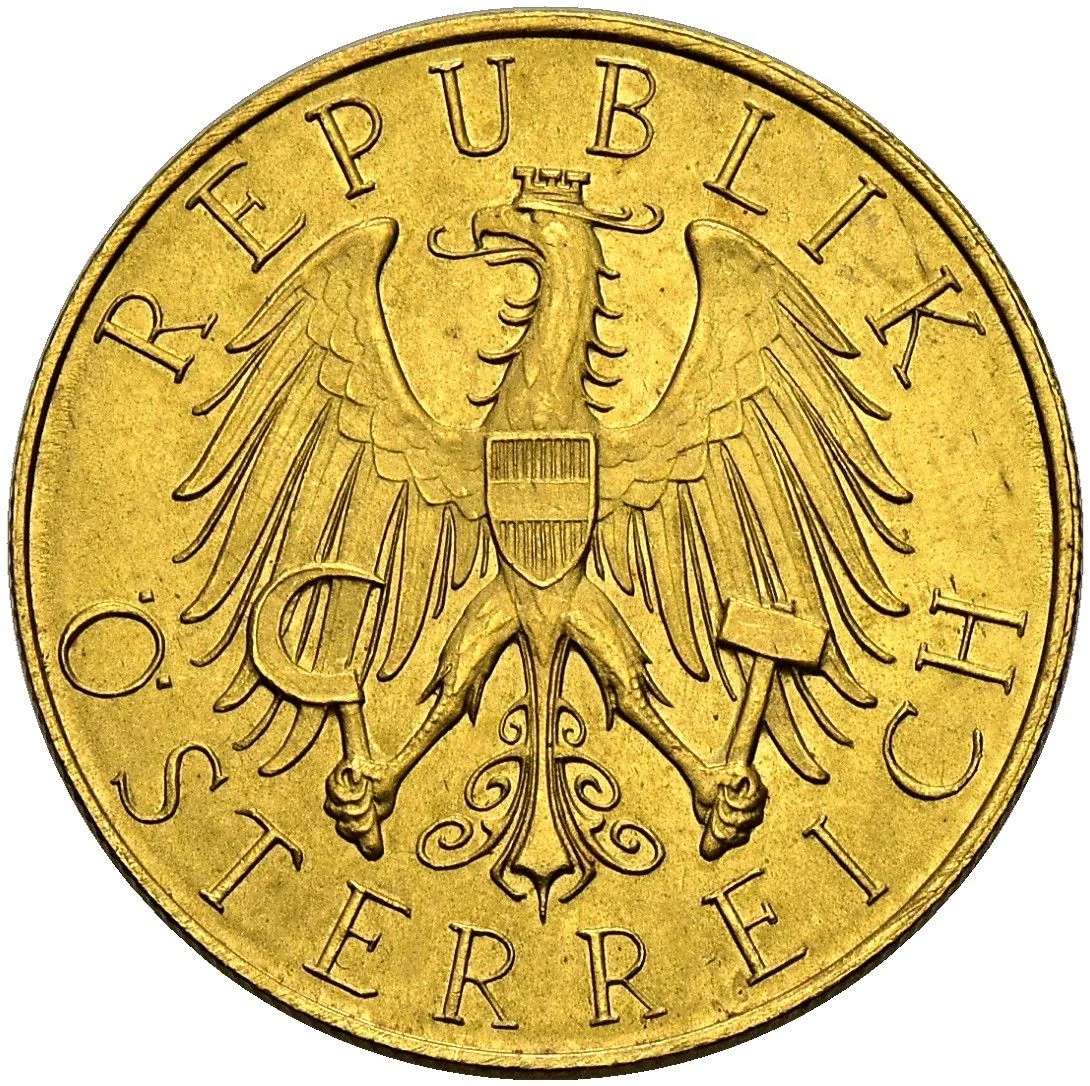
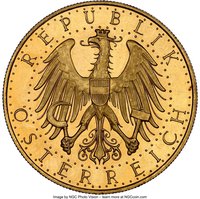
Austrian eagle with shield, country name above and below.
Inscription:
REPUBLIK
ÖSTERREICH
ÖSTERREICH
Translation:
REPUBLIC
AUSTRIA
AUSTRIA
Script: Latin
Language: German
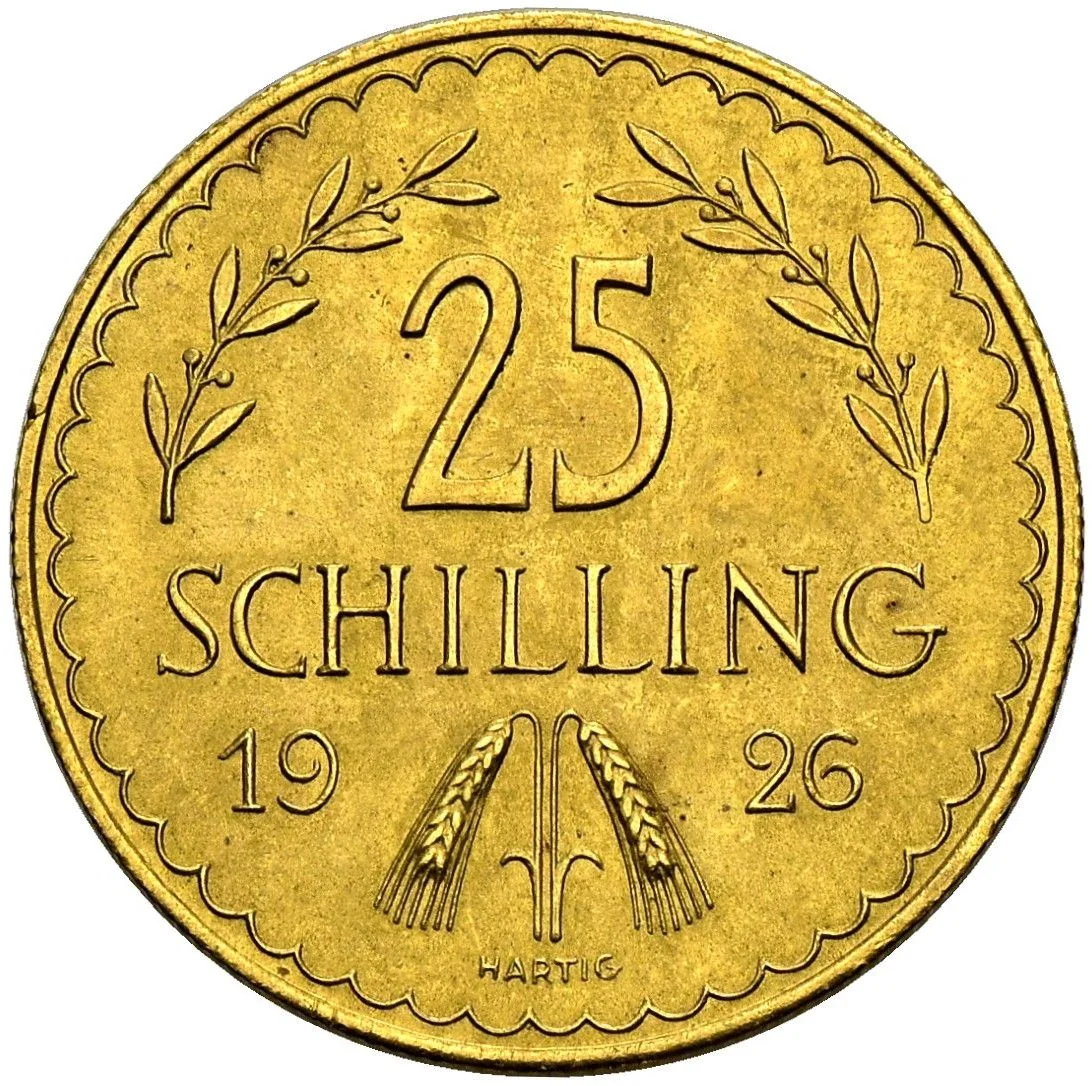
Engraver: Arnold Hartig
Reverse
Edge
Categories
| Symbol> Hammer and sickle |
| Symbols> Coat of Arms |
| Animal> Bird> Eagle |
Mints
| Name | Mark |
|---|---|
| Münze Österreich | — |
Mintings
| Year | Mint Mark | Mintage | Quality | Collection |
|---|---|---|---|---|
| 1926 | — | 276,705 | Proof | |
| 1926 | — | 276,705 | Prooflike | |
| 1927 | — | 72,672 | Proof | |
| 1927 | — | 72,672 | Prooflike | |
| 1928 | — | 134,041 | Proof | |
| 1928 | — | 134,041 | Prooflike | |
| 1929 | — | 243,269 | Proof | |
| 1929 | — | 243,269 | Prooflike | |
| 1930 | — | 129,535 | Proof | |
| 1930 | — | 129,535 | Prooflike | |
| 1931 | — | 169,002 | Proof | |
| 1931 | — | 169,002 | Prooflike | |
| 1933 | — | 4,944 | Proof | |
| 1933 | — | 4,944 | Prooflike | |
| 1934 | — | 11,000 | Proof | |
| 1934 | — | 11,000 | Prooflike |
Historical background
By 1926, Austria’s currency situation had achieved a fragile but crucial stability, marking a dramatic turnaround from the hyperinflation that had destroyed the Austrian krone in the early 1920s. The collapse of the Austro-Hungarian Empire left the small republic with massive war debts, a large bureaucracy, and a shattered industrial base, leading to rampant money printing. Hyperinflation peaked in 1922, rendering the krone virtually worthless and causing profound social and economic distress.
International intervention became essential. In 1922, the League of Nations orchestrated a rescue package known as the "Geneva Protocols," which provided a large loan contingent on strict domestic reforms. Austria committed to balancing its budget, establishing an independent central bank (the Oesterreichische Nationalbank in 1923), and halting the financing of deficits with printed money. A cornerstone of this stabilization was the introduction of a new currency, the schilling, in December 1924. It was defined by a gold peg and set at a rate of 10,000 old paper kronen to 1 new schilling.
Therefore, in 1926, the schilling was in its second year of circulation, enjoying hard-won confidence both domestically and internationally. The currency was stable, inflation was under control, and the state budget was balanced—a condition verified by a League of Nations commissioner. However, this stability came at a significant cost: it was dependent on foreign oversight, and the deflationary policies required to achieve it had led to high unemployment and slow economic growth. The Austrian economy in 1926 was thus characterized by a stable currency in a fragile and subdued economic landscape, a legacy of the drastic cure administered after the inflationary crisis.
International intervention became essential. In 1922, the League of Nations orchestrated a rescue package known as the "Geneva Protocols," which provided a large loan contingent on strict domestic reforms. Austria committed to balancing its budget, establishing an independent central bank (the Oesterreichische Nationalbank in 1923), and halting the financing of deficits with printed money. A cornerstone of this stabilization was the introduction of a new currency, the schilling, in December 1924. It was defined by a gold peg and set at a rate of 10,000 old paper kronen to 1 new schilling.
Therefore, in 1926, the schilling was in its second year of circulation, enjoying hard-won confidence both domestically and internationally. The currency was stable, inflation was under control, and the state budget was balanced—a condition verified by a League of Nations commissioner. However, this stability came at a significant cost: it was dependent on foreign oversight, and the deflationary policies required to achieve it had led to high unemployment and slow economic growth. The Austrian economy in 1926 was thus characterized by a stable currency in a fragile and subdued economic landscape, a legacy of the drastic cure administered after the inflationary crisis.
🌟 Limited