

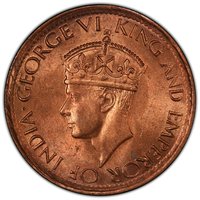
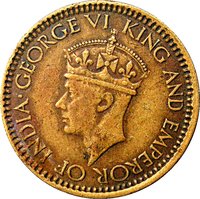
Obverse
Description:
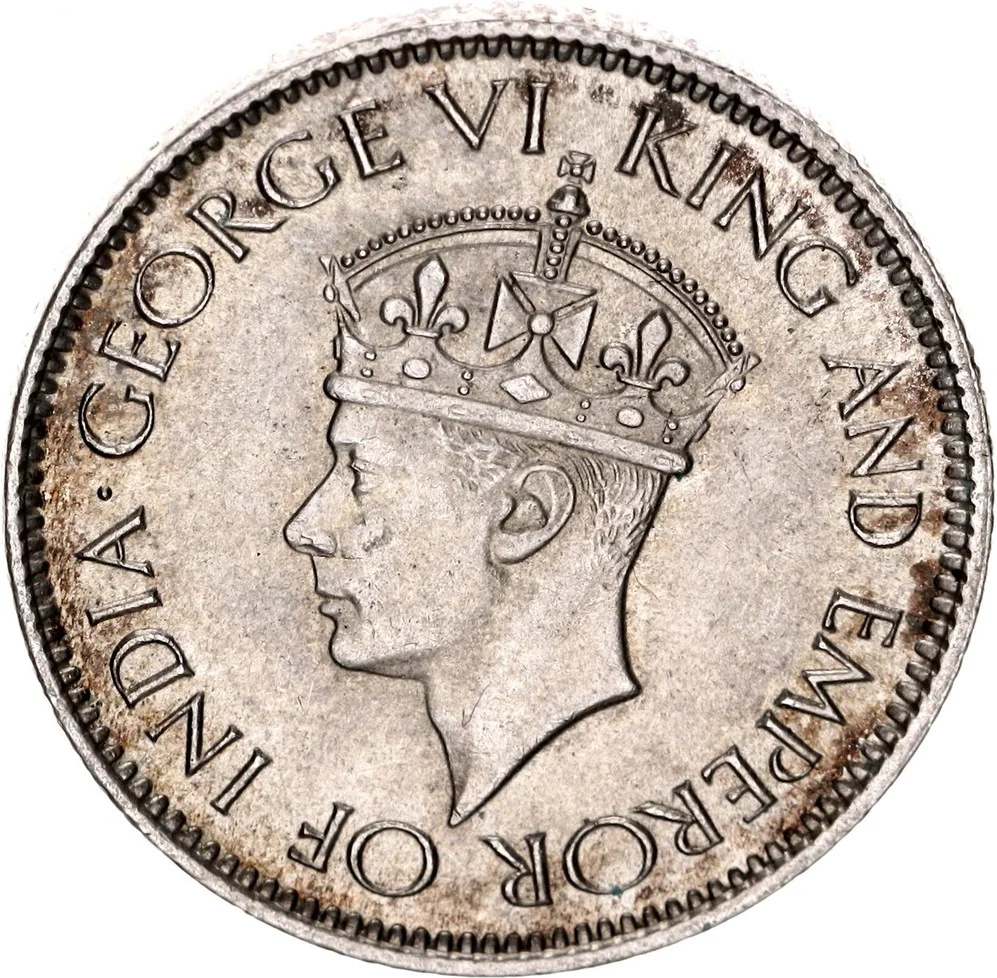
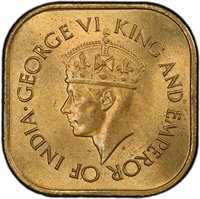
Crowned left-facing bust.
Inscription:
GEORGE VI KING AND EMPEROR OF INDIA.
Translation:
GEORGE VI KING AND EMPEROR OF INDIA.
Language: English
Engraver: Percy Metcalfe
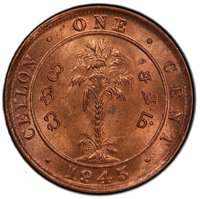
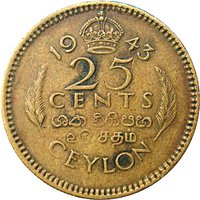
Reverse
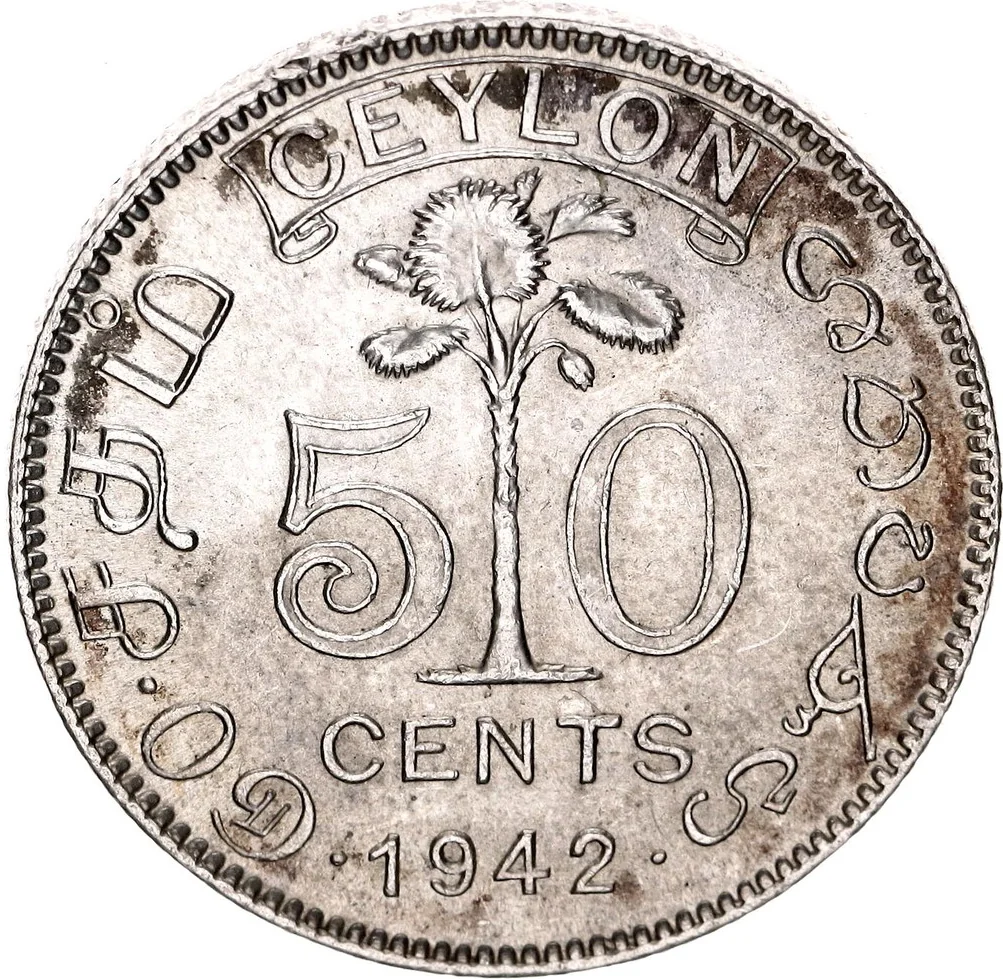
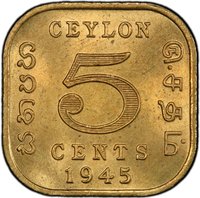
Description:
Denomination
Inscription:
CEYLON
50
CENTS
௫௦.௧தம
ශන ඵණහ
·1942·
50
CENTS
௫௦.௧தம
ශන ඵණහ
·1942·
Translation:
CEYLON 50 CENTS 50 CENTS 1942
Engraver: Leonard Charles Wyon
Edge
Reeded
Mints
| Name | Mark |
|---|---|
| Kolkata / Calcutta / Murshidabad | — |
Mintings
| Year | Mint Mark | Mintage | Quality | Collection |
|---|---|---|---|---|
| 1942 | — | 662,000 |
Historical background
In 1942, Ceylon (now Sri Lanka) found itself in a complex currency situation shaped by the exigencies of World War II. As a British colony, its monetary system was formally tied to the Indian rupee, which itself was on a sterling exchange standard. However, the fall of Singapore in February 1942 and the subsequent Japanese advance into the Indian Ocean severed Ceylon’s normal trade and financial links. The island became a crucial Allied military base, leading to a massive influx of British and Allied troops, creating sudden and intense demand pressures on the local economy.
This wartime crisis precipitated a severe currency shortage. The existing note issue, managed by the Currency Board System through the Ceylon Currency Board, proved inadequate to meet the soaring demand for cash, driven by military expenditures and hoarding by a nervous public. To avert a liquidity collapse, the British government authorized the emergency issuance of "Occupation Currency" – rupee notes printed in Britain and issued under the authority of the "Government of Ceylon" but bearing a distinctive design. These notes, often called "British Occupation Notes," entered circulation alongside the regular currency to facilitate military payments and stabilize transactions.
The situation was further complicated by the coexistence of this new emergency currency with the existing rupee system and the widespread use of British military vouchers. While the stopgap measures prevented a monetary breakdown, they led to inflationary pressures and a degree of confusion in the currency supply. This period underscored Ceylon’s dependent colonial financial structure and its vulnerability to external shocks, laying bare the need for a more autonomous monetary authority, a change that would materialize after independence with the establishment of the Central Bank of Ceylon in 1950.
This wartime crisis precipitated a severe currency shortage. The existing note issue, managed by the Currency Board System through the Ceylon Currency Board, proved inadequate to meet the soaring demand for cash, driven by military expenditures and hoarding by a nervous public. To avert a liquidity collapse, the British government authorized the emergency issuance of "Occupation Currency" – rupee notes printed in Britain and issued under the authority of the "Government of Ceylon" but bearing a distinctive design. These notes, often called "British Occupation Notes," entered circulation alongside the regular currency to facilitate military payments and stabilize transactions.
The situation was further complicated by the coexistence of this new emergency currency with the existing rupee system and the widespread use of British military vouchers. While the stopgap measures prevented a monetary breakdown, they led to inflationary pressures and a degree of confusion in the currency supply. This period underscored Ceylon’s dependent colonial financial structure and its vulnerability to external shocks, laying bare the need for a more autonomous monetary authority, a change that would materialize after independence with the establishment of the Central Bank of Ceylon in 1950.
🌟 Limited