

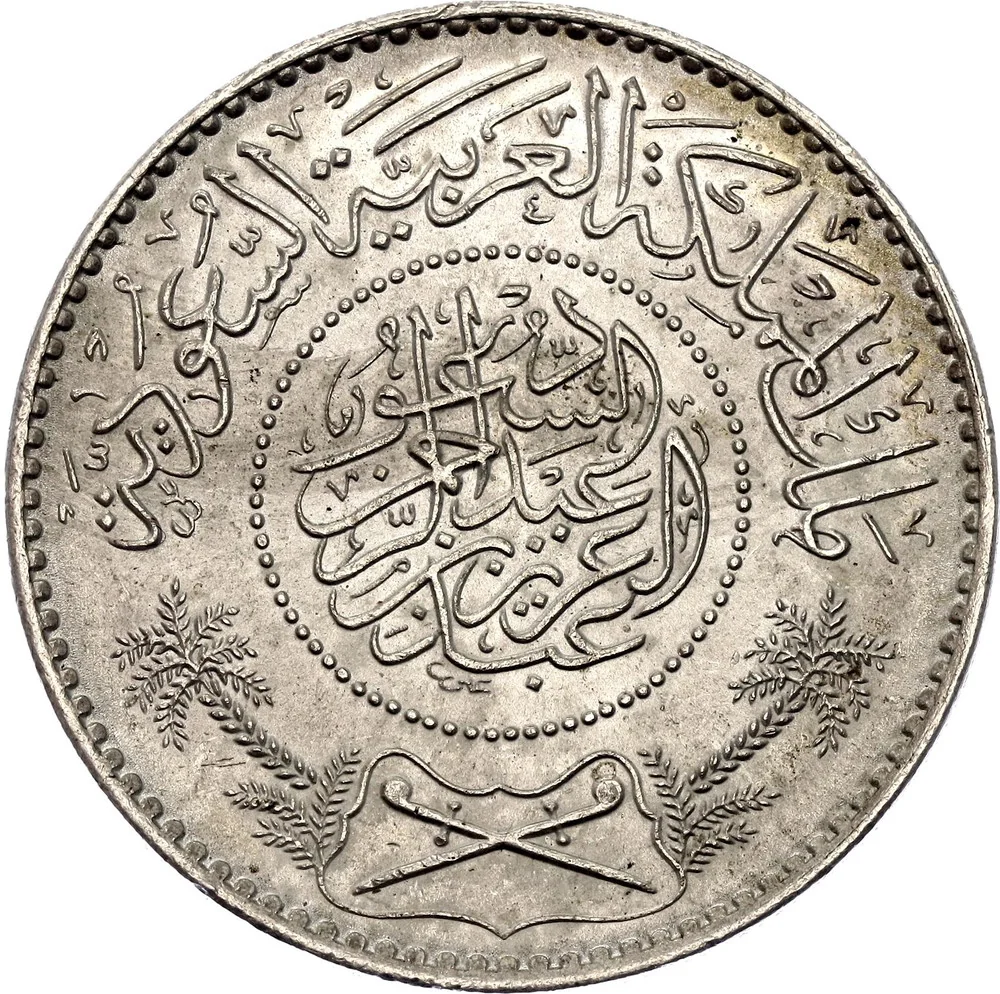
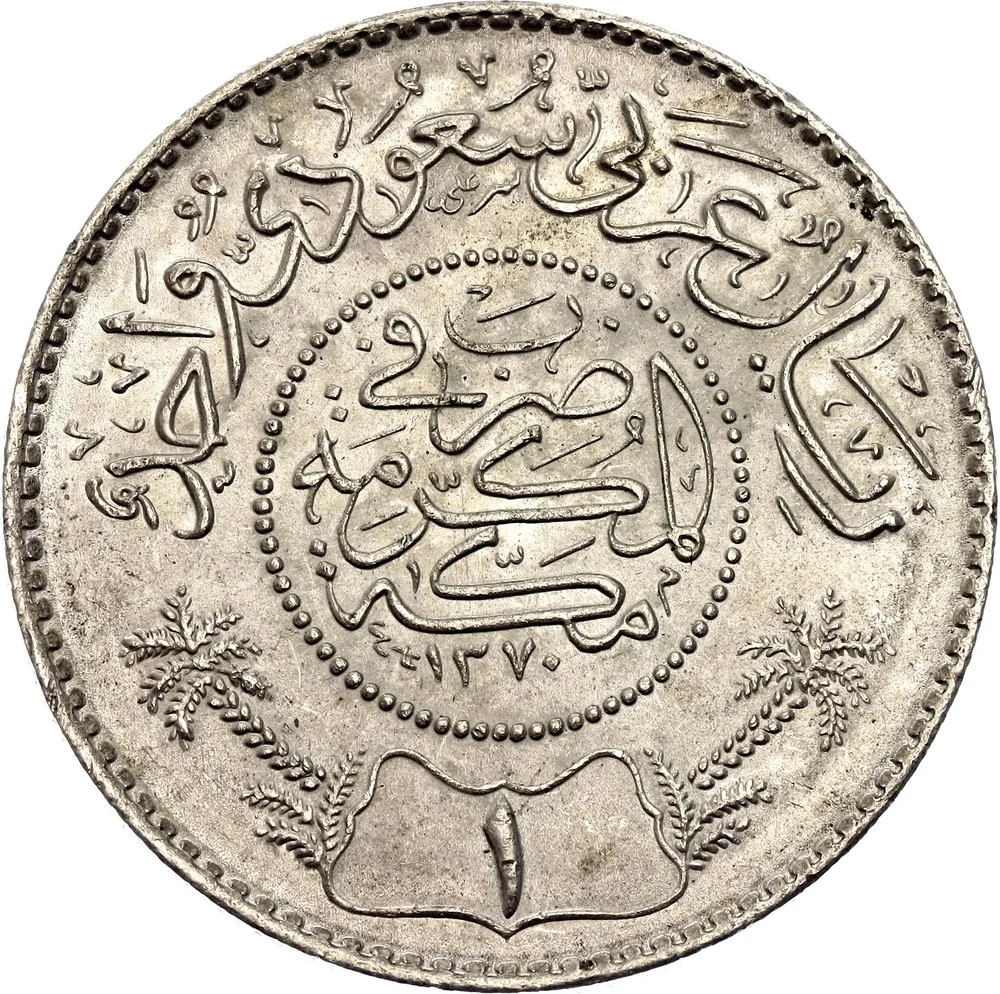
1 riyal – Saudi Arabia
Add to wishlist
Saudi Arabia
Context
Years: 1935–1950
Issuer: Saudi Arabia
Ruler: Abdulaziz bin Abdulrahman
Currency:
(1925—1960)
Demonetized: Yes
Total mintage: 80,000,000
Material
References
KM: #
Numista: #14755
Value
Bullion value: $27.11
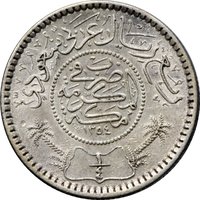
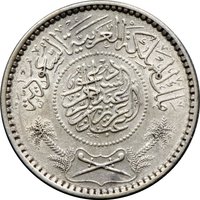
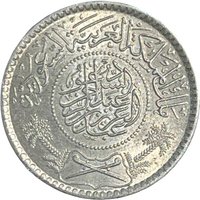
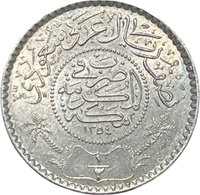
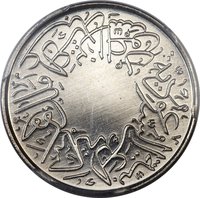
Obverse
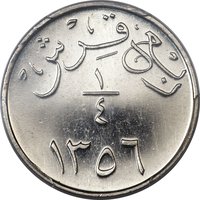
Reverse
Edge
Reeded
Categories
| Object> Cold weapons |
| Plant> Tree |
Mints
| Name | Mark |
|---|---|
| Heaton and Sons / The Mint Birmingham | — |
| Mexican Mint | — |
| United States Mint of Philadelphia | — |
Mintings
| Year | Mint Mark | Mintage | Quality | Collection |
|---|---|---|---|---|
| 1935 | — | 60,000,000 | ||
| 1935 | — | 20,000,000 | Proof | |
| 1948 | — | — | ||
| 1950 | — | — |
Historical background
In 1935, the currency situation in the Kingdom of Saudi Arabia was one of transition and complexity, reflecting the nation's recent unification and its still-developing economic infrastructure. Following the establishment of the Kingdom in 1932, there was no single, unified national currency. Instead, the monetary system was a fragmented mix of foreign and historic coins circulating simultaneously. The most prominent was the Saudi Riyal, a silver coin first minted in 1928, but it competed with a plethora of other mediums of exchange, including Ottoman and Maria Theresa thalers, British gold sovereigns, and Indian rupees. This heterogeneity created significant challenges for trade and administration, as values fluctuated based on metal content and prevailing market rates.
The economic context for this monetary disarray was profound poverty, with state revenues heavily reliant on pilgrimage receipts and limited agricultural taxes. However, a transformative change was on the horizon. In 1933, King Abdulaziz ibn Saud had granted the oil concession to the Standard Oil Company of California (SOCAL), and by 1935, the first exploratory wells were being drilled in Dhahran. While oil wealth was not yet a reality, the anticipation of future revenues and the need for modern state-building began to highlight the inadequacy of the existing currency system. The government recognized that a stable and controlled monetary system was essential for asserting sovereignty, facilitating commerce, and managing future income.
Consequently, 1935 stands as a pivotal year just before significant monetary reform. The pressures of nascent statehood, combined with the early promise of oil, set the stage for the decisive actions that would follow. In 1936, the government would formally adopt a bimetallic standard and establish a clearer legal framework for the Riyal, beginning the process of phasing out foreign coins. Thus, the currency situation of 1935 is best understood as the final chapter of a pre-modern monetary era, immediately preceding the Kingdom's first concerted efforts to create a unified national currency system fit for its emerging role in the twentieth century.
The economic context for this monetary disarray was profound poverty, with state revenues heavily reliant on pilgrimage receipts and limited agricultural taxes. However, a transformative change was on the horizon. In 1933, King Abdulaziz ibn Saud had granted the oil concession to the Standard Oil Company of California (SOCAL), and by 1935, the first exploratory wells were being drilled in Dhahran. While oil wealth was not yet a reality, the anticipation of future revenues and the need for modern state-building began to highlight the inadequacy of the existing currency system. The government recognized that a stable and controlled monetary system was essential for asserting sovereignty, facilitating commerce, and managing future income.
Consequently, 1935 stands as a pivotal year just before significant monetary reform. The pressures of nascent statehood, combined with the early promise of oil, set the stage for the decisive actions that would follow. In 1936, the government would formally adopt a bimetallic standard and establish a clearer legal framework for the Riyal, beginning the process of phasing out foreign coins. Thus, the currency situation of 1935 is best understood as the final chapter of a pre-modern monetary era, immediately preceding the Kingdom's first concerted efforts to create a unified national currency system fit for its emerging role in the twentieth century.
🌱 Common