

1 rial – Muscat and Oman
Add to wishlist
Oman
Context
Years: 1959–1970
Country: Oman
Issuer: Muscat and Oman
Ruler: Said bin Taimur
Currency:
(1946—1970)
Demonetized: Yes
Total mintage: 450
Material
References
KM: #
Numista: #102953
Value
Bullion value: $6547.47
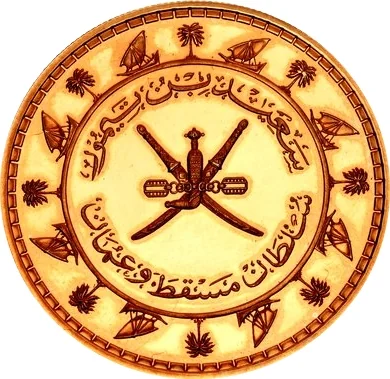
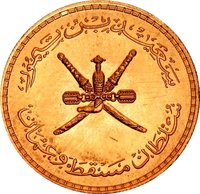
Obverse
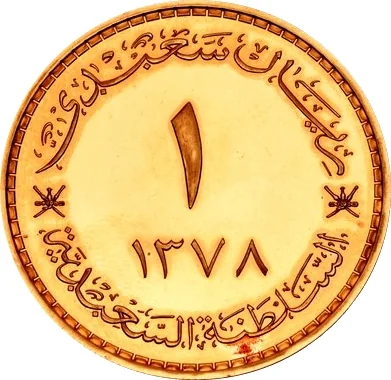
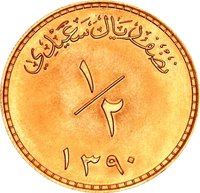
Reverse
Edge
Reeded
Categories
| Transportation> Watercraft |
| Plant> Tree |
| Symbols> Coat of Arms |
| Object> Cold weapons |
Mints
| Name | Mark |
|---|---|
| Royal Mint (Tower Hill) | — |
Mintings
| Year | Mint Mark | Mintage | Quality | Collection |
|---|---|---|---|---|
| 1959 | — | 100 | Proof | |
| 1970 | — | 350 | Proof |
Historical background
In 1959, the currency situation in Muscat and Oman was fragmented and complex, reflecting the political divisions within the territory. The Sultanate of Muscat, under Sultan Said bin Taimur, officially used the Gulf Rupee, a currency issued by the Reserve Bank of India for use in the Persian Gulf. This tied the coastal economy to the Indian monetary system. However, in the interior, the Imamate of Oman, which had been de facto independent since the 1913 Treaty of Sib, often relied on the Maria Theresa Thaler (a historic silver coin) and Saudi Riyals, particularly in the Dhofar region, due to trade and political ties.
This monetary disarray was exacerbated by a severe currency crisis in 1959. The Indian government, facing economic pressures, unexpectedly demonetized the higher-denomination Gulf Rupee notes. This action caused immediate financial disruption in Muscat, where these notes were widely held, effectively wiping out a significant portion of the currency in circulation. The crisis threatened the Sultanate's liquidity and exposed its vulnerability to external monetary decisions, creating urgent economic instability.
Sultan Said bin Taimur's response was swift and transformative. To assert monetary sovereignty and stabilize the economy, he introduced the Muscat Rial (also known as the Rial Saidi) in May 1959, replacing the Gulf Rupee at a rate of 1 Rial to 21 Rupees. The new currency was pegged to the British Pound Sterling, and its issuance was managed through the newly created Muscat Currency Authority. This move not only resolved the immediate crisis but also served as a powerful political tool, helping to unify the Sultanate's economy and strengthen central authority in the lead-up to the final military defeat of the Imamate in the Jebel Akhdar War.
This monetary disarray was exacerbated by a severe currency crisis in 1959. The Indian government, facing economic pressures, unexpectedly demonetized the higher-denomination Gulf Rupee notes. This action caused immediate financial disruption in Muscat, where these notes were widely held, effectively wiping out a significant portion of the currency in circulation. The crisis threatened the Sultanate's liquidity and exposed its vulnerability to external monetary decisions, creating urgent economic instability.
Sultan Said bin Taimur's response was swift and transformative. To assert monetary sovereignty and stabilize the economy, he introduced the Muscat Rial (also known as the Rial Saidi) in May 1959, replacing the Gulf Rupee at a rate of 1 Rial to 21 Rupees. The new currency was pegged to the British Pound Sterling, and its issuance was managed through the newly created Muscat Currency Authority. This move not only resolved the immediate crisis but also served as a powerful political tool, helping to unify the Sultanate's economy and strengthen central authority in the lead-up to the final military defeat of the Imamate in the Jebel Akhdar War.

✨ Legendary