

½ rial – Muscat and Oman
Add to wishlist
Oman
Context
Years: 1962–1970
Country: Oman
Issuer: Muscat and Oman
Ruler: Said bin Taimur
Currency:
(1946—1970)
Demonetized: Yes
Total mintage: 600
Material
References
KM: #
Numista: #102951
Value
Bullion value: $3593.04
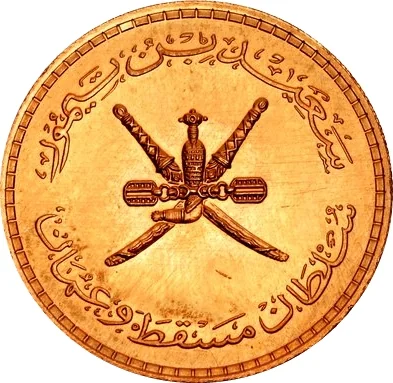
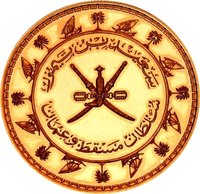
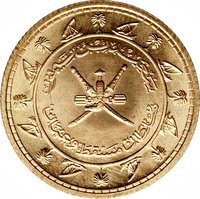
Obverse
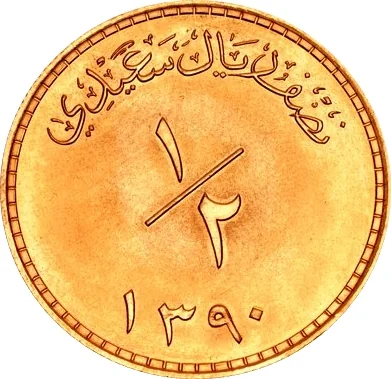
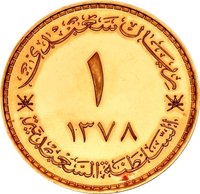
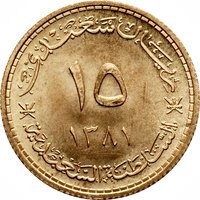
Reverse
Edge
Reeded
Categories
| Symbols> Coat of Arms |
| Object> Cold weapons |
Mints
| Name | Mark |
|---|---|
| Royal Mint (Tower Hill) | — |
Mintings
| Year | Mint Mark | Mintage | Quality | Collection |
|---|---|---|---|---|
| 1962 | — | 150 | Proof | |
| 1963 | — | 100 | Proof | |
| 1970 | — | 350 | Proof |
Historical background
In 1962, the currency situation in Muscat and Oman was a direct reflection of the Sultanate's complex political geography and economic ties. The coastal region, historically known as the Sultanate of Muscat, primarily used the Gulf Rupee (also known as the Persian Gulf Rupee), a currency issued by the Government of India and later the Reserve Bank of India. This currency was pegged to the Indian Rupee and was the dominant medium of exchange for maritime trade, particularly with India and East Africa, underscoring the region's deep historical connections to the Indian Ocean economy.
However, this system was not uniform across the territory. In the interior, ruled by the Imam of Oman until the Jebel Akhdar War concluded in 1959, the Maria Theresa Thaler (a silver coin minted in Austria) and Indian Rupees circulated alongside Saudi Riyals in some border areas. Furthermore, British Sovereigns and Maria Theresa Thalers remained important for high-value transactions and as a store of wealth, especially in tribal areas where their intrinsic silver and gold value was trusted more than paper currency.
This fragmented monetary landscape was on the cusp of significant change. The discovery of commercial oil in 1962 and its subsequent export from 1967 began a profound economic transformation. In response, the Sultanate introduced its own national currency, the Saidi Rial, in 1970, which was replaced by the Omani Rial in 1973. Thus, the 1962 currency scene represents the final years of a traditional, externally influenced system before the unifying force of oil revenues enabled the creation of a modern, centralized monetary authority.
However, this system was not uniform across the territory. In the interior, ruled by the Imam of Oman until the Jebel Akhdar War concluded in 1959, the Maria Theresa Thaler (a silver coin minted in Austria) and Indian Rupees circulated alongside Saudi Riyals in some border areas. Furthermore, British Sovereigns and Maria Theresa Thalers remained important for high-value transactions and as a store of wealth, especially in tribal areas where their intrinsic silver and gold value was trusted more than paper currency.
This fragmented monetary landscape was on the cusp of significant change. The discovery of commercial oil in 1962 and its subsequent export from 1967 began a profound economic transformation. In response, the Sultanate introduced its own national currency, the Saidi Rial, in 1970, which was replaced by the Omani Rial in 1973. Thus, the 1962 currency scene represents the final years of a traditional, externally influenced system before the unifying force of oil revenues enabled the creation of a modern, centralized monetary authority.
✨ Legendary