

20 francs – France
Add to wishlist
France
Context
Years: 1830–1831
Issuer: France
Ruler: Louis Philippe I
Currency:
(1795—1959)
Demonetization: 25 June 1928
Total mintage: 2,371,848
Material
References
KM: #
Numista: #147095
Value
Bullion value: $903.76
Obverse
Description:
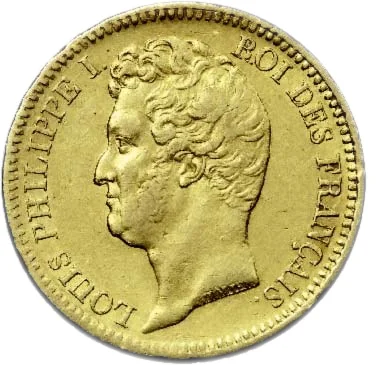
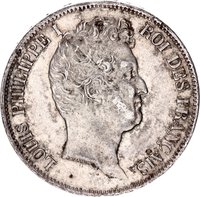
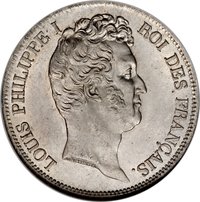
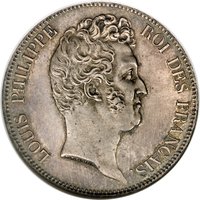
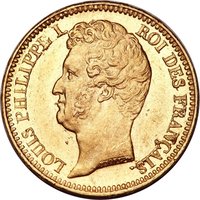
Louis-Philippe's bare head, facing left.
Inscription:
LOUIS PHILIPPE I. ROI DES FRANÇAIS.
TIOLIER
TIOLIER
Translation:
LOUIS PHILIPPE I, KING OF THE FRENCH.
TIOLIER
TIOLIER
Script: Latin
Language: French
Engraver: Nicolas-Pierre Tiolier
Reverse
Description:
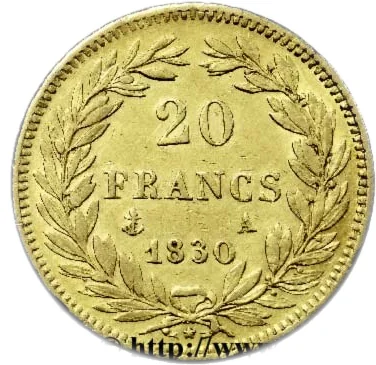
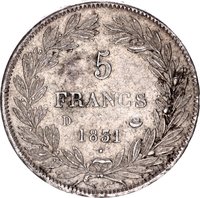
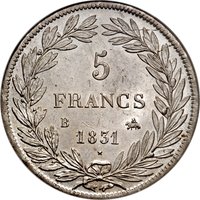
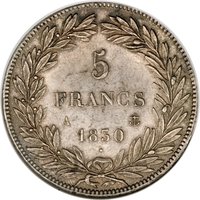
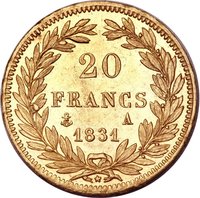
Laurel-crowned face value.
Inscription:
20
FRANCS
A
1831
FRANCS
A
1831
Script: Latin
Engraver: Nicolas-Pierre Tiolier
Edge
Edge incused inscribed.
Legend:
DIEU * PROTÉGE * LA * FRANCE
Translation:
GOD * PROTECT * FRANCE
Language: French
Mints
| Name | Mark |
|---|---|
| Monnaie de Paris | A |
| Rouen | B |
| Lille | W |
Historical background
In 1830, France's currency system was in a state of transition, caught between the revolutionary legacy of the franc and the practical realities of a post-Napoleonic economy. The franc germinal, established by Napoleon in 1803, provided a foundation of bimetallism, defining the franc in terms of fixed weights of both gold and silver (1 franc = 4.5 grams of fine silver, or 0.29 grams of gold). This system aimed for stability, but the official mint ratio between the two metals often diverged from market values, leading to the effective disappearance of the undervalued metal from circulation—a problem known as Gresham's Law.
The monetary landscape on the eve of the July Revolution was thus characterized by a chronic shortage of specie, particularly small-denomination coins for everyday transactions. While the Bank of France held the exclusive right to issue banknotes, public trust in paper money remained low, a lingering sentiment from the hyperinflation of the assignats during the French Revolution. Consequently, people hoarded gold and silver, and a confusing mix of older, worn coins and foreign currency (especially Spanish piastres) circulated alongside official issues, complicating commerce and undermining the uniformity the franc germinal was meant to ensure.
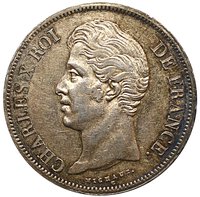
The July Monarchy of Louis-Philippe, which came to power after the 1830 revolution, inherited this unstable situation. While not immediately overhauling the bimetallic system, the new regime recognized the need for monetary order and confidence. One of its early and symbolic acts was to remove the effigy of Charles X from the coinage, replacing it with its own iconography. More substantively, the period saw increased efforts to standardize coinage in circulation and, over the following decade, a gradual shift in policy that would eventually favor the gold standard, setting the stage for the Latin Monetary Union of the 1860s.
The monetary landscape on the eve of the July Revolution was thus characterized by a chronic shortage of specie, particularly small-denomination coins for everyday transactions. While the Bank of France held the exclusive right to issue banknotes, public trust in paper money remained low, a lingering sentiment from the hyperinflation of the assignats during the French Revolution. Consequently, people hoarded gold and silver, and a confusing mix of older, worn coins and foreign currency (especially Spanish piastres) circulated alongside official issues, complicating commerce and undermining the uniformity the franc germinal was meant to ensure.
The July Monarchy of Louis-Philippe, which came to power after the 1830 revolution, inherited this unstable situation. While not immediately overhauling the bimetallic system, the new regime recognized the need for monetary order and confidence. One of its early and symbolic acts was to remove the effigy of Charles X from the coinage, replacing it with its own iconography. More substantively, the period saw increased efforts to standardize coinage in circulation and, over the following decade, a gradual shift in policy that would eventually favor the gold standard, setting the stage for the Latin Monetary Union of the 1860s.
Series: 1830 France circulation coins
⭐ Rare