

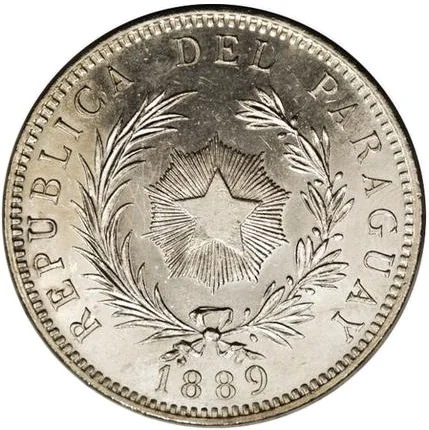
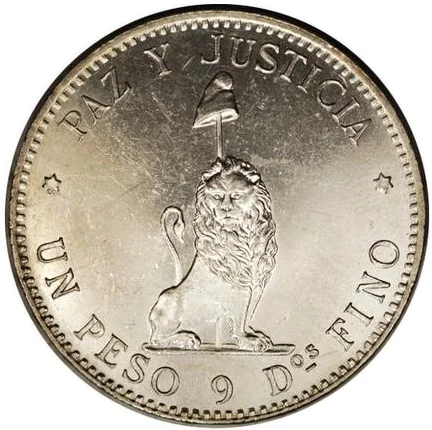
Obverse
Reverse
Edge
Plain with legend
Legend:
IGUALDAD ANTE LA LEY
Translation:
Equality before the Law
Language: Spanish
Categories
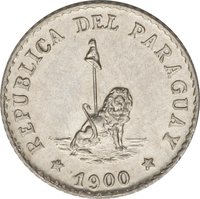
| Animal> Feline |
| Symbols> Coat of Arms |
| Symbol> Phrygian cap |
Mints
| Name | Mark |
|---|---|
| Buenos Aires | — |
Mintings
| Year | Mint Mark | Mintage | Quality | Collection |
|---|---|---|---|---|
| 1889 | — | 603,880 |
Historical background
In 1889, Paraguay’s currency situation was characterized by profound instability and a severe shortage of metallic money, a direct legacy of the catastrophic War of the Triple Alliance (1864-1870). The conflict had devastated the population, economy, and state finances, leaving the government with limited means to mint coinage. Consequently, the primary circulating medium was a flood of low-quality, privately issued paper money known as billetes fiscales and notes from the Banco Nacional and other institutions. These notes were heavily discounted and widely distrusted, leading to a chaotic monetary environment where multiple forms of paper, often of dubious value, circulated simultaneously.
The government of President Patricio Escobar (1886-1890) attempted to address this crisis through the Currency Law of 1887, which aimed to unify the currency system. The law introduced the peso fuerte as the new unit, backed by a theoretical gold standard, and mandated the gradual withdrawal of the old depreciated paper. However, the state lacked the necessary gold reserves to make this convertibility credible. By 1889, the promised monetary reform was faltering; the new paper pesos were themselves beginning to depreciate, and the public’s lack of confidence persisted. The economy remained effectively on a fiduciary standard, with the value of money driven by government fiat rather than tangible assets.
This monetary disorder in 1889 occurred within a specific economic context: a postwar boom driven by massive land sales and foreign investment, particularly in the nascent yerba mate and tannin industries. The influx of foreign capital, especially from British and Argentine interests, created pockets of prosperity in Asunción but also heightened dependence on external markets. The weak and fragmented currency system complicated domestic commerce and highlighted the fragile foundation of Paraguay’s economic recovery. Thus, the currency situation of 1889 reflected a nation struggling to construct a modern financial system atop the ruins of war, caught between ambitious reform and the harsh realities of insufficient reserves and deep-seated public skepticism.
The government of President Patricio Escobar (1886-1890) attempted to address this crisis through the Currency Law of 1887, which aimed to unify the currency system. The law introduced the peso fuerte as the new unit, backed by a theoretical gold standard, and mandated the gradual withdrawal of the old depreciated paper. However, the state lacked the necessary gold reserves to make this convertibility credible. By 1889, the promised monetary reform was faltering; the new paper pesos were themselves beginning to depreciate, and the public’s lack of confidence persisted. The economy remained effectively on a fiduciary standard, with the value of money driven by government fiat rather than tangible assets.
This monetary disorder in 1889 occurred within a specific economic context: a postwar boom driven by massive land sales and foreign investment, particularly in the nascent yerba mate and tannin industries. The influx of foreign capital, especially from British and Argentine interests, created pockets of prosperity in Asunción but also heightened dependence on external markets. The weak and fragmented currency system complicated domestic commerce and highlighted the fragile foundation of Paraguay’s economic recovery. Thus, the currency situation of 1889 reflected a nation struggling to construct a modern financial system atop the ruins of war, caught between ambitious reform and the harsh realities of insufficient reserves and deep-seated public skepticism.
⭐ Somewhat Rare