

5 francs – Rwanda
Add to wishlist
Rwanda
Context
Years: 1974–1987
Issuer: Rwanda
Issuing organization: National Bank of Rwanda
Period:
(since 1962)
Currency:
(since 1964)
Demonetized: Yes
Total mintage: 25,002,000
Material
References
KM: #
Numista: #4448
Value
Exchange value: 5 RWF
Obverse
Description:
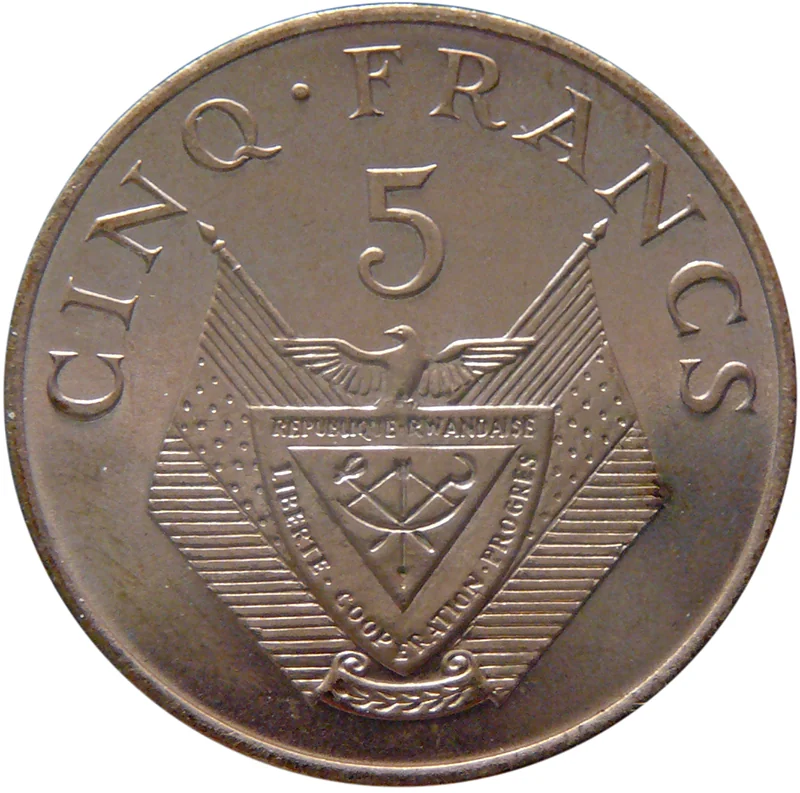
Rwanda's coat of arms bears the national motto.
Inscription:
CINQ · FRANCS
5
REPUBLIQUE RWANDAISE
LIBERTE · COOPERATION · PROGRES
5
REPUBLIQUE RWANDAISE
LIBERTE · COOPERATION · PROGRES
Translation:
Five Francs
Rwandan Republic
Liberty · Cooperation · Progress
Rwandan Republic
Liberty · Cooperation · Progress
Script: Latin
Language: French
Engraver: Leslie Durbin
Reverse
Description:
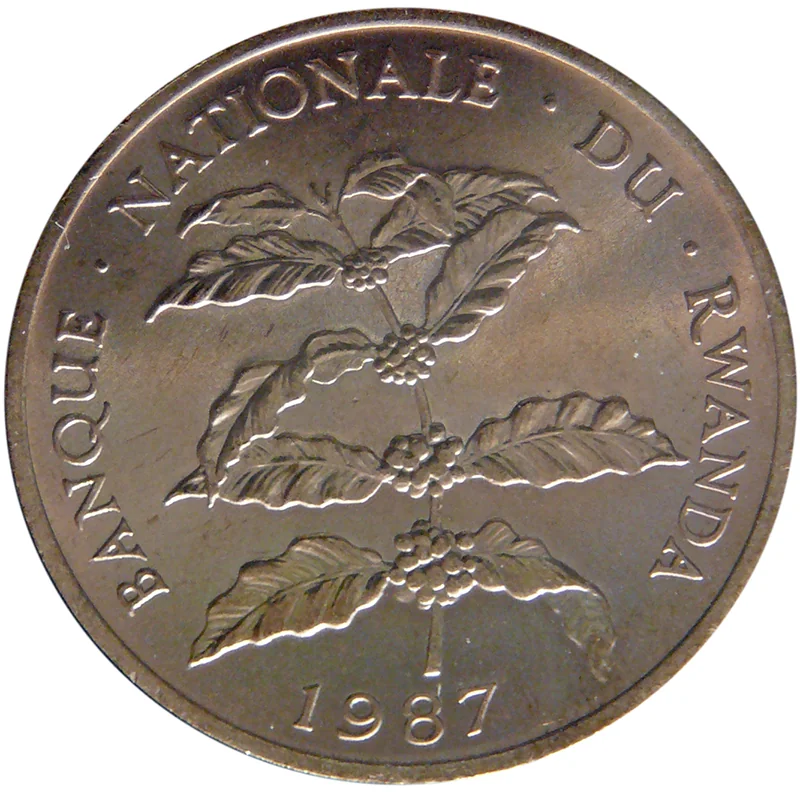
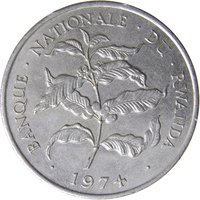
Coffee branch.
Inscription:
BANQUE · NATIONALE · DU · RWANDA
1987
1987
Translation:
National Bank of Rwanda
1987
1987
Script: Latin
Language: French
Engraver: Leslie Durbin
Edge
Plain
Categories
| Plant> Tree |
| Symbols> Coat of Arms |
Mints
| Name | Mark |
|---|---|
| Royal Mint | — |
Mintings
| Year | Mint Mark | Mintage | Quality | Collection |
|---|---|---|---|---|
| 1974 | — | 7,000,000 | ||
| 1977 | — | 7,002,000 | ||
| 1987 | — | 11,000,000 |
Historical background
In 1974, Rwanda's currency situation was defined by its membership in the Bank of Central African States (BEAC) and the use of the CFA franc, a colonial-era arrangement it shared with several other Francophone African nations. This currency, officially the CFA Franc (Financial Cooperation in Africa), was pegged to the French franc at a fixed and guaranteed exchange rate (1 French franc = 50 CFA francs). This arrangement provided significant monetary stability and low inflation, as Rwanda's money supply and foreign exchange reserves were managed collectively by the BEAC, with France underwriting the convertibility. For a small, landlocked, and developing nation like Rwanda, this eliminated the risks of independent currency management and facilitated trade within the franc zone.
However, this stability came with notable trade-offs. The fixed peg to the French franc, while curbing inflation, also tied Rwanda's economic competitiveness to France's monetary policy, which was not designed for Rwandan conditions. Furthermore, the system required Rwanda to deposit a substantial portion of its foreign exchange reserves with the French Treasury, limiting its direct control over its own monetary sovereignty. Economically, the period was one of modest growth heavily reliant on coffee and tea exports, with the currency's stability aiding predictable, if limited, export earnings. The year 1974 itself saw global economic shocks from the 1973 oil crisis, but Rwanda's membership in the CFA zone provided a buffer against the extreme currency volatility experienced by many non-pegged developing nations.
The situation in 1974 was ultimately a point of transition. While the CFA franc provided a framework of stability, Rwandan authorities were increasingly aware of its constraints as they sought greater economic autonomy. This culminated just three years later, in 1977, when Rwanda made a decisive break from the BEAC. The country introduced its own national currency, the Rwanda franc, and established the National Bank of Rwanda to pursue an independent monetary policy better suited to its specific national development goals, ending its direct participation in the Central African CFA franc zone.
However, this stability came with notable trade-offs. The fixed peg to the French franc, while curbing inflation, also tied Rwanda's economic competitiveness to France's monetary policy, which was not designed for Rwandan conditions. Furthermore, the system required Rwanda to deposit a substantial portion of its foreign exchange reserves with the French Treasury, limiting its direct control over its own monetary sovereignty. Economically, the period was one of modest growth heavily reliant on coffee and tea exports, with the currency's stability aiding predictable, if limited, export earnings. The year 1974 itself saw global economic shocks from the 1973 oil crisis, but Rwanda's membership in the CFA zone provided a buffer against the extreme currency volatility experienced by many non-pegged developing nations.
The situation in 1974 was ultimately a point of transition. While the CFA franc provided a framework of stability, Rwandan authorities were increasingly aware of its constraints as they sought greater economic autonomy. This culminated just three years later, in 1977, when Rwanda made a decisive break from the BEAC. The country introduced its own national currency, the Rwanda franc, and established the National Bank of Rwanda to pursue an independent monetary policy better suited to its specific national development goals, ending its direct participation in the Central African CFA franc zone.
🌱 Common