

20 kroner – Denmark
Add to wishlist
Denmark
Context
Years: 1994–1999
Issuer: Denmark
Ruler: Margrethe II
Currency:
(since 1873)
Total mintage: 19,349,363
Material
Diameter: 27 mm
Weight: 9.3 g
Thickness: 2.35 mm
Shape: Round
Composition: Aluminium bronze
Magnetic: No
Technique: Milled
Alignment: Medal alignment
flip
References
KM: #
Numista: #1469
Value
Exchange value: 20 DKK
Inflation-adjusted value: 36.47 DKK
Obverse
Description:
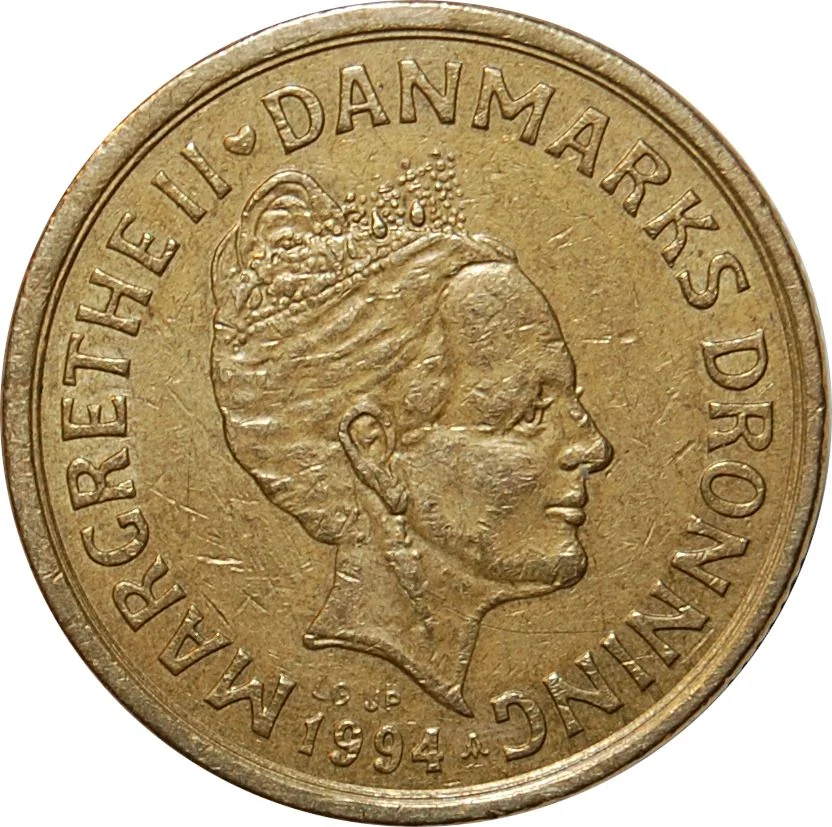
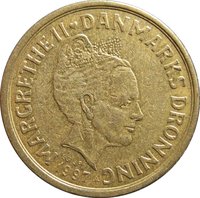
Portrait of Queen Margrethe II (third effigy)
Inscription:
MARGRETHE II 🖤 DANMARKS DRONNING
LG JP
1994 A
LG JP
1994 A
Translation:
MARGRETHE II 🖂 QUEEN OF DENMARK
LG JP
1994 A
LG JP
1994 A
Script: Latin
Engraver: J. Petersen
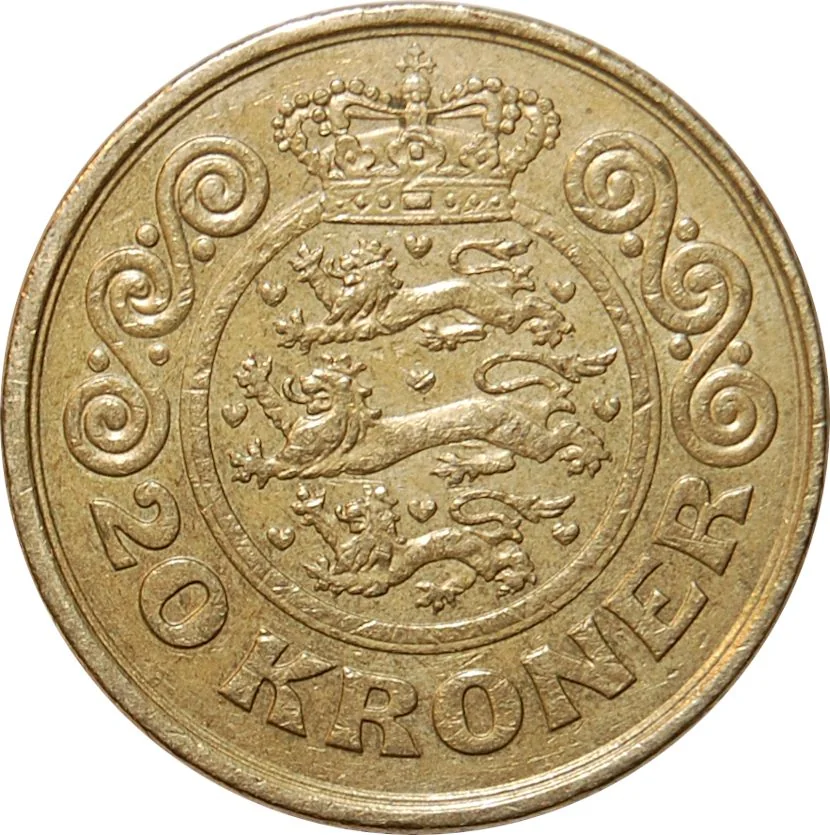
Reverse
Edge
Segmented reeding
Mints
| Name | Mark |
|---|---|
| Royal Danish Mint | — |
Mintings
| Year | Mint Mark | Mintage | Quality | Collection |
|---|---|---|---|---|
| 1994 | LG;JP;A | 2,565,000 | ||
| 1996 | LG;JP;A | 8,651,000 | ||
| 1998 | LG;JP;A | 4,000,000 | ||
| 1999 | LG;JP;A | 4,133,363 |
Historical background
In 1994, Denmark's currency situation was defined by its unique position within the European Monetary System (EMS). Following the turmoil of the 1992-1993 European currency crisis, which forced the British pound and Italian lira to exit the Exchange Rate Mechanism (ERM), Denmark had negotiated a crucial opt-out from the Maastricht Treaty's single currency provisions in 1992. This meant the country was not obligated to adopt the future euro. However, Denmark remained a committed member of the ERM, pegging the Danish krone (DKK) very tightly to the Deutsche Mark (DEM), the anchor currency of the system. This policy, known as the "hard krone" policy, was a cornerstone of Danish economic stability and credibility.
The primary objective of Danish monetary policy in 1994 was unwavering exchange rate stability. The central bank, Danmarks Nationalbank, operated with a fixed exchange rate as its nominal anchor, subordinating domestic interest rate decisions to the need of maintaining the krone's peg. This meant shadowing the interest rate moves of the German Bundesbank, even when the domestic economic cycle might have suggested a different course. The system functioned successfully, with the krone trading stably within the very narrow ±2.25% fluctuation band agreed upon after the 1993 crisis widened the standard bands.
Consequently, 1994 was a year of relative calm and consolidation for the krone, situated between the preceding ERM crisis and the future 2000 referendum on adopting the euro. The currency arrangement enjoyed broad political and public support, as it provided predictable exchange rates for trade (with Germany being a key partner) and was seen as a bulwark against inflation. While the debate on deeper European integration continued, the practical reality in 1994 was a stable and well-functioning national currency, autonomously managed but deliberately and closely aligned with the core of the European monetary system.
The primary objective of Danish monetary policy in 1994 was unwavering exchange rate stability. The central bank, Danmarks Nationalbank, operated with a fixed exchange rate as its nominal anchor, subordinating domestic interest rate decisions to the need of maintaining the krone's peg. This meant shadowing the interest rate moves of the German Bundesbank, even when the domestic economic cycle might have suggested a different course. The system functioned successfully, with the krone trading stably within the very narrow ±2.25% fluctuation band agreed upon after the 1993 crisis widened the standard bands.
Consequently, 1994 was a year of relative calm and consolidation for the krone, situated between the preceding ERM crisis and the future 2000 referendum on adopting the euro. The currency arrangement enjoyed broad political and public support, as it provided predictable exchange rates for trade (with Germany being a key partner) and was seen as a bulwark against inflation. While the debate on deeper European integration continued, the practical reality in 1994 was a stable and well-functioning national currency, autonomously managed but deliberately and closely aligned with the core of the European monetary system.
🌱 Very Common