

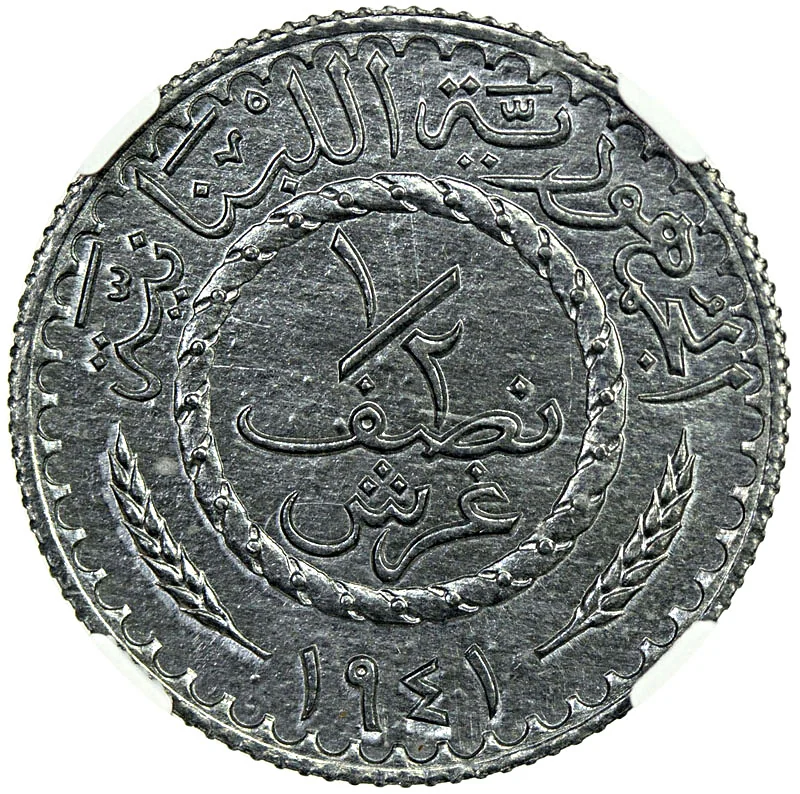
Obverse
Description:
الاسم والتاريخ بالعربية
Inscription:
الجمهورية اللبنانية
½
نصف
غرش
١٩٤١
½
نصف
غرش
١٩٤١
Translation:
Lebanese Republic
½
Half Qirsh
1941
½
Half Qirsh
1941
Language: Arabic
Engraver: Lucien Georges Bazor
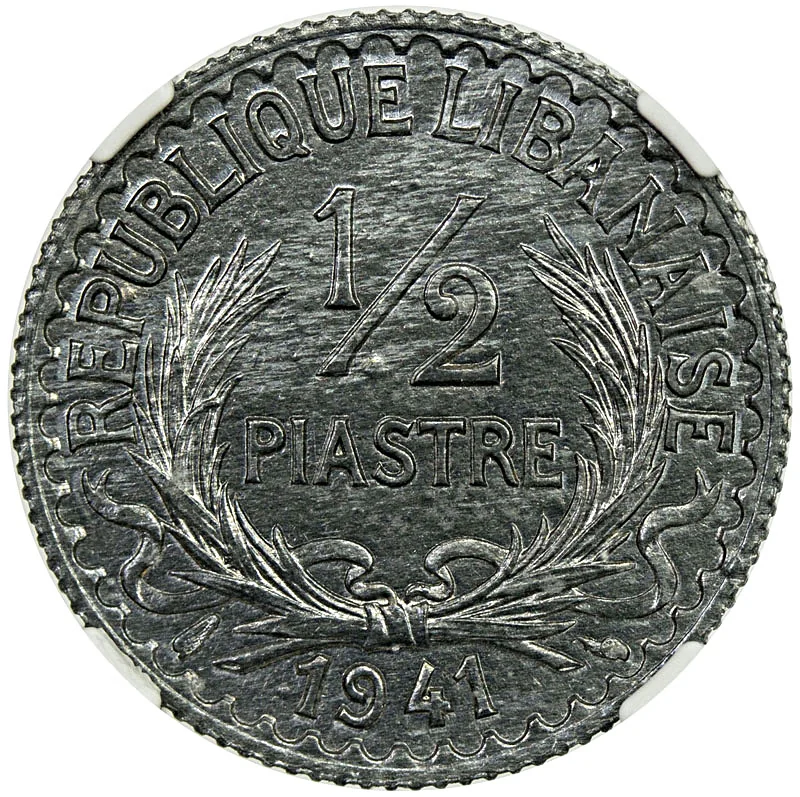
Reverse
Description:
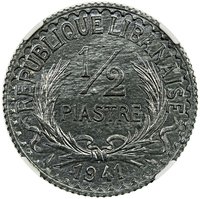
Nom et date en français.
Inscription:
REPUBLIQUE LIBANAISE
½
PIASTRE
1941
½
PIASTRE
1941
Translation:
LEBANESE REPUBLIC
½
PIASTER
1941
½
PIASTER
1941
Language: French
Engraver: Lucien Georges Bazor
Edge
Milled
Mints
| Name | Mark |
|---|---|
| Monnaie de Paris | — |
Mintings
| Year | Mint Mark | Mintage | Quality | Collection |
|---|---|---|---|---|
| 1941 | — | 1,000,000 |
Historical background
In 1941, Lebanon's currency situation was intrinsically tied to its status as a French mandate and the broader economic disruptions of World War II. Following the fall of France in 1940, the mandate authority split between the Vichy French administration in Beirut and the Free French forces allied with Britain. This political division created immediate monetary uncertainty, as the currency in circulation was the French-mandated Syrian-Lebanese pound (or livre), which was pegged to and backed by the French franc. With France under occupation, confidence in this peg and the backing of the currency collapsed, leading to severe inflation and a scarcity of goods.
The British and Free French invasion in June 1941, which ousted Vichy forces, aimed to stabilize the region. A critical financial step was taken in July when, by agreement between the British government and the Free French, the Syrian-Lebanese pound was severed from the devalued and unstable French franc. It was instead repegged to the British pound sterling at a fixed rate of 8.83 Syrian-Lebanese pounds to £1 sterling. This move was orchestrated to anchor the local currency to a stronger, Allied-controlled reserve and to facilitate the financing of British military operations in the Levant.
This sterling peg provided temporary stability but also placed Lebanon's currency under direct British economic influence, a point of contention with Free French political authority. The arrangement was administered through a currency council that controlled issuance, a precursor to the later central bank. Thus, the monetary landscape of 1941 was defined by a pivotal transition: from a Franc-zone dependency linked to a defeated power to a Sterling-zone dependency under wartime Allied stewardship, setting the stage for postwar debates over financial sovereignty and the eventual establishment of an independent Lebanese currency.
The British and Free French invasion in June 1941, which ousted Vichy forces, aimed to stabilize the region. A critical financial step was taken in July when, by agreement between the British government and the Free French, the Syrian-Lebanese pound was severed from the devalued and unstable French franc. It was instead repegged to the British pound sterling at a fixed rate of 8.83 Syrian-Lebanese pounds to £1 sterling. This move was orchestrated to anchor the local currency to a stronger, Allied-controlled reserve and to facilitate the financing of British military operations in the Levant.
This sterling peg provided temporary stability but also placed Lebanon's currency under direct British economic influence, a point of contention with Free French political authority. The arrangement was administered through a currency council that controlled issuance, a precursor to the later central bank. Thus, the monetary landscape of 1941 was defined by a pivotal transition: from a Franc-zone dependency linked to a defeated power to a Sterling-zone dependency under wartime Allied stewardship, setting the stage for postwar debates over financial sovereignty and the eventual establishment of an independent Lebanese currency.
⭐ Rare