

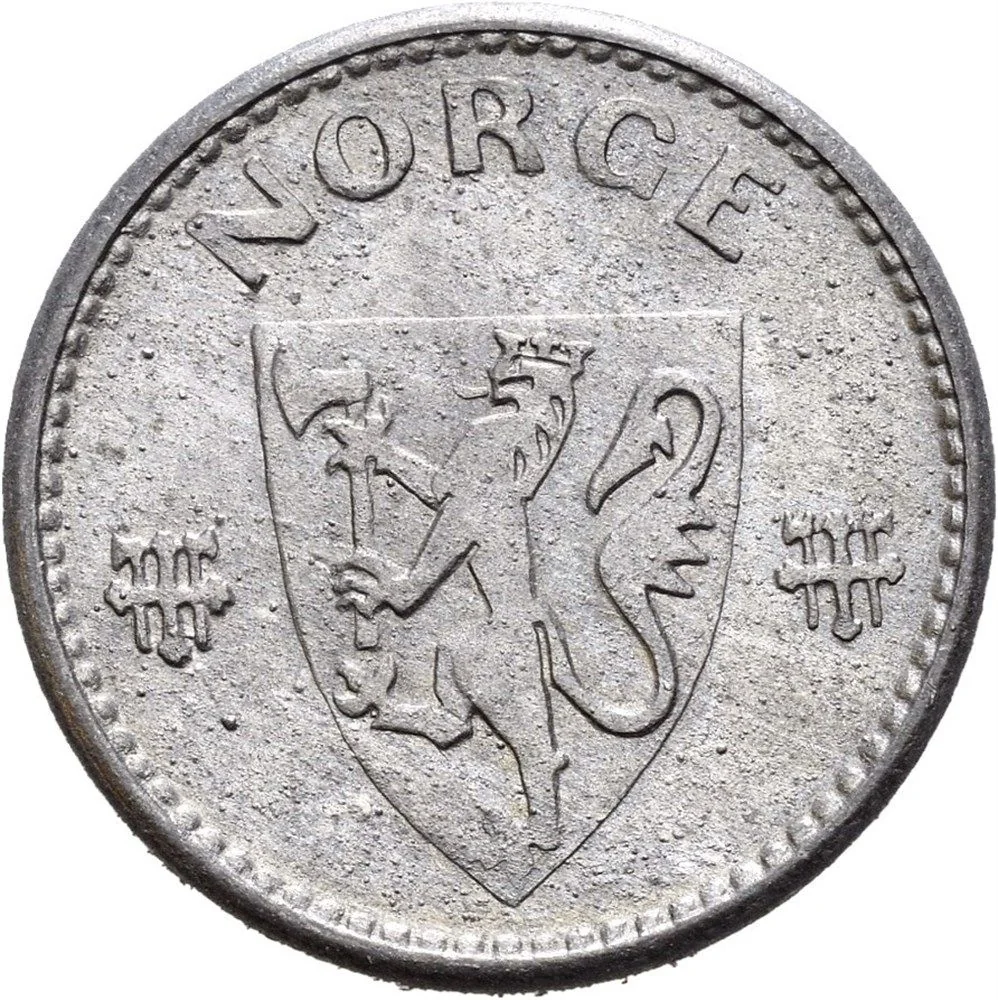
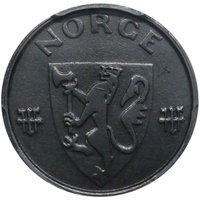
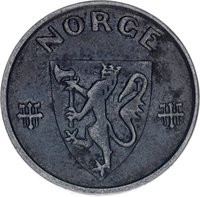
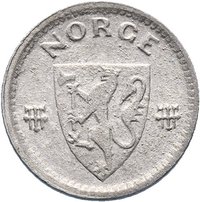
Obverse
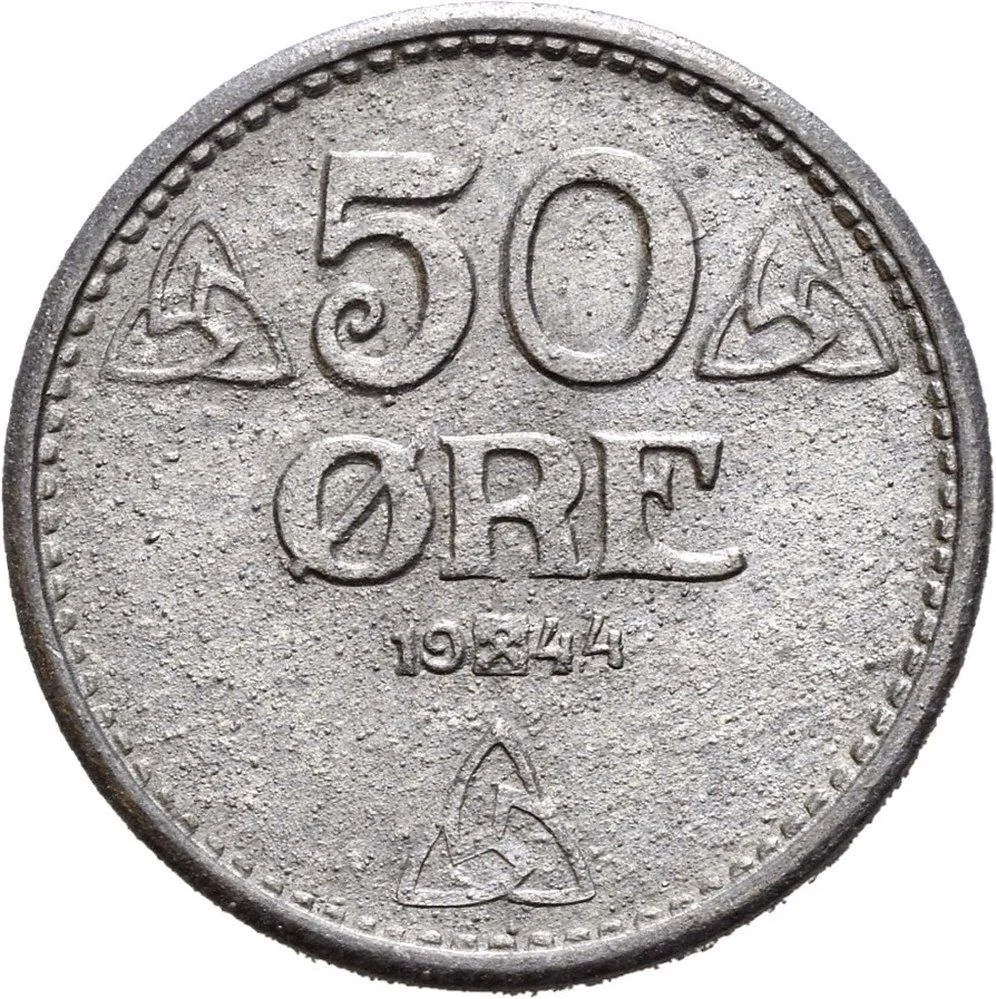
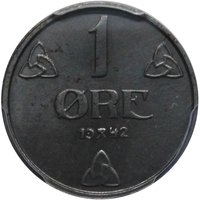
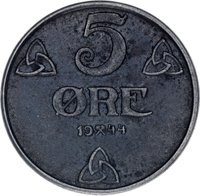
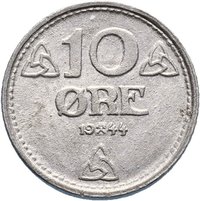
Reverse
Edge
Plain
Mints
| Name | Mark |
|---|---|
| Norwegian Mint | — |
Mintings
| Year | Mint Mark | Mintage | Quality | Collection |
|---|---|---|---|---|
| 1941 | — | 7,760,800 | ||
| 1942 | — | 7,605,550 | ||
| 1943 | — | 3,348,500 | ||
| 1944 | — | 1,542,400 | ||
| 1945 | — | 226,000 |
Historical background
Following the German invasion of Norway in April 1940, the currency situation by 1941 was one of severe strain and controlled occupation. The Norwegian krone (NOK) remained the official currency, but its management was forcibly co-opted by the Nazi authorities through the collaborationist Quisling regime. The occupying power established fixed, highly disadvantageous exchange rates, notably pegging the Reichsmark to the krone at an artificially high value. This mechanism, alongside the system of "occupation costs" that Norway was forced to pay, functioned as legalized plunder, draining the Norwegian economy to fund the German war effort and leading to massive, hidden inflation.
Within Norway, the monetary system was destabilized by a sharp increase in the money supply. The Norwegian central bank, under immense pressure, was compelled to print large amounts of currency to cover the exorbitant occupation payments demanded by Berlin. This flood of kroner into the economy, coupled with severe shortages of consumer goods due to blockade and rationing, created a powerful inflationary spiral. Prices rose sharply, and the real value of savings eroded, while a burgeoning black market emerged where goods traded at many times their official prices, further undermining the krone's legitimacy.
In response, a symbolic and practical resistance movement developed around the currency. The Norwegian government-in-exile in London, with the support of the underground Home Front, orchestrated a secretive project to print and stockpile new, high-quality banknotes in the United Kingdom. These notes, intended for use after liberation, were a direct repudiation of the occupation regime's financial control. Furthermore, many Norwegians defiantly continued to use pre-war notes bearing the portrait of King Haakon VII, while treating any new currency issued by the Quisling authorities with suspicion, using it as a tool of silent protest and maintaining faith in the eventual restoration of legitimate national sovereignty.
Within Norway, the monetary system was destabilized by a sharp increase in the money supply. The Norwegian central bank, under immense pressure, was compelled to print large amounts of currency to cover the exorbitant occupation payments demanded by Berlin. This flood of kroner into the economy, coupled with severe shortages of consumer goods due to blockade and rationing, created a powerful inflationary spiral. Prices rose sharply, and the real value of savings eroded, while a burgeoning black market emerged where goods traded at many times their official prices, further undermining the krone's legitimacy.
In response, a symbolic and practical resistance movement developed around the currency. The Norwegian government-in-exile in London, with the support of the underground Home Front, orchestrated a secretive project to print and stockpile new, high-quality banknotes in the United Kingdom. These notes, intended for use after liberation, were a direct repudiation of the occupation regime's financial control. Furthermore, many Norwegians defiantly continued to use pre-war notes bearing the portrait of King Haakon VII, while treating any new currency issued by the Quisling authorities with suspicion, using it as a tool of silent protest and maintaining faith in the eventual restoration of legitimate national sovereignty.
Series: 1941 Norway circulation coins
🌱 Common