

5 kroner (Nansen's return from the Arctic) – Norway
Add to wishlist
Circulating commemorative coins
Commemoration: 100th Anniversary of Return of Nansen from the Arctic
Norway
Context
Material
Diameter: 29.5 mm
Weight: 11.5 g
Thickness: 2.23 mm
Shape: Round
Composition: Copper-nickel
Technique: Milled
Alignment: Medal alignment
flip
References
KM: #
Numista: #14686
Value
Exchange value: 5 NOK
Inflation-adjusted value: 10.10 NOK
Obverse
Description:
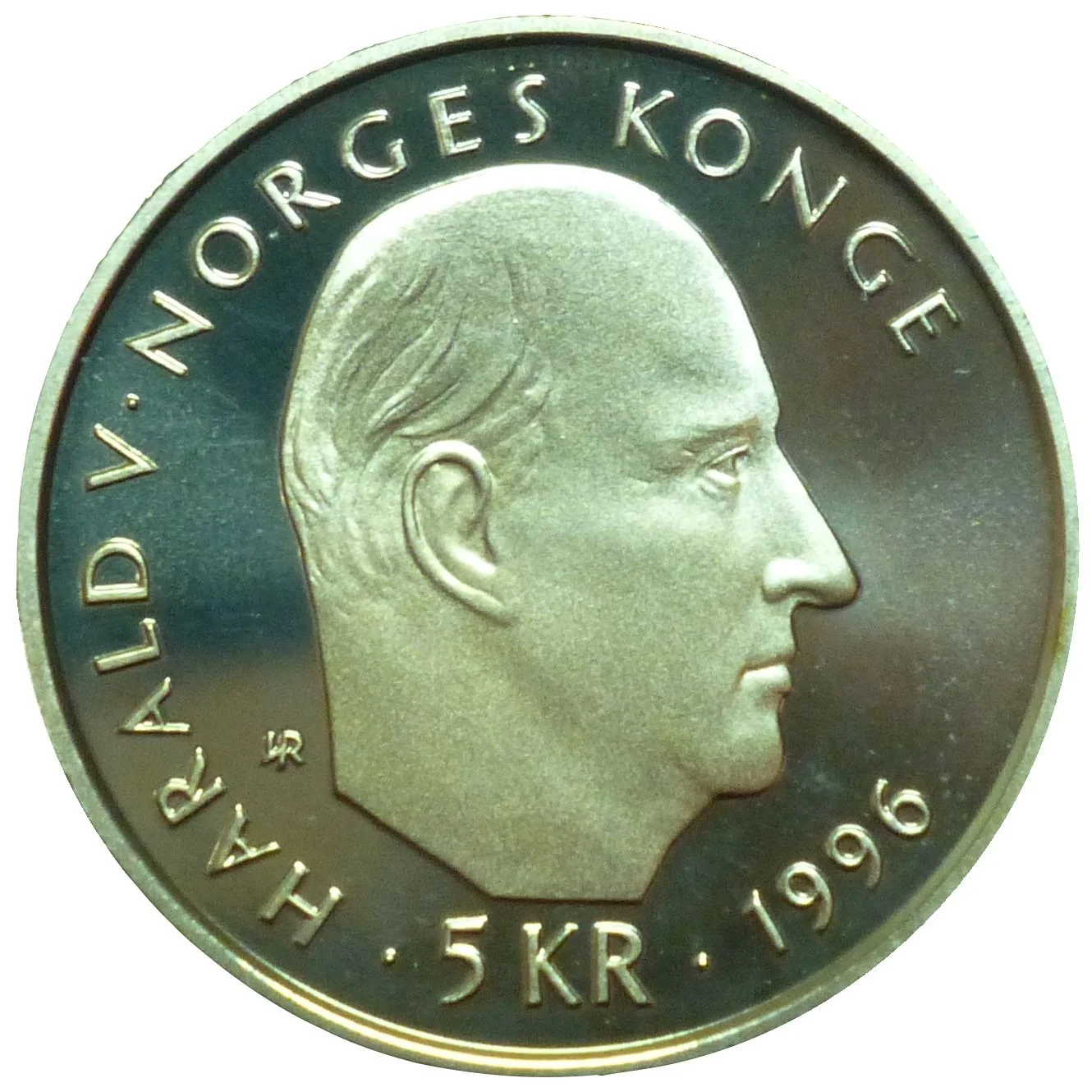
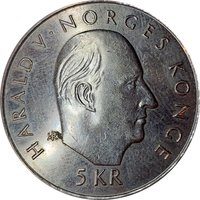
Right-facing bust of King Harald V with engraver's initials behind it, surrounded by an inscription. Value and date below. Solid rim ring.
Inscription:
HARALD V · NORGES KONGE
IAR
· 5 KR · 1996
IAR
· 5 KR · 1996
Translation:
Harald V, Norway's King
IAR
5 Crowns 1996
IAR
5 Crowns 1996
Script: Latin
Engraver: Ingrid Austlid Rise
Reverse
Description:
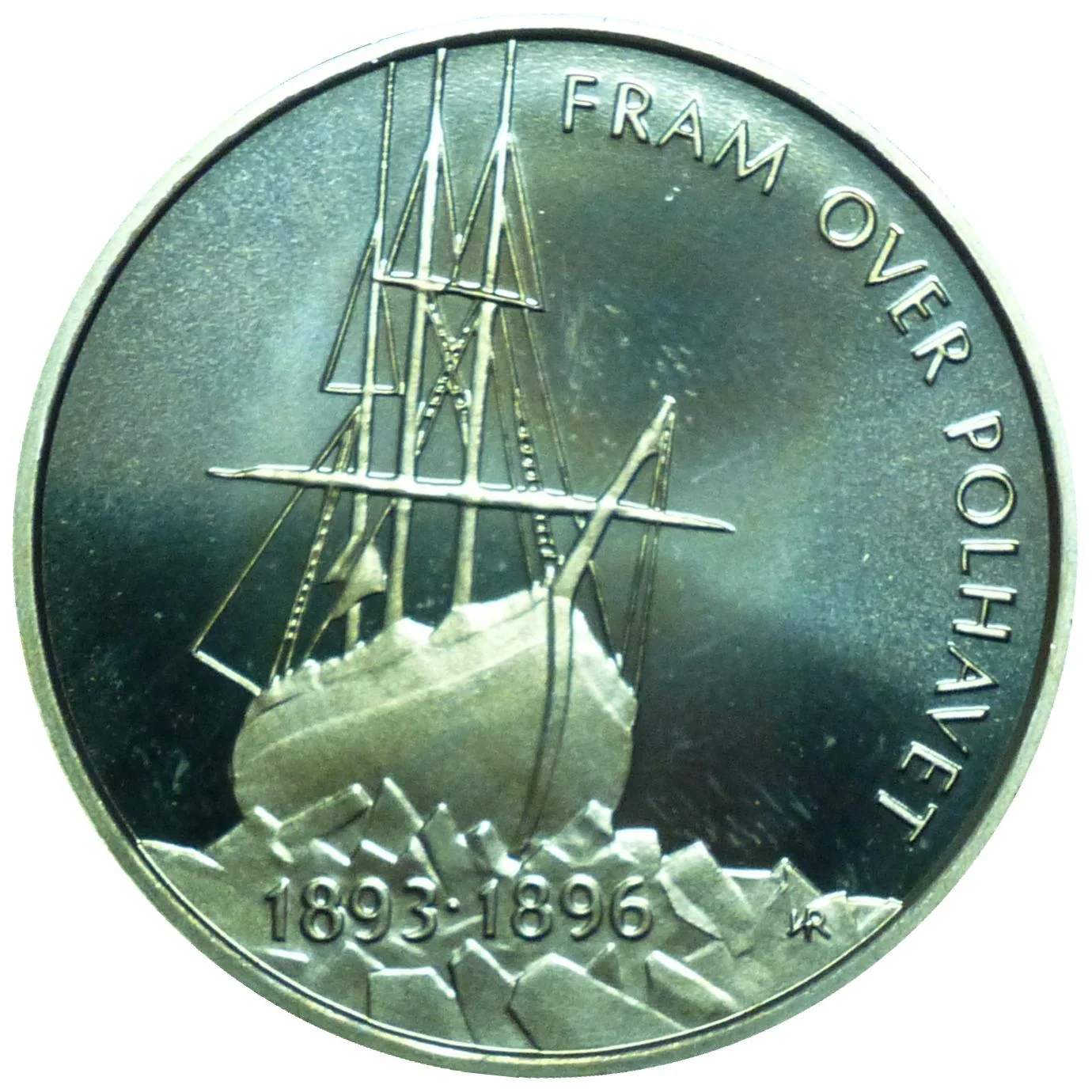
The *Fram* locked in ice. Inscription top right. Expedition date and engraver's initials in the ice. Solid ring on rim.
Inscription:
FRAM OVER POLHAVET
1893·1896
IAR
1893·1896
IAR
Translation:
FRAM OVER THE POLAR SEA
1893·1896
YEAR
1893·1896
YEAR
Script: Latin
Engraver: Ingrid Austlid Rise
Edge
Smooth, inscribed with crossed hammers, the mark of the mint master J and waved lines.
Legend:
J
Categories
| Transportation> Watercraft |
Mints
| Name | Mark |
|---|---|
| Norwegian Mint | — |
Mintings
| Year | Mint Mark | Mintage | Quality | Collection |
|---|---|---|---|---|
| 1996 | — | 1,291,909 | ||
| 1996 | — | 11,551 | Proof | |
| 1996 | — | 12,000 | BU |
Historical background
In 1996, Norway's currency situation was defined by its managed float exchange rate regime for the Norwegian krone (NOK). Following the collapse of the European Exchange Rate Mechanism (ERM) in 1992, Norges Bank, the central bank, had shifted from a fixed exchange rate policy to one where the krone's value was allowed to fluctuate within an unofficial, unpublished target band against a trade-weighted basket of currencies, though with a heavy emphasis on stability against European currencies, particularly the Deutsche Mark. The primary objective of monetary policy was explicitly to maintain a stable krone, with interest rates being the main tool to counteract undue volatility and speculative pressures.
The year was marked by significant economic strength, driven by rising petroleum revenues from the North Sea oil and gas sector. This created a complex policy dilemma: strong capital inflows and a growing current account surplus naturally put upward pressure on the krone. Norges Bank was therefore actively engaged in "leaning against the wind," using foreign exchange interventions and adjusting interest rates to prevent an excessive appreciation that would harm the competitiveness of Norway's non-oil export industries, such as shipping and manufacturing. Inflation was low and stable, but concerns about domestic overheating and asset price inflation were beginning to emerge.
This period laid the crucial groundwork for the major policy shift that would follow. The challenges of managing the krone amidst volatile capital flows and the "Dutch disease" effects of a resource-rich economy led to an intense domestic debate. By 1996, Norges Bank was increasingly advocating for a new framework that would prioritize an explicit inflation target over exchange rate stability. This culminated in 2001 with the formal adoption of an inflation-targeting regime, making the 1996 environment a pivotal final chapter in Norway's era of exchange rate-focused monetary policy.
The year was marked by significant economic strength, driven by rising petroleum revenues from the North Sea oil and gas sector. This created a complex policy dilemma: strong capital inflows and a growing current account surplus naturally put upward pressure on the krone. Norges Bank was therefore actively engaged in "leaning against the wind," using foreign exchange interventions and adjusting interest rates to prevent an excessive appreciation that would harm the competitiveness of Norway's non-oil export industries, such as shipping and manufacturing. Inflation was low and stable, but concerns about domestic overheating and asset price inflation were beginning to emerge.
This period laid the crucial groundwork for the major policy shift that would follow. The challenges of managing the krone amidst volatile capital flows and the "Dutch disease" effects of a resource-rich economy led to an intense domestic debate. By 1996, Norges Bank was increasingly advocating for a new framework that would prioritize an explicit inflation target over exchange rate stability. This culminated in 2001 with the formal adoption of an inflation-targeting regime, making the 1996 environment a pivotal final chapter in Norway's era of exchange rate-focused monetary policy.
🌱 Common