

2 Pounds – United Kingdom
Circulating commemorative coins
Commemoration: XIII Commonwealth Games, Edinburgh 1986
Series: Commonwealth Games
United Kingdom
Context
Year: 1986
Issuer: United Kingdom 
Ruler: Elizabeth II
Currency:
(since 1971)
Total mintage: 8,484,005
Material
Diameter: 28.4 mm
Weight: 15.98 g
Thickness: 3.3 mm
Shape: Round
Composition: Nickel brass
Magnetic: No
Technique: Milled
Alignment: Medal alignment
flip
References
KM: #Click to copy to clipboard947
Numista: #4410
Value
Exchange value: 2 GBP = $2.71
Inflation-adjusted value: 7.74 GBP
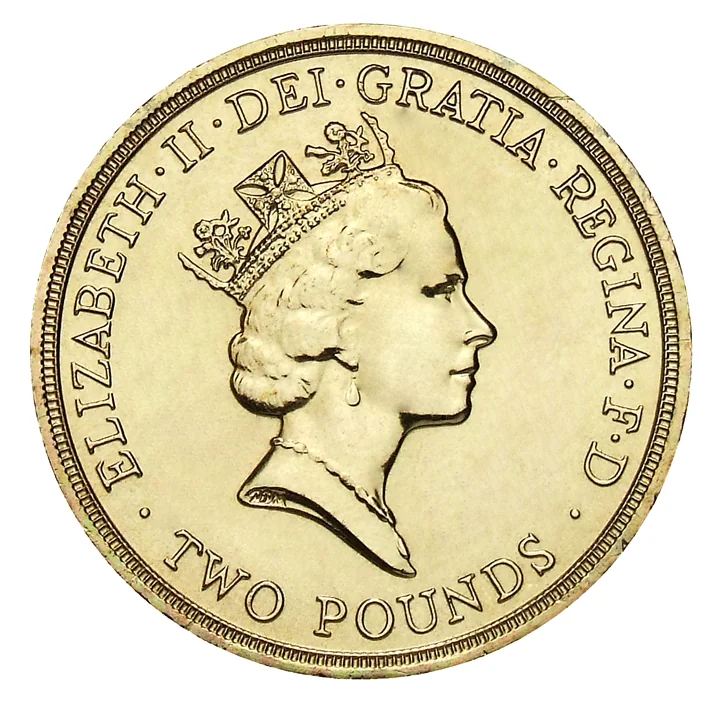
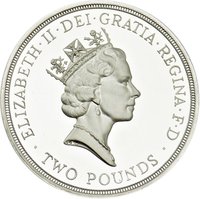
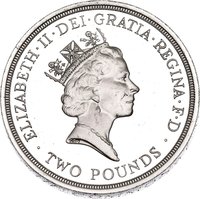
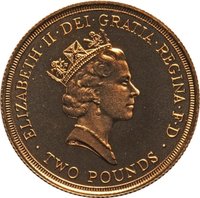
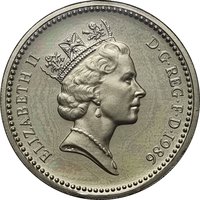
Obverse
Description:
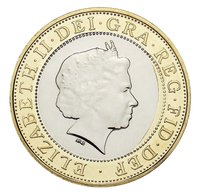
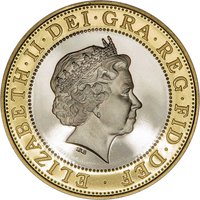
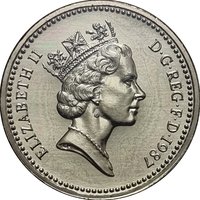
Third crowned portrait of Queen Elizabeth II facing right, wearing the George IV State Diadem.
Inscription:
ELIZABETH·II·DEI·GRATIA·REGINA·F·D
RDM
· TWO POUNDS ·
RDM
· TWO POUNDS ·
Translation:
Elizabeth II by the Grace of God Queen Defender of the Faith
Two Pounds
Two Pounds
Script: Latin
Language: Latin
Engraver: Raphael David Maklouf
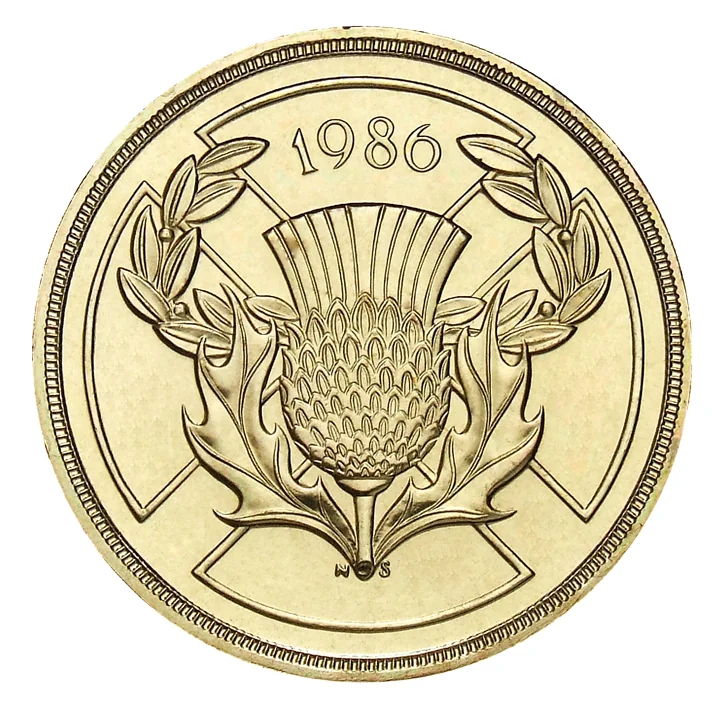
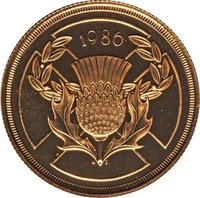
Reverse
Description:
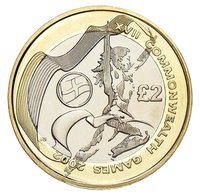
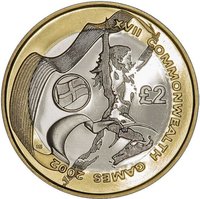
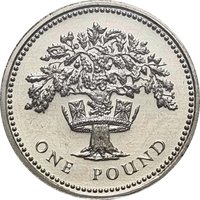
St Andrew's cross with thistle above date.
Inscription:
1986
N S
N S
Script: Latin
Engraver: Norman Sillman
Edge
Reeded with incuse lettering
Legend:
XIII COMMONWEALTH GAMES SCOTLAND 1986
Mints
| Name | Mark |
|---|---|
| Royal Mint | — |
Mintings
| Year | Mint Mark | Mintage | Quality | Collection |
|---|---|---|---|---|
| 1986 | — | 8,212,184 | ||
| 1986 | — | 104,597 | Proof | |
| 1986 | — | 167,224 | BU |
Historical background
In 1986, the United Kingdom's currency situation was characterised by a managed float within the context of a strong and volatile US dollar. The pound sterling was not pegged to any specific currency or basket, following the collapse of the Bretton Woods system and the UK's exit from the European Exchange Rate Mechanism (ERM) in 1972. However, the government, under Prime Minister Margaret Thatcher and Chancellor Nigel Lawson, informally "shadowed" the Deutsche Mark, aiming for a degree of stability against European currencies while allowing flexibility. This period saw a significant appreciation of sterling in the early-to-mid-1980s, partly driven by high interest rates and North Sea oil revenues, which created economic headwinds for British exporters.
The year itself was one of relative calm and strength for the pound, following the turbulence of the early 1980s. It traded in a range roughly between $1.40 and $1.55 against the dollar, a marked recovery from its historic low near $1.05 in 1985. This strength was underpinned by tight monetary policy aimed at controlling inflation, which had fallen from the highs of the previous decade but remained a key policy concern. The strong pound, however, continued to exacerbate the decline of traditional manufacturing industries, contributing to high unemployment in industrial regions and a growing north-south economic divide.
Politically, 1986 fell within a crucial period of debate about exchange rate policy that would culminate in the UK's ill-fated entry into the ERM in 1990. Chancellor Lawson was a growing advocate for a formal fixed exchange rate to curb inflation and provide stability, a view that increasingly clashed with Prime Minister Thatcher's more sceptical stance. Therefore, while the currency markets in 1986 were not experiencing a crisis, the underlying monetary policy tensions and the question of European monetary integration were setting the stage for major financial and political confrontations in the years immediately ahead.
The year itself was one of relative calm and strength for the pound, following the turbulence of the early 1980s. It traded in a range roughly between $1.40 and $1.55 against the dollar, a marked recovery from its historic low near $1.05 in 1985. This strength was underpinned by tight monetary policy aimed at controlling inflation, which had fallen from the highs of the previous decade but remained a key policy concern. The strong pound, however, continued to exacerbate the decline of traditional manufacturing industries, contributing to high unemployment in industrial regions and a growing north-south economic divide.
Politically, 1986 fell within a crucial period of debate about exchange rate policy that would culminate in the UK's ill-fated entry into the ERM in 1990. Chancellor Lawson was a growing advocate for a formal fixed exchange rate to curb inflation and provide stability, a view that increasingly clashed with Prime Minister Thatcher's more sceptical stance. Therefore, while the currency markets in 1986 were not experiencing a crisis, the underlying monetary policy tensions and the question of European monetary integration were setting the stage for major financial and political confrontations in the years immediately ahead.
Series: Commonwealth Games


🌱 Very Common