

Obverse
Description:
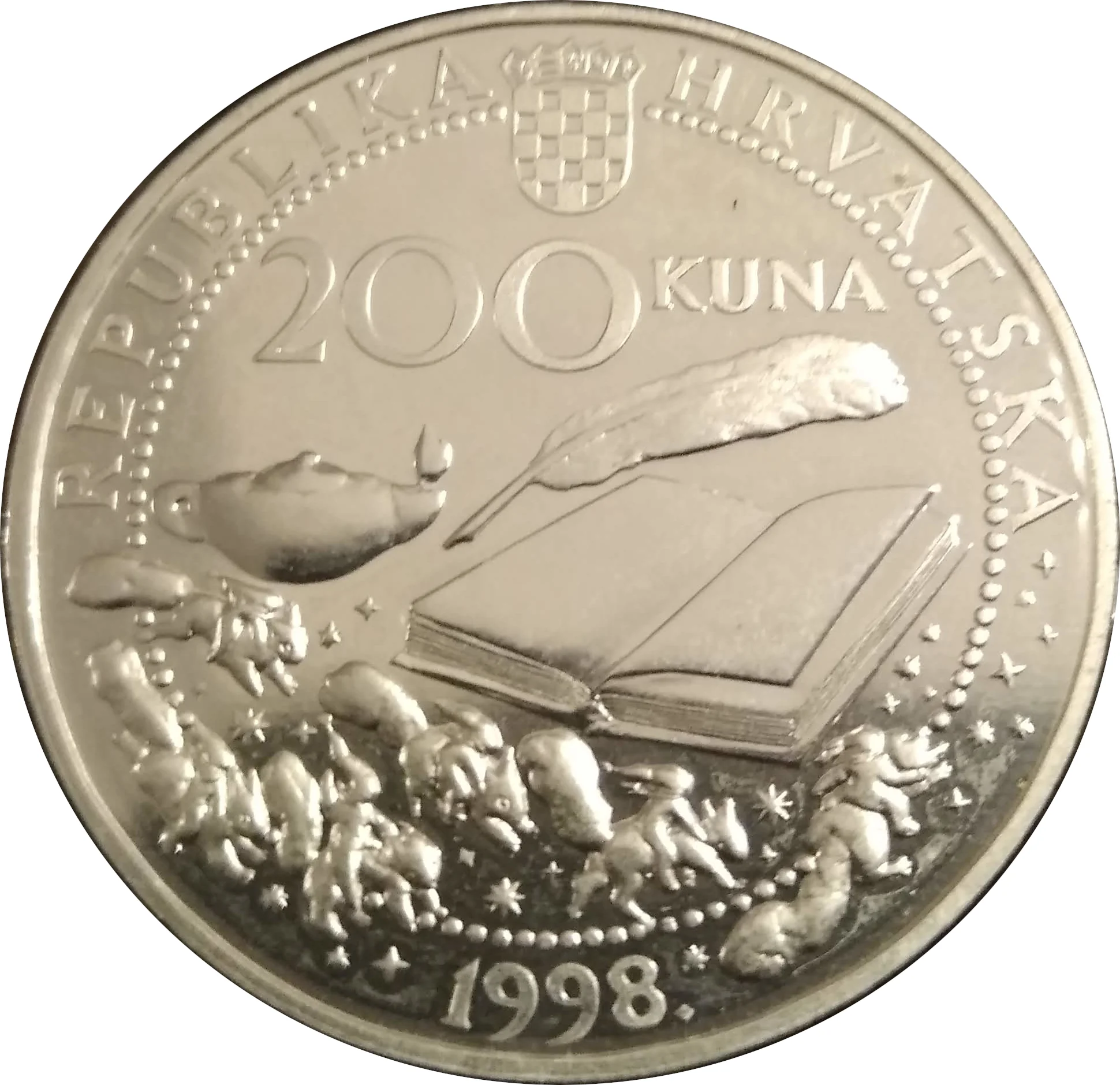
National emblem over book, quill, and lamp.
Inscription:
REPUBLIKA HRVATSKA
200 KUNA
1998.
200 KUNA
1998.
Translation:
REPUBLIC OF CROATIA
200 KUNA
1998.
200 KUNA
1998.
Script: Latin
Language: Croatian
Designer: Stjepan Divković
Reverse
Description:
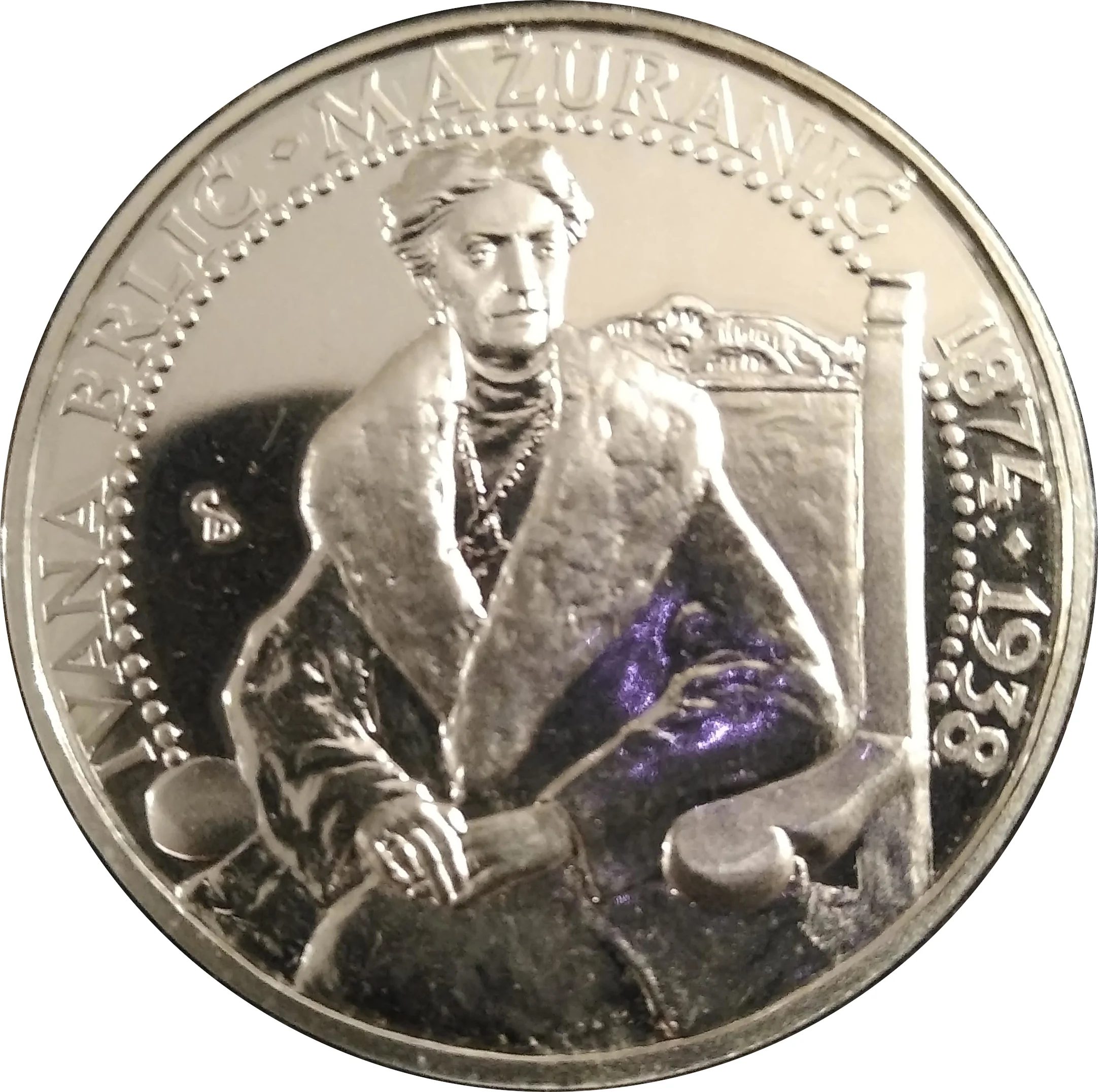
Ivana Brlić Mazuranić, seated, facing right.
Inscription:
IVANA BRLIĆ-MAŽURANIĆ 1874.-1938
Translation:
Ivana Brlić-Mažuranić 1874-1938
Script: Latin
Language: Croatian
Designer: Stjepan Divković
Edge
Plain
Mintings
| Year | Mint Mark | Mintage | Quality | Collection |
|---|---|---|---|---|
| 1998 | — | 2,000 | Proof |
Historical background
In 1998, Croatia was navigating a complex monetary landscape just three years after the end of the Homeland War and during the early phase of post-socialist economic transition. The national currency, the Croatian kuna (HRK), had been introduced in 1994, replacing the Croatian dinar as part of a stabilization program to curb hyperinflation and establish monetary sovereignty. The kuna was designed to be a strong, stable currency, and its management by the Croatian National Bank (HNB) was heavily influenced by the need to build domestic and international confidence. A de facto managed float was in place, with the HNB intervening to smooth excessive volatility, but the currency's value was largely influenced by market forces, the country's current account deficit, and the level of foreign exchange reserves.
The broader economic context was challenging. Croatia was still recovering from war damage, facing a large public debt burden, and undergoing a slow and often painful privatization process. The banking sector was fragile, and the economy was marked by a high degree of euroization, where many savings and large transactions were conducted in Deutsche Marks due to lingering distrust in the domestic currency. This dollarization/euroization limited the effectiveness of the HNB's monetary policy. Furthermore, 1998 was a period of regional economic turbulence following the 1997 Asian financial crisis and the 1998 Russian financial crisis, which increased risk aversion towards emerging European markets and put indirect pressure on the kuna.
Overall, the currency situation in 1998 was one of fragile stability. The kuna had succeeded in ending hyperinflation, but it operated within a vulnerable economy highly sensitive to external shocks and dependent on capital inflows, particularly from tourism and foreign borrowing. The HNB's primary focus was on maintaining price and exchange rate stability as a foundation for further economic recovery, setting the stage for the more formal stabilization policies that would follow in the early 2000s as Croatia moved closer to European Union accession and eventual Eurozone membership.
The broader economic context was challenging. Croatia was still recovering from war damage, facing a large public debt burden, and undergoing a slow and often painful privatization process. The banking sector was fragile, and the economy was marked by a high degree of euroization, where many savings and large transactions were conducted in Deutsche Marks due to lingering distrust in the domestic currency. This dollarization/euroization limited the effectiveness of the HNB's monetary policy. Furthermore, 1998 was a period of regional economic turbulence following the 1997 Asian financial crisis and the 1998 Russian financial crisis, which increased risk aversion towards emerging European markets and put indirect pressure on the kuna.
Overall, the currency situation in 1998 was one of fragile stability. The kuna had succeeded in ending hyperinflation, but it operated within a vulnerable economy highly sensitive to external shocks and dependent on capital inflows, particularly from tourism and foreign borrowing. The HNB's primary focus was on maintaining price and exchange rate stability as a foundation for further economic recovery, setting the stage for the more formal stabilization policies that would follow in the early 2000s as Croatia moved closer to European Union accession and eventual Eurozone membership.

✨ Legendary