

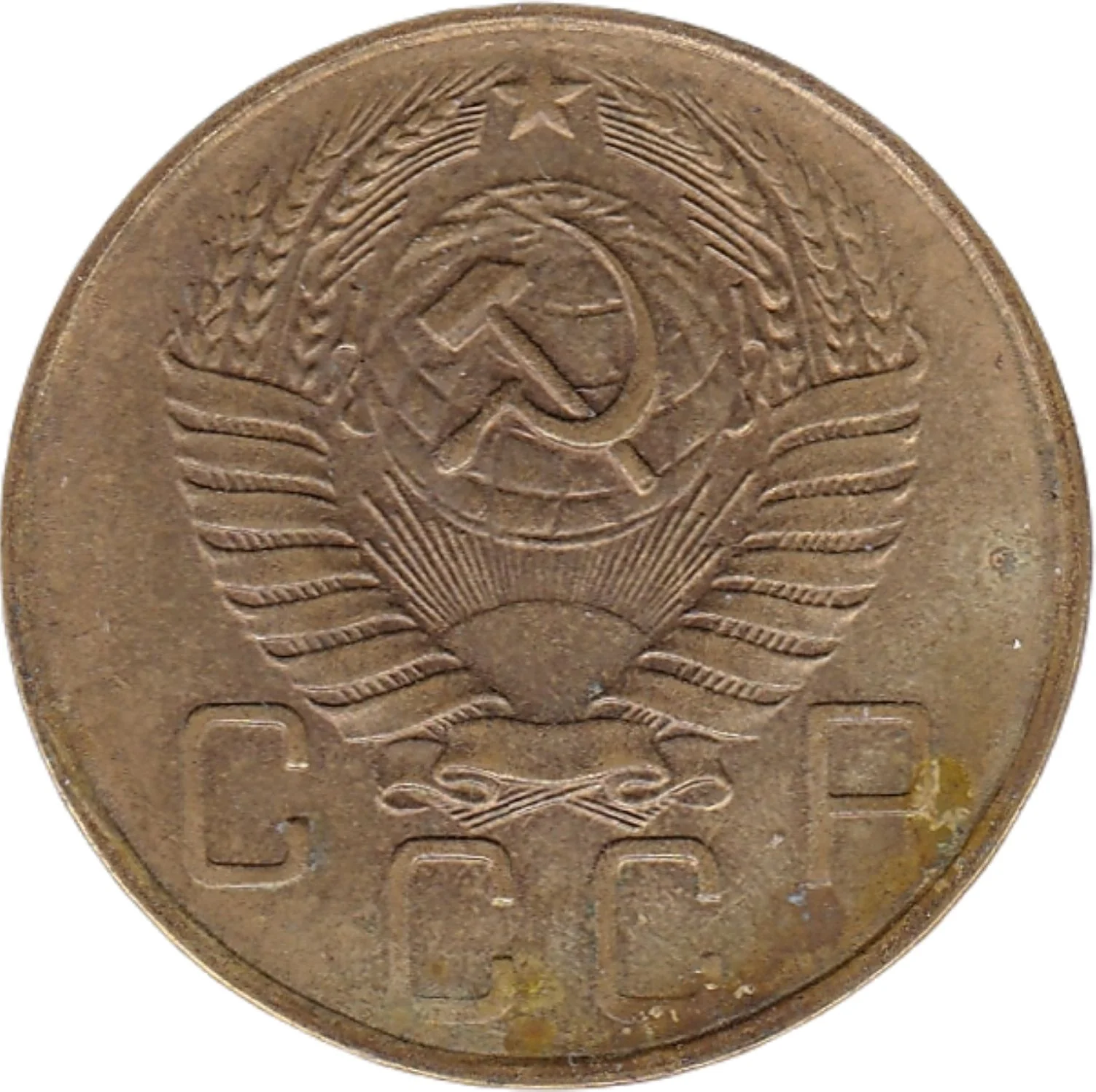
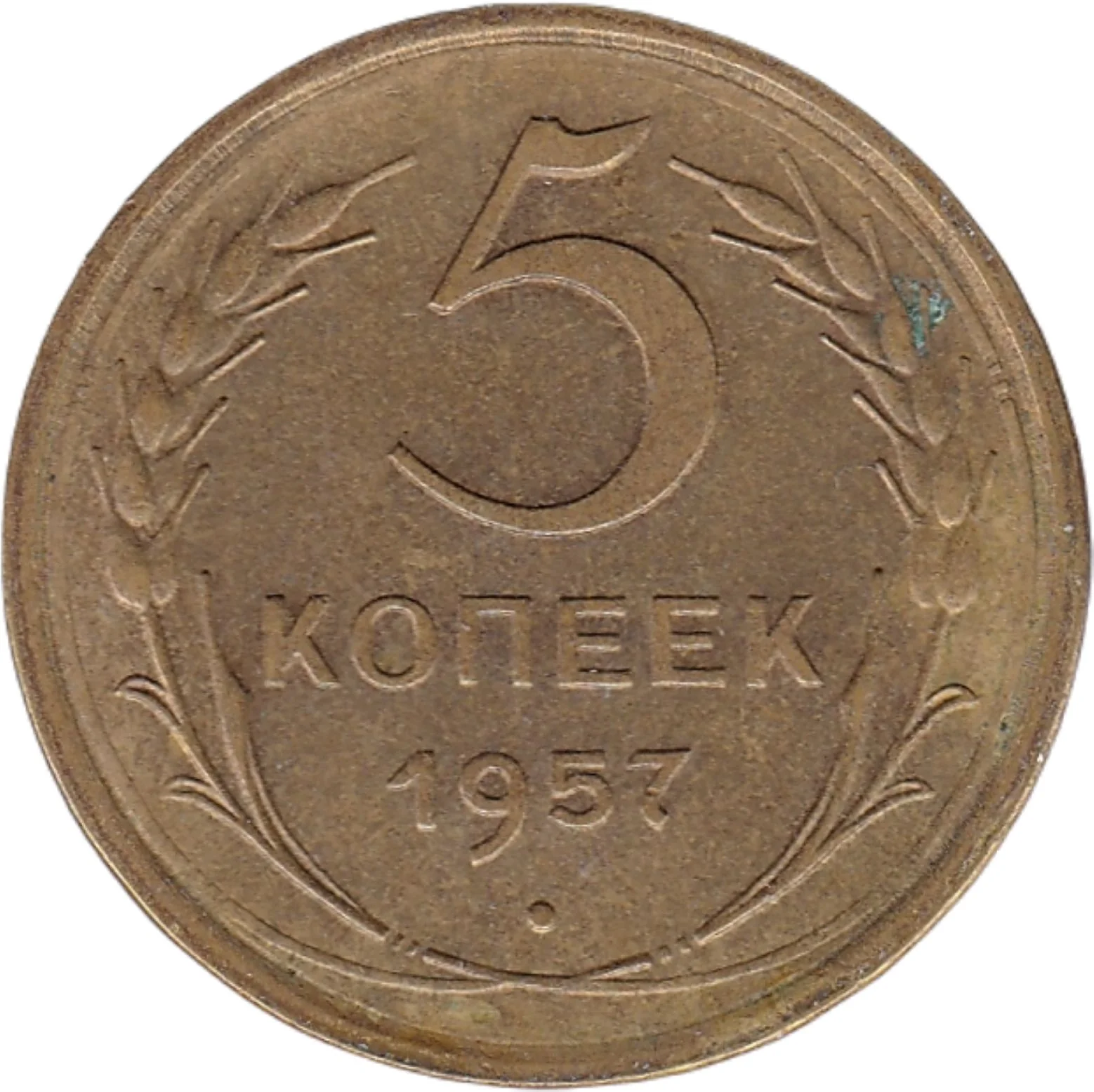
5 kopecks – Soviet Union
Add to wishlist
Russia
Context
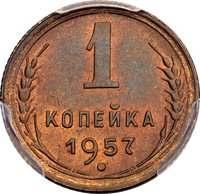
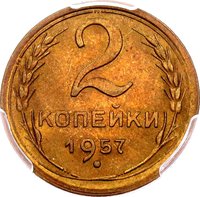
Year: 1957
Country: Russia
Issuer: Soviet Union
Period:
(1922—1991)
Currency:
(1947—1960)
Demonetized: Yes
Material
Diameter: 25 mm
Weight: 5 g
Thickness: 1.5 mm
Shape: Round
Composition: Aluminium bronze
Magnetic: No
Technique: Milled
Alignment: Medal alignment
flip
References
Y: #
Numista: #14666
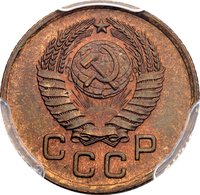
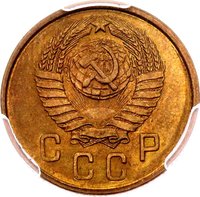
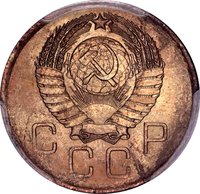
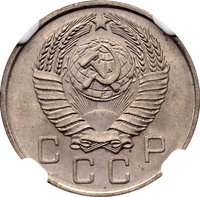
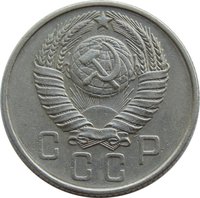
Obverse
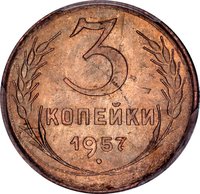
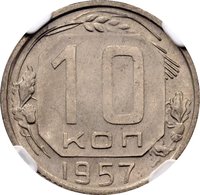
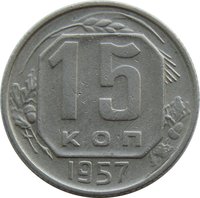
Reverse
Edge
Reeded
Categories
| Symbol> Hammer and sickle |
Mintings
| Year | Mint Mark | Mintage | Quality | Collection |
|---|---|---|---|---|
| 1957 | — | — |
Historical background
In 1957, the Soviet Union's currency situation was characterized by strict state control within a largely cashless planned economy. The ruble existed in two forms: cash rubles used by the population for small-scale retail transactions, and non-cash "bank money" used for accounting between state enterprises. This bifurcation was a deliberate policy to prevent unauthorized market activity, as non-cash funds could not be converted to cash, thereby maintaining the state's monopoly over resource allocation and limiting the scope of the shadow economy. Prices for essential goods were heavily subsidized and stable, but this came at the cost of frequent shortages and a limited range of consumer items.
Internationally, the Soviet ruble was a non-convertible currency, meaning it could not be freely traded on global markets and had an artificially set official exchange rate with no relation to its domestic purchasing power. This isolation shielded the Soviet economy from external shocks but also hindered foreign trade, which was conducted through complex bilateral agreements and clearing accounts. For citizens, access to foreign currency was virtually impossible except through the black market, where the ruble traded at a fraction of its official rate, highlighting the vast gap between the state's proclaimed value and its actual worth abroad.
The year 1957 fell within the broader Khrushchev era, a period of attempted economic reforms and a declared focus on improving living standards. While no major currency reform occurred that year (the traumatic 1947 reform and the smaller 1961 redenomination bookended this period), the monetary system reflected the core contradictions of the Soviet economy: surface-level stability and official price controls masking underlying inefficiencies, a growing but suppressed consumer demand, and a complete separation from the global financial system. The currency regime thus functioned primarily as an instrument of administrative control rather than a true market medium of exchange.
Internationally, the Soviet ruble was a non-convertible currency, meaning it could not be freely traded on global markets and had an artificially set official exchange rate with no relation to its domestic purchasing power. This isolation shielded the Soviet economy from external shocks but also hindered foreign trade, which was conducted through complex bilateral agreements and clearing accounts. For citizens, access to foreign currency was virtually impossible except through the black market, where the ruble traded at a fraction of its official rate, highlighting the vast gap between the state's proclaimed value and its actual worth abroad.
The year 1957 fell within the broader Khrushchev era, a period of attempted economic reforms and a declared focus on improving living standards. While no major currency reform occurred that year (the traumatic 1947 reform and the smaller 1961 redenomination bookended this period), the monetary system reflected the core contradictions of the Soviet economy: surface-level stability and official price controls masking underlying inefficiencies, a growing but suppressed consumer demand, and a complete separation from the global financial system. The currency regime thus functioned primarily as an instrument of administrative control rather than a true market medium of exchange.
🌱 Common