

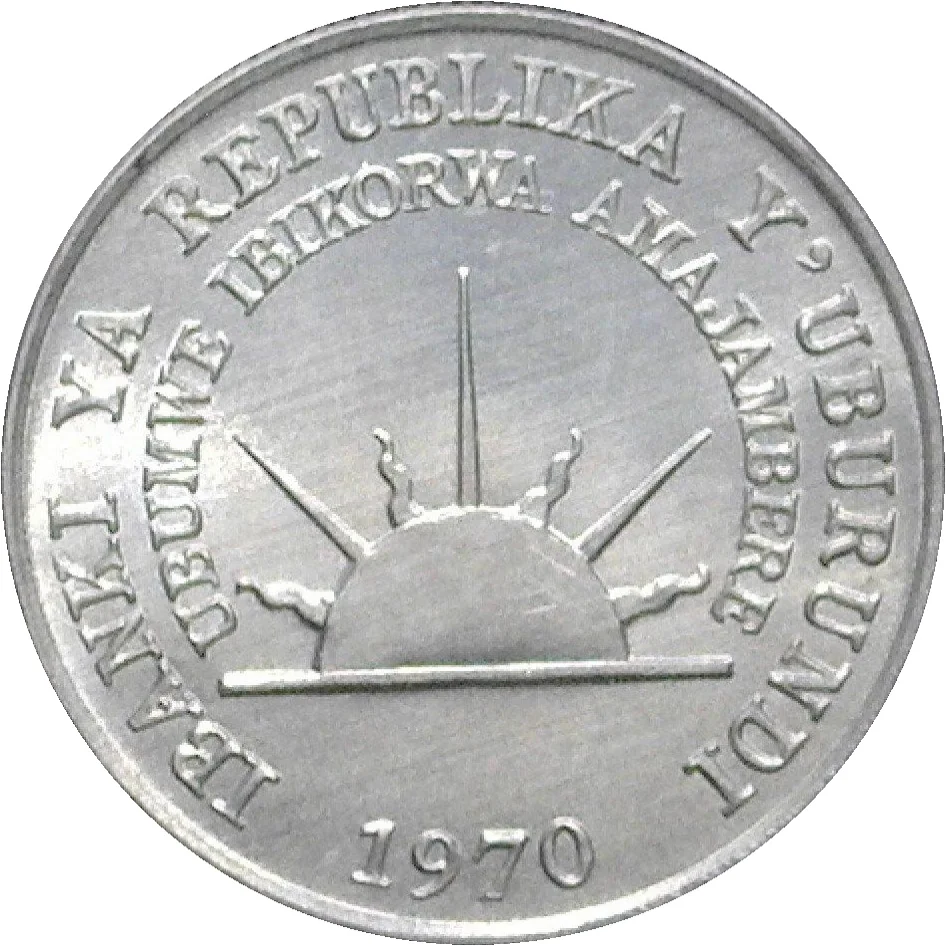
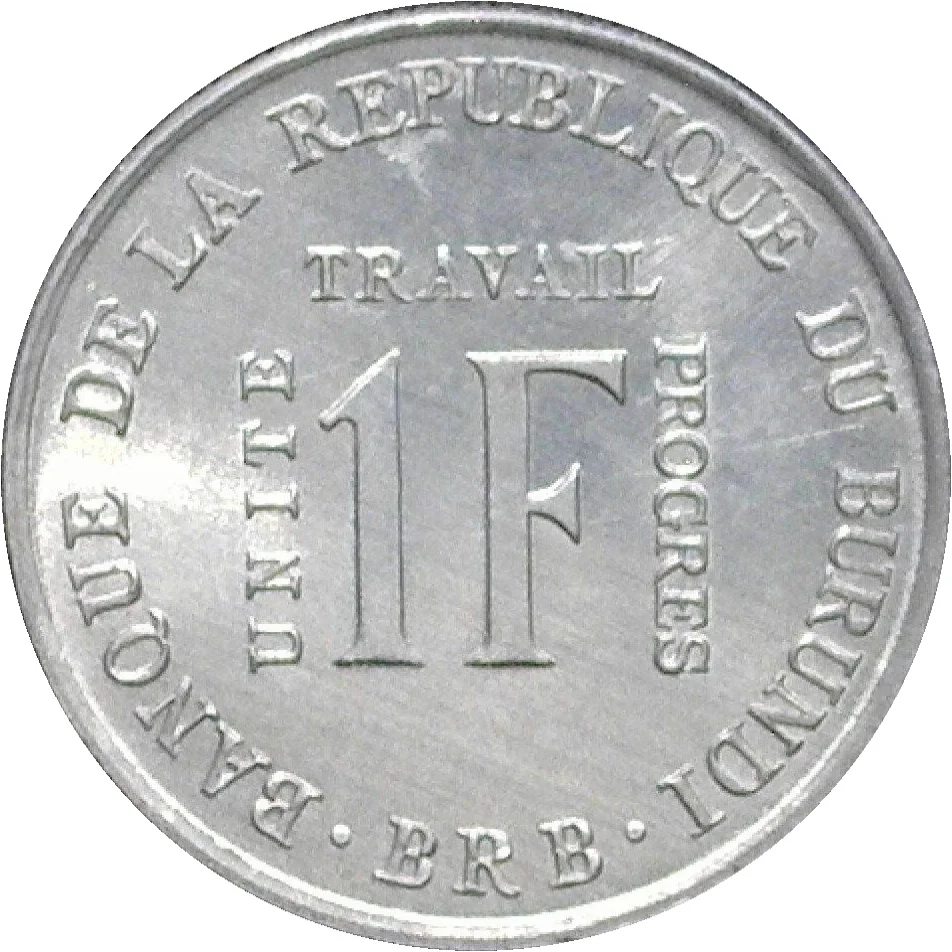
1 Franc – Burundi
Burundi
Context
Year: 1970
Issuer: Burundi 
Issuing organization: Bank of the Republic of Burundi
Period:
(since 1966)
Currency:
(since 1962)
Total mintage: 10,000,000
Material
References
KM: #Click to copy to clipboard18
Numista: #4388
Value
Exchange value: 1 BIF
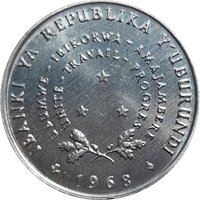
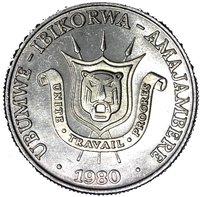
Obverse
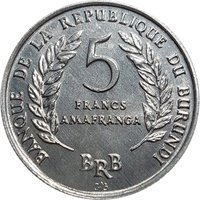
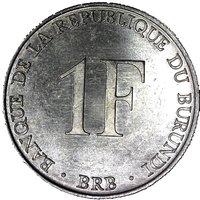
Reverse
Edge
Reeded
Mints
| Name | Mark |
|---|---|
| Royal Mint | — |
Mintings
| Year | Mint Mark | Mintage | Quality | Collection |
|---|---|---|---|---|
| 1970 | — | 10,000,000 |
Historical background
In 1970, Burundi's currency situation was defined by its membership in the Franc Zone and its use of the Burundi Franc (BIF), which was pegged to the French Franc (FRF) at a fixed rate of 1 FRF = 50 BIF. This arrangement, managed through the Central Bank of the Republic of Burundi (established in 1964), provided monetary stability and guaranteed convertibility through the French Treasury. This link to France was a legacy of the colonial period and offered a buffer against inflation, but it also meant Burundi's monetary policy was largely aligned with French interests rather than being fully autonomous.
Economically, the country was heavily reliant on agricultural exports, particularly coffee, which accounted for the vast majority of its foreign exchange earnings. This made the national currency vulnerable to fluctuations in global commodity prices. While the fixed peg provided stability for international transactions, it did little to address underlying structural issues: a lack of economic diversification, a small industrial sector, and widespread rural poverty. The currency's value was thus underpinned more by the external guarantee from France than by a robust and diversified domestic economy.
Politically, this period fell within the authoritarian rule of President Michel Micombero, who had declared a republic in 1966. The regime's focus was on consolidating power, and monetary policy was not a primary tool for developmental planning. The fixed exchange rate system simplified trade, primarily with European partners, but offered limited flexibility to respond to domestic economic shocks. Consequently, while the currency itself was stable on paper, the broader financial environment in 1970 Burundi was characterized by an underdeveloped banking sector, limited access to credit, and an economy whose fundamental weaknesses were merely stabilized, not resolved, by its currency peg.
Economically, the country was heavily reliant on agricultural exports, particularly coffee, which accounted for the vast majority of its foreign exchange earnings. This made the national currency vulnerable to fluctuations in global commodity prices. While the fixed peg provided stability for international transactions, it did little to address underlying structural issues: a lack of economic diversification, a small industrial sector, and widespread rural poverty. The currency's value was thus underpinned more by the external guarantee from France than by a robust and diversified domestic economy.
Politically, this period fell within the authoritarian rule of President Michel Micombero, who had declared a republic in 1966. The regime's focus was on consolidating power, and monetary policy was not a primary tool for developmental planning. The fixed exchange rate system simplified trade, primarily with European partners, but offered limited flexibility to respond to domestic economic shocks. Consequently, while the currency itself was stable on paper, the broader financial environment in 1970 Burundi was characterized by an underdeveloped banking sector, limited access to credit, and an economy whose fundamental weaknesses were merely stabilized, not resolved, by its currency peg.
🌱 Common