

1 franc – Burundi
Add to wishlist
Burundi
Context
Years: 1976–2022
Issuer: Burundi
Issuing organization: Bank of the Republic of Burundi
Period:
(since 1966)
Currency:
(since 1962)
Total mintage: 5,000,000
Material
References
KM: #
Numista: #4387
Value
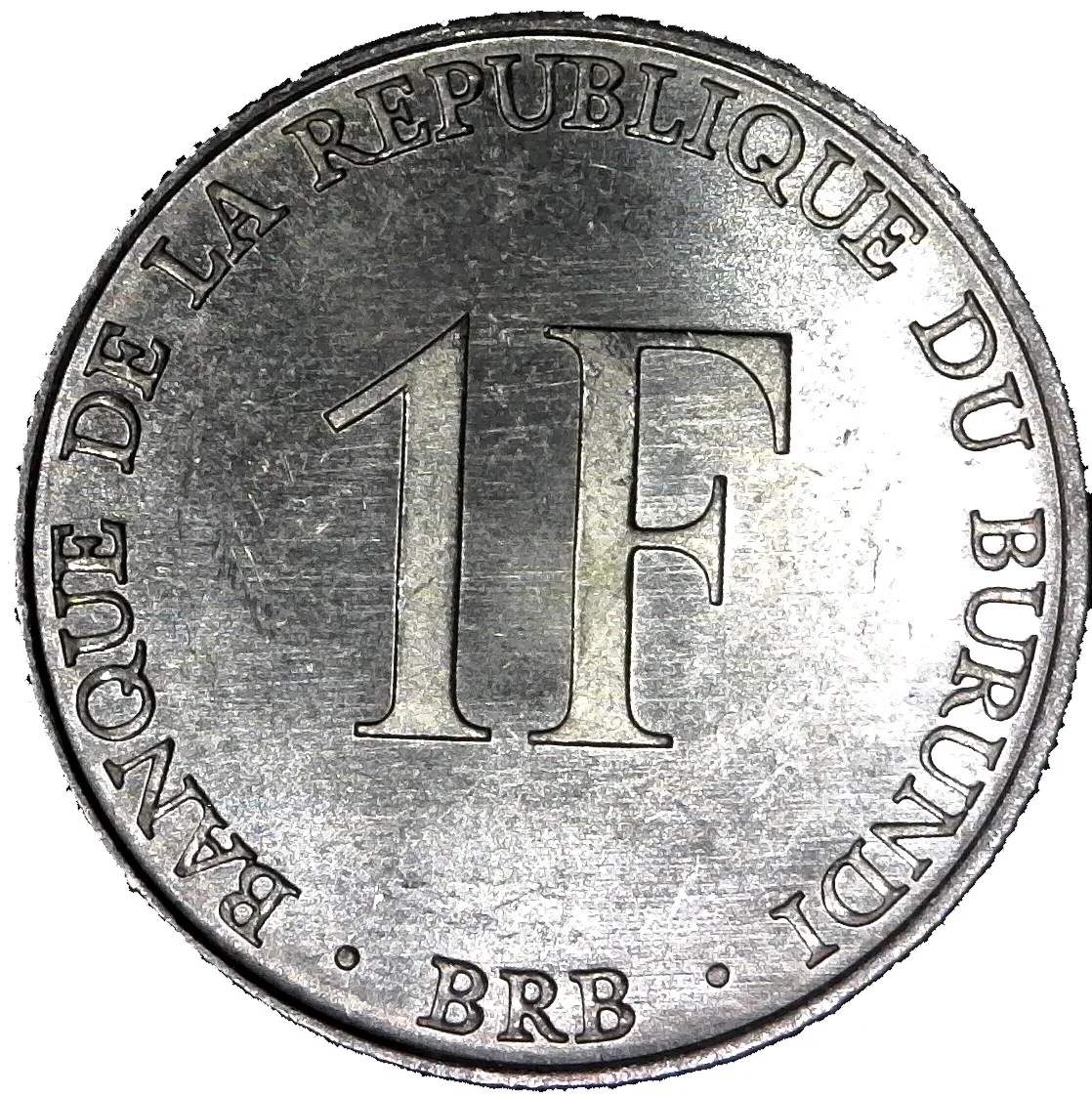
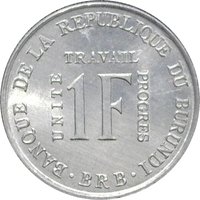
Exchange value: 1 BIF
Obverse
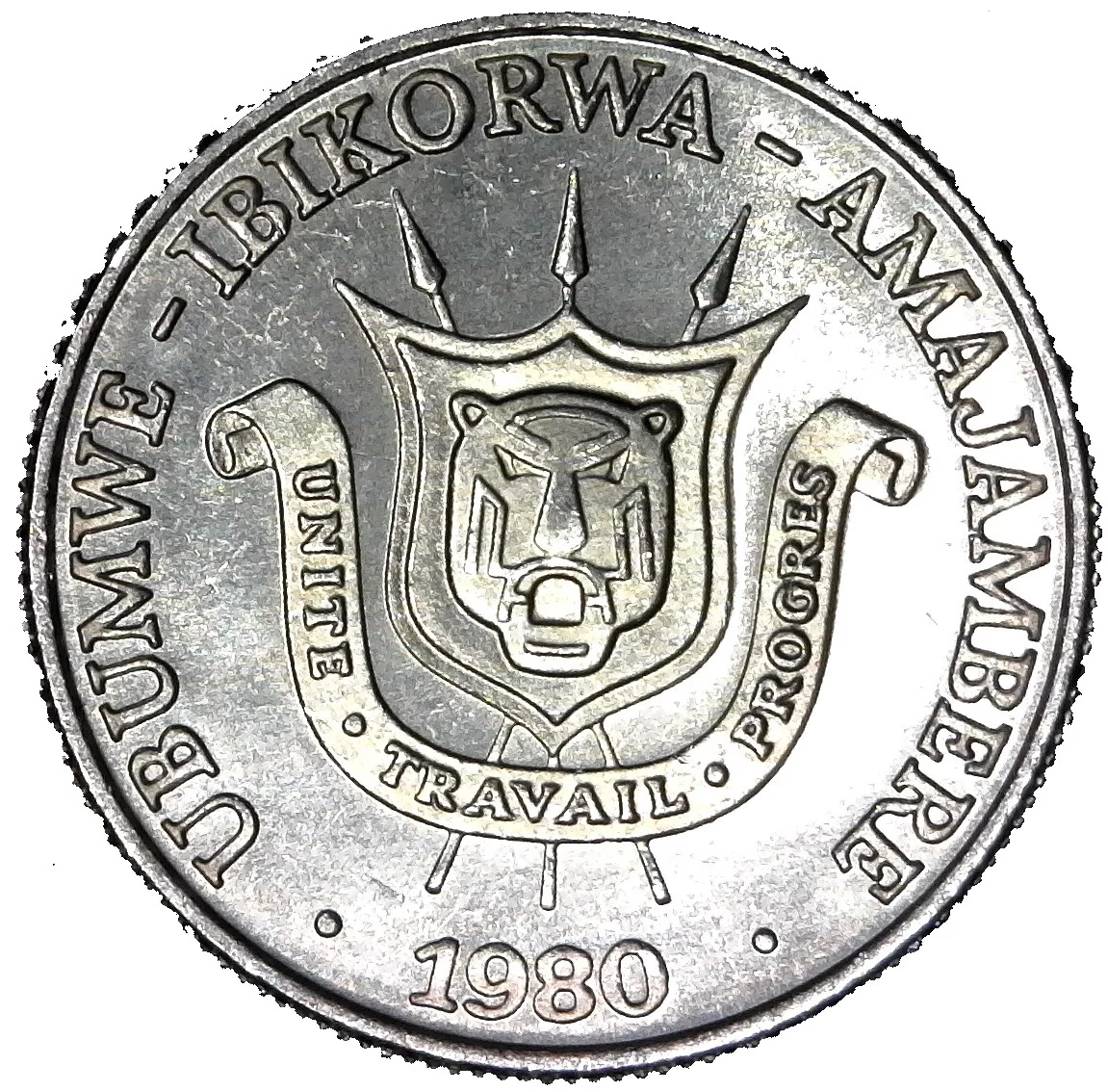
Description:
National arms, date beneath.
Inscription:
UBUMWE-IBIKORWA-AMAJAMBERE
UNITE-TRAVAIL-PROGRES
1980
UNITE-TRAVAIL-PROGRES
1980
Script: Latin
Reverse
Edge
Reeded
Categories
| Animal> Feline |
| Symbols> Coat of Arms |
| Object> Cold weapons |
Mints
| Name | Mark |
|---|---|
| VDM Metals / Vereinigte Deutsche Metallwerke | — |
| Pobjoy Mint | (PM) |
Mintings
| Year | Mint Mark | Mintage | Quality | Collection |
|---|---|---|---|---|
| 1976 | — | 5,000,000 | ||
| 1980 | — | — | ||
| 1990 | PM | — | ||
| 1993 | PM | — | ||
| 2003 | PM | — | ||
| 2022 | — | — |
Historical background
In 1976, Burundi’s currency situation was characterized by its use of the Burundi franc (FBu), which was pegged to a stable international benchmark as a member of the Franc Zone. The country was part of the Franc de la Coopération Financière en Afrique (CFA franc) system, but notably issued its own national currency, the Burundi franc, rather than using the shared CFA franc. Its value was fixed to the Special Drawing Right (SDR), a basket of international reserve assets defined by the International Monetary Fund, which provided a degree of stability by tethering it to major world currencies like the US dollar, French franc, and others.
This monetary arrangement was managed under the auspices of the Bank of the Republic of Burundi, with the peg intended to control inflation and foster foreign trade confidence. However, the structural weaknesses of Burundi's economy—heavily dependent on coffee exports, which accounted for the vast majority of its foreign earnings—made it vulnerable to terms of trade shocks. A poor harvest or a drop in global coffee prices could swiftly create balance of payments pressures, straining the fixed exchange rate regime and the country's limited foreign reserves.
Politically, 1976 was a year of significant upheaval, with Lieutenant-Colonel Jean-Baptiste Bagaza seizing power in a military coup in November. While immediate currency devaluation was not a direct consequence of the coup, the event underscored a period of economic and political fragility. The government's fiscal policies were constrained, and the stability of the Burundi franc in the long term was inherently tied to the volatile single-commodity export model and the new regime's ability to manage economic policy amidst a challenging post-colonial landscape.
This monetary arrangement was managed under the auspices of the Bank of the Republic of Burundi, with the peg intended to control inflation and foster foreign trade confidence. However, the structural weaknesses of Burundi's economy—heavily dependent on coffee exports, which accounted for the vast majority of its foreign earnings—made it vulnerable to terms of trade shocks. A poor harvest or a drop in global coffee prices could swiftly create balance of payments pressures, straining the fixed exchange rate regime and the country's limited foreign reserves.
Politically, 1976 was a year of significant upheaval, with Lieutenant-Colonel Jean-Baptiste Bagaza seizing power in a military coup in November. While immediate currency devaluation was not a direct consequence of the coup, the event underscored a period of economic and political fragility. The government's fiscal policies were constrained, and the stability of the Burundi franc in the long term was inherently tied to the volatile single-commodity export model and the new regime's ability to manage economic policy amidst a challenging post-colonial landscape.
🌱 Very Common