

10 öre – Sweden
Add to wishlist
Sweden
Context
Years: 1976–1991
Issuer: Sweden
Ruler: Carl XVI Gustaf
Currency:
(since 1873)
Demonetization: 30 September 1992
Total mintage: 1,571,121,812
Material
References
KM: #
Numista: #1466
Value
Exchange value: 0.10 SEK
Inflation-adjusted value: 0.69 SEK
Obverse
Description:
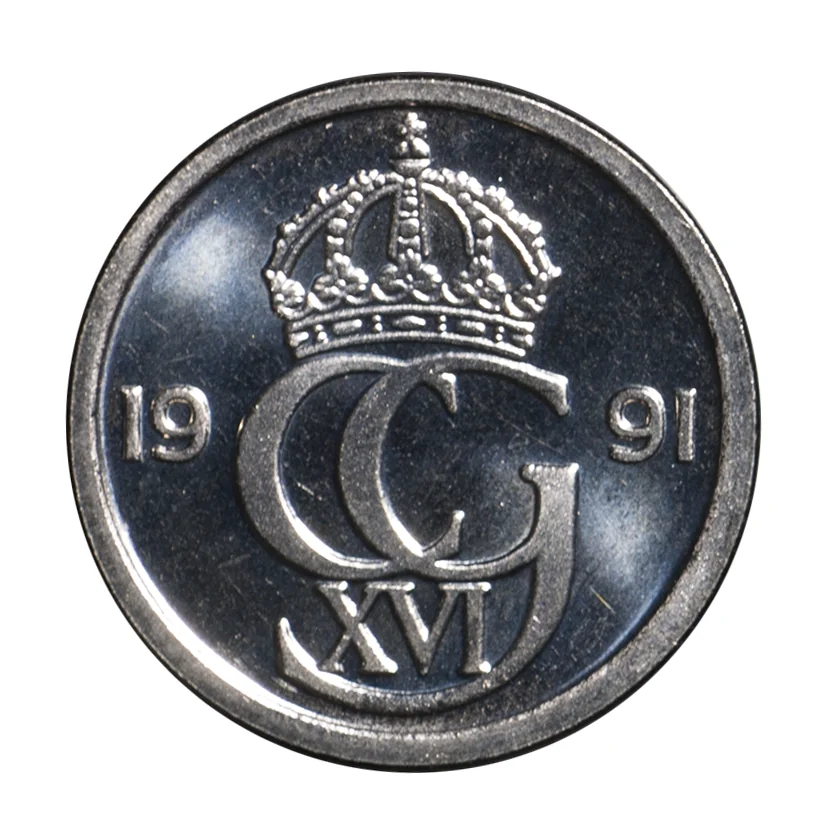
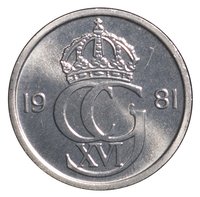
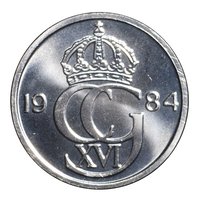
Carl XVI Gustaf monogram divides date.
Inscription:
CG XVI
1978
1978
Script: Latin
Engraver: Lars Englund
Reverse
Description:
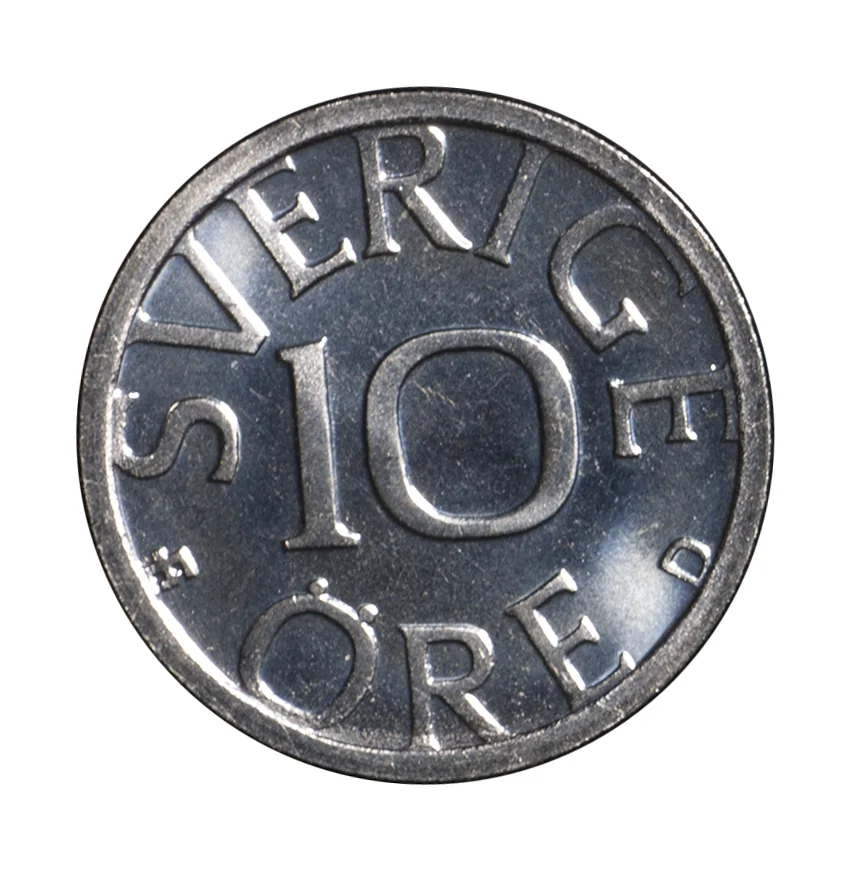
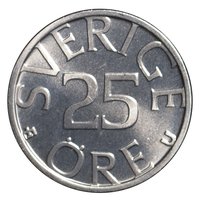
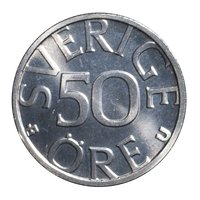
The reverse features the figure 10, with SVERIGE above and ÖRE below. The mintmark is left of ÖRE, and the Riksbank Governor's initial is to the right.
Inscription:
SVERIGE
10 ÖRE
E U
10 ÖRE
E U
Translation:
SWEDEN
10 ORE
E U
10 ORE
E U
Script: Latin
Language: Swedish
Engraver: Lars Englund
Edge
Plain
Mints
| Name | Mark |
|---|---|
| Myntverket | — |
Mintings
| Year | Mint Mark | Mintage | Quality | Collection |
|---|---|---|---|---|
| 1976 | — | 4,111,556 | ||
| 1977 | — | 44,473,941 | ||
| 1978 | — | 74,290,360 | ||
| 1979 | — | 75,256,451 | ||
| 1980 | — | 108,238,176 | ||
| 1981 | — | 102,376,666 | ||
| 1982 | — | 103,837,357 | ||
| 1983 | — | 77,315,000 | ||
| 1984 | — | 122,047,143 | ||
| 1985 | — | 79,094,489 | ||
| 1986 | — | 48,909,643 | ||
| 1987 | — | 146,801,658 | ||
| 1988 | — | 194,924,911 | ||
| 1989 | — | 245,116,579 | ||
| 1990 | — | 139,236,636 | ||
| 1991 | — | 5,091,246 |
Historical background
In 1976, Sweden found itself at a pivotal and challenging juncture in its post-war economic history, grappling with the severe consequences of the 1973 oil crisis and a deteriorating international economic climate. The nation's famed "Swedish Model," built on full employment, high wages, and a generous welfare state, was under immense strain. A significant loss of industrial competitiveness, driven by powerful wage pushes from centralized unions, led to falling exports and rising inflation. This created a persistent and growing current account deficit, putting sustained downward pressure on the Swedish krona (SEK), which was pegged to a trade-weighted currency basket.
The Social Democratic government, which had been in power for over four decades, was acutely aware of the currency's vulnerability but was deeply reluctant to devalue. Such a move was seen as a betrayal of the model's stability and a threat to workers' purchasing power. Instead, the Riksbank engaged in a costly defense of the peg, spending substantial foreign currency reserves and raising interest rates. This defensive strategy, however, failed to address the core issue of cost inflation and industrial competitiveness, instead tightening the economic squeeze on businesses and households.
The currency crisis became a central issue in the September 1976 general election, contributing to the historic defeat of the Social Democrats. The new center-right coalition government, led by Thorbjörn Fälldin, took office and faced immediate pressure. Within weeks, in October 1976, it was forced to make the decision its predecessors had avoided: a dramatic 10% devaluation of the krona. This move, while necessary to restore export competitiveness, marked the end of an era of perceived economic invulnerability and set the stage for further currency turbulence and policy shifts in the years to follow.
The Social Democratic government, which had been in power for over four decades, was acutely aware of the currency's vulnerability but was deeply reluctant to devalue. Such a move was seen as a betrayal of the model's stability and a threat to workers' purchasing power. Instead, the Riksbank engaged in a costly defense of the peg, spending substantial foreign currency reserves and raising interest rates. This defensive strategy, however, failed to address the core issue of cost inflation and industrial competitiveness, instead tightening the economic squeeze on businesses and households.
The currency crisis became a central issue in the September 1976 general election, contributing to the historic defeat of the Social Democrats. The new center-right coalition government, led by Thorbjörn Fälldin, took office and faced immediate pressure. Within weeks, in October 1976, it was forced to make the decision its predecessors had avoided: a dramatic 10% devaluation of the krona. This move, while necessary to restore export competitiveness, marked the end of an era of perceived economic invulnerability and set the stage for further currency turbulence and policy shifts in the years to follow.
Series: 1976 Sweden circulation coins

🌱 Very Common