

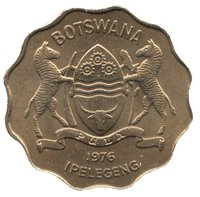
Obverse
Description:
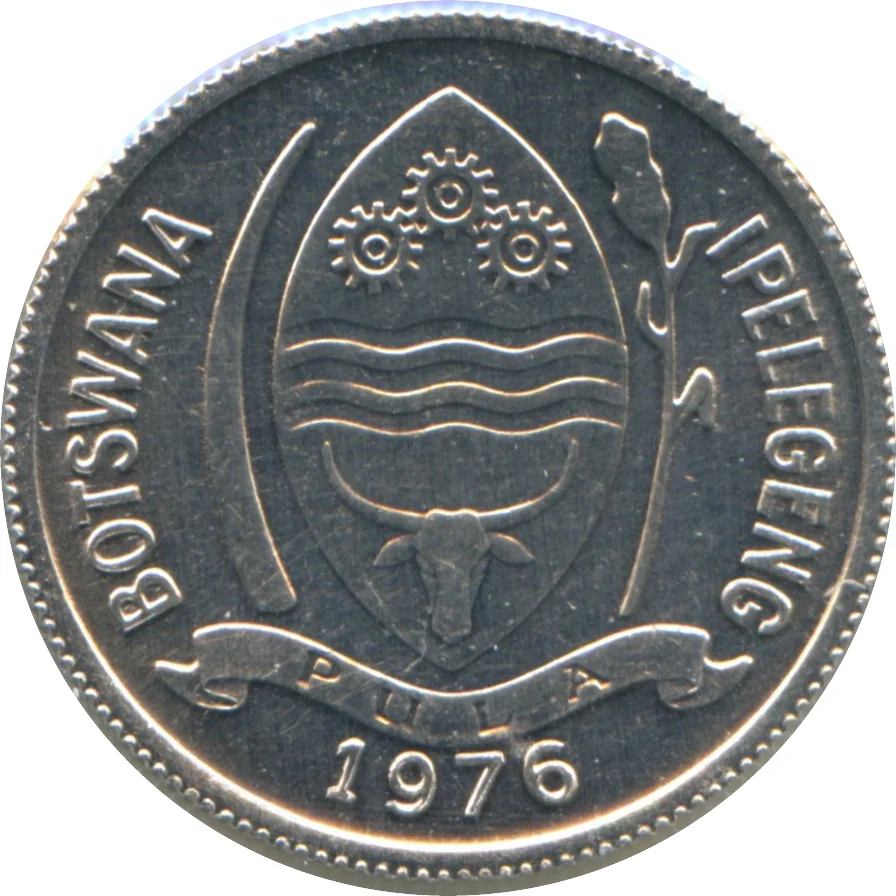
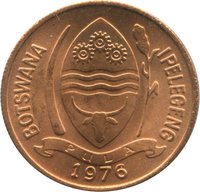
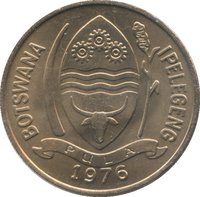
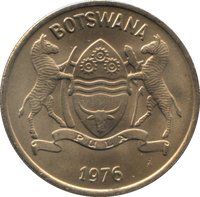
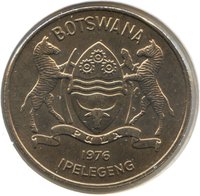
The national coat of arms of Botswana.
Inscription:
BOTSWANA IPELEGENG
PULA
1976
PULA
1976
Translation:
Self-reliance
Rain
1976
Rain
1976
Script: Latin
Engraver: Michael Hibbit
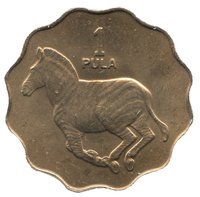
Reverse
Edge
Reeded
Categories
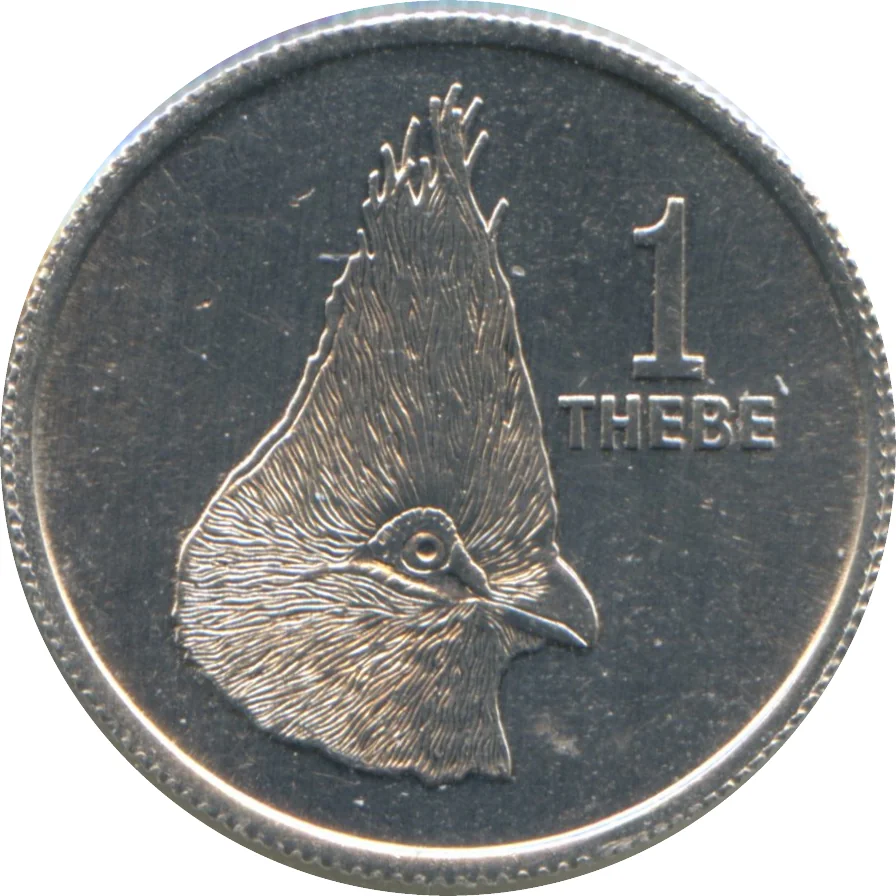
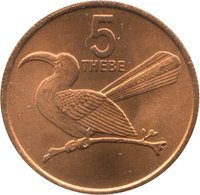
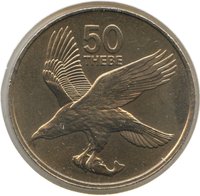
| Animal> Bird |
| Symbols> Coat of Arms |
Mints
| Name | Mark |
|---|---|
| Royal Mint | — |
Mintings
| Year | Mint Mark | Mintage | Quality | Collection |
|---|---|---|---|---|
| 1976 | — | 14,433,000 | ||
| 1976 | — | 16,742 | Proof | |
| 1981 | — | 10,000 | Proof | |
| 1983 | — | 5,000,000 | ||
| 1984 | — | 5,000,000 | ||
| 1985 | — | — | ||
| 1987 | — | — | ||
| 1988 | — | — | ||
| 1989 | — | — | ||
| 1991 | — | — |
Historical background
In 1976, Botswana's currency situation was defined by its recent and successful transition to monetary independence. Just five years prior, in 1971, the country had replaced the South African Rand with its own currency, the Pula. This move was a profound statement of economic sovereignty, strategically decoupling Botswana from the direct monetary influence of its politically contentious and economically dominant neighbor, apartheid South Africa. The establishment of the Bank of Botswana in 1975 further solidified this independence, creating a central monetary authority to manage the new currency and the nation's reserves.
The Pula was introduced at par with the Rand, maintaining a crucial link within the Southern African Customs Union (SACU) but under Botswana's own control. By 1976, the currency was stable and well-managed, underpinned by conservative fiscal policies and the growing revenues from the nascent diamond mining sector, which had begun production at the Orapa mine in 1971. This diamond wealth provided a critical foundation of confidence, allowing the government to build foreign exchange reserves and avoid the inflationary pressures and deficits that plagued many other developing nations.
Thus, in 1976, Botswana presented a rare African case study of prudent monetary management and deliberate nation-building through currency. The Pula stood as a symbol of stability and self-determination, carefully insulated by growing diamond revenues and managed by newly established, robust institutions. This strong foundation positioned Botswana to navigate the global economic turbulence of the 1970s and set the stage for its subsequent decades of remarkable economic growth.
The Pula was introduced at par with the Rand, maintaining a crucial link within the Southern African Customs Union (SACU) but under Botswana's own control. By 1976, the currency was stable and well-managed, underpinned by conservative fiscal policies and the growing revenues from the nascent diamond mining sector, which had begun production at the Orapa mine in 1971. This diamond wealth provided a critical foundation of confidence, allowing the government to build foreign exchange reserves and avoid the inflationary pressures and deficits that plagued many other developing nations.
Thus, in 1976, Botswana presented a rare African case study of prudent monetary management and deliberate nation-building through currency. The Pula stood as a symbol of stability and self-determination, carefully insulated by growing diamond revenues and managed by newly established, robust institutions. This strong foundation positioned Botswana to navigate the global economic turbulence of the 1970s and set the stage for its subsequent decades of remarkable economic growth.
Series: 1976 Botswana circulation coins
🌱 Very Common