


10 centésimos – Uruguay
Add to wishlist
Uruguay
Context
Year: 1936
Issuer: Uruguay
Period:
(since 1825)
Currency:
(1863—1975)
Demonetization: 1 July 1975
Total mintage: 2,000,000
Material
Diameter: 25 mm
Weight: 6 g
Thickness: 1.67 mm
Shape: Round
Composition: Aluminium bronze
Magnetic: No
Technique: Milled
Alignment: Coin alignment
flip

References
KM: #
Numista: #4368
Value
Exchange value: 0.10 UYP
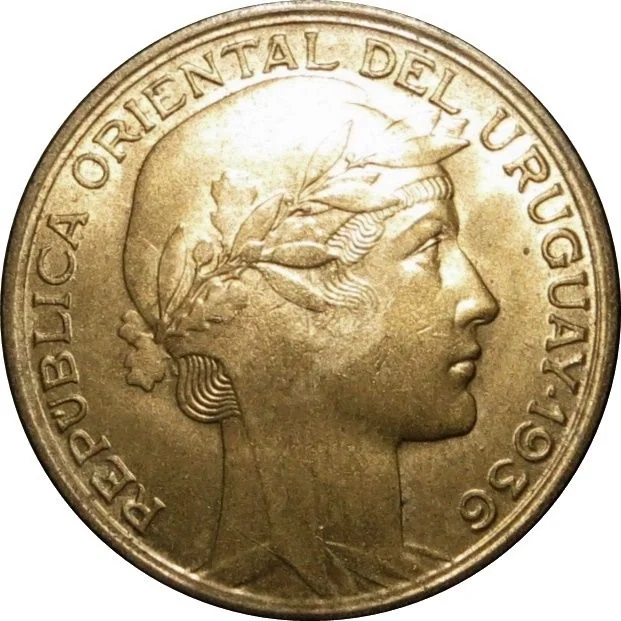
Obverse
Description:
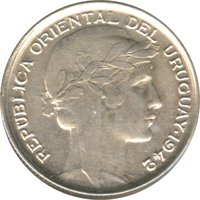
Marianne allegory facing right.
Inscription:
REPUBLICA ORIENTAL DEL URUGUAY 1936
Translation:
Eastern Republic of Uruguay 1936
Script: Latin
Language: Spanish
Engraver: Pierre-Alexandre Morlon
Reverse
Edge
Reeded
Mints
| Name | Mark |
|---|---|
| Münze Österreich | — |
Mintings
| Year | Mint Mark | Mintage | Quality | Collection |
|---|---|---|---|---|
| 1936 | A | 2,000,000 |
Historical background
In 1936, Uruguay's currency situation was characterized by the lingering effects of the Great Depression and a significant shift in monetary policy. The country had abandoned the gold standard in 1929, and by the early 1930s, it faced a severe balance of payments crisis, falling export revenues for its key wool and meat products, and a depletion of gold reserves. In response, the government under President Gabriel Terra, who had come to power through a coup in 1933, implemented strict exchange controls in 1934. These controls created a complex system with multiple, artificially set exchange rates for different types of transactions, aiming to conserve foreign currency and protect domestic industry.
This system led to the creation of a parallel black market for foreign exchange, as the official rates often did not reflect economic realities. The peso became increasingly overvalued at the official commercial rate, discouraging vital agricultural exports, while importers and others sought dollars on the illicit market at a premium. This duality created distortions, rent-seeking opportunities, and administrative burdens. The government's primary tool was the Comisión de Cambios, which had broad authority to allocate scarce U.S. dollars and British sterling, often favoring essential imports and debt servicing.
The year 1936 itself did not see a major reform but represented a period of operation under this controlled regime. The system was a hallmark of the terra era's statist and interventionist economic approach, which also included high tariffs and industrial promotion. While it provided short-term stability and helped avoid the banking collapses seen elsewhere, the multiple exchange rate regime stifled the export sector and became a persistent feature of Uruguay's economy for decades, only fully liberalized much later in the 20th century. The situation in 1936 thus reflects a nation prioritizing internal control and industrial development over free convertibility, at the cost of market efficiency and long-term export competitiveness.
This system led to the creation of a parallel black market for foreign exchange, as the official rates often did not reflect economic realities. The peso became increasingly overvalued at the official commercial rate, discouraging vital agricultural exports, while importers and others sought dollars on the illicit market at a premium. This duality created distortions, rent-seeking opportunities, and administrative burdens. The government's primary tool was the Comisión de Cambios, which had broad authority to allocate scarce U.S. dollars and British sterling, often favoring essential imports and debt servicing.
The year 1936 itself did not see a major reform but represented a period of operation under this controlled regime. The system was a hallmark of the terra era's statist and interventionist economic approach, which also included high tariffs and industrial promotion. While it provided short-term stability and helped avoid the banking collapses seen elsewhere, the multiple exchange rate regime stifled the export sector and became a persistent feature of Uruguay's economy for decades, only fully liberalized much later in the 20th century. The situation in 1936 thus reflects a nation prioritizing internal control and industrial development over free convertibility, at the cost of market efficiency and long-term export competitiveness.
🌱 Common