

4 centésimos – Uruguay
Add to wishlist
Uruguay
Context
Year: 1869
Issuer: Uruguay
Issuing organization: Bank of Oriental Republic of Uruguay
Period:
(since 1825)
Currency:
(1863—1975)
Demonetization: 14 July 1902
Total mintage: 2,000,000
Material
References
KM: #
Numista: #4359
Value
Exchange value: 0.04 UYP
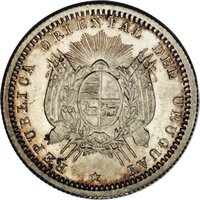
Obverse
Description:
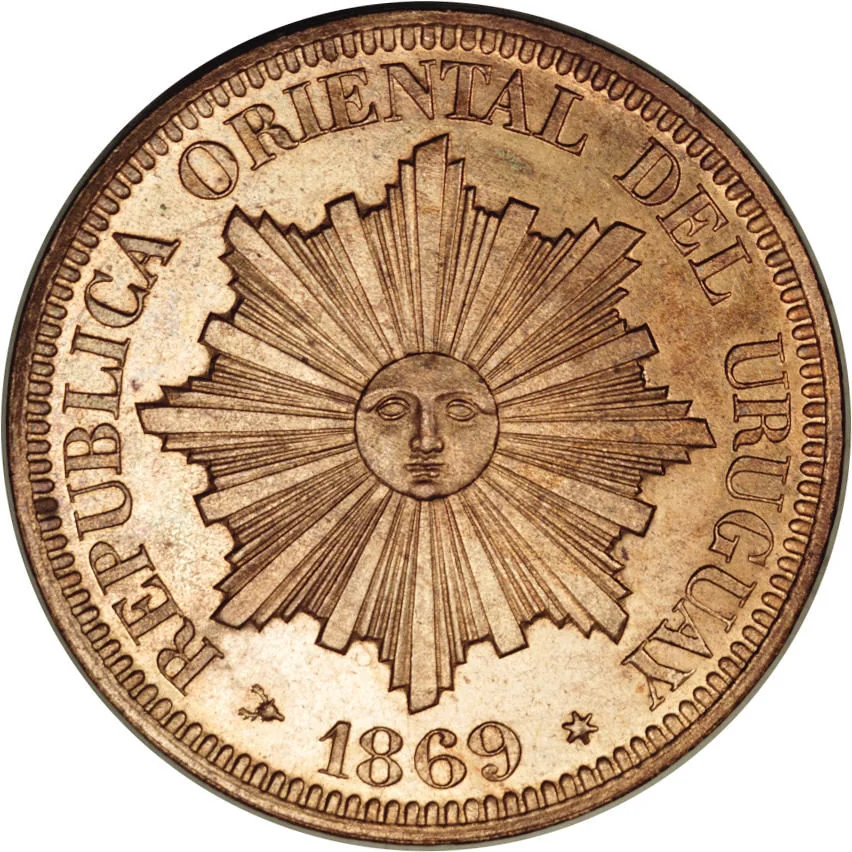
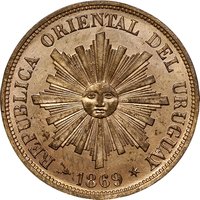
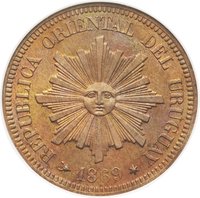
Sun-faced radiant sun, country name encircling, date below.
Inscription:
REPUBLICA ORIENTAL DEL URUGUAY
1869
1869
Translation:
ORIENTAL REPUBLIC OF URUGUAY
1869
1869
Script: Latin
Language: Spanish
Engraver: Ernest Paulin Tasset
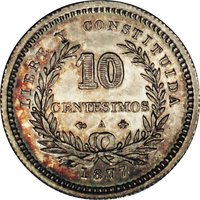
Reverse
Description:
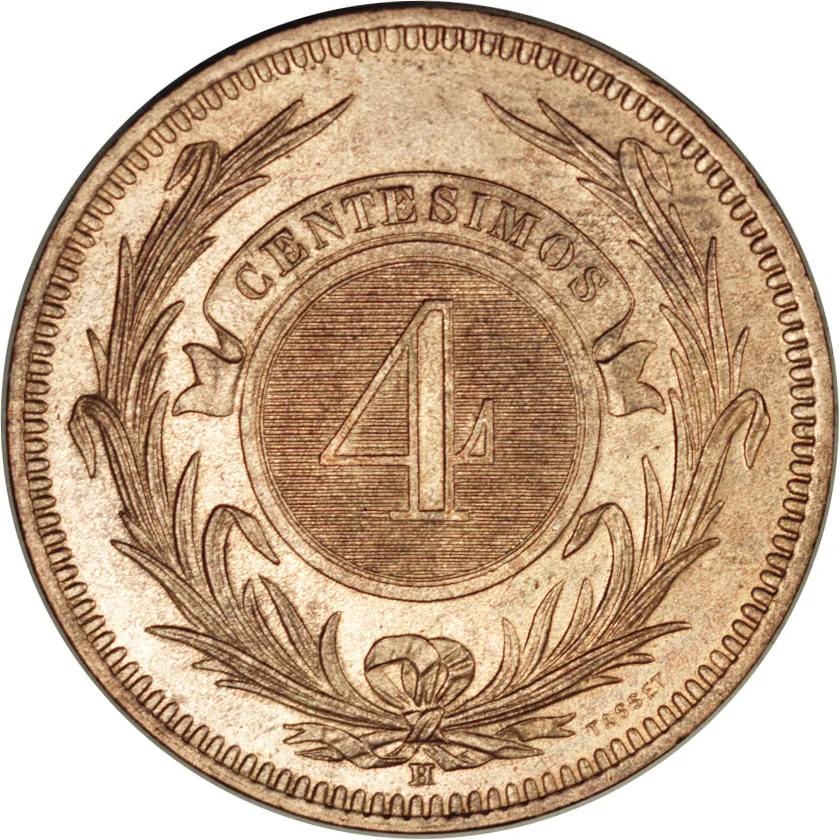
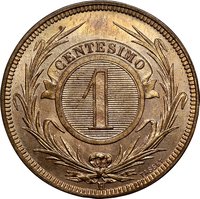
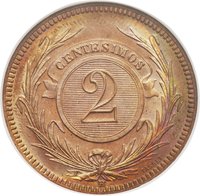
Reeded circle within laurel wreath, denomination above, mint mark below.
Inscription:
CENTESIMOS
4
H
TASSET
4
H
TASSET
Translation:
Four centesimos. H. Tasset.
Script: Latin
Language: Spanish
Engraver: Ernest Paulin Tasset
Edge
Plain
Mints
| Name | Mark |
|---|---|
| Monnaie de Paris | A |
| Heaton and Sons / The Mint Birmingham | H |
Historical background
In 1869, Uruguay's currency situation was characterized by profound instability and fragmentation, a direct legacy of the ongoing Guerra Grande (1839-1851) and subsequent political turmoil. The national treasury was depleted, and the government, lacking strong central authority and fiscal discipline, resorted heavily to the issuance of inconvertible paper money to finance its operations. This led to a chaotic monetary landscape where multiple forms of money circulated simultaneously: devalued government-issued pesos, currencies from previous regimes, and even currencies from neighboring countries like Brazil and Argentina, which held significant economic influence.
The core problem was the severe depreciation of the paper peso against gold and silver. By 1869, the paper peso had lost a substantial portion of its value, creating a sharp divergence between the "peso fuerte" (strong peso, tied to metal) and the vastly depreciated paper currency in daily use. This exchange rate volatility crippled domestic and international trade, created price unpredictability, and eroded public trust in the government's financial promises. The situation was exacerbated by counterfeiting and the circulation of private tokens issued by merchants and estancias to facilitate local transactions in the absence of reliable small change.
This monetary anarchy was a critical concern for the government of President Lorenzo Batlle, who was attempting to consolidate state power and modernize the economy. The currency crisis of 1869 underscored the urgent need for monetary reform, a challenge that would be directly addressed in the following decade. It set the stage for the pivotal reforms of the 1870s, most notably the creation of the Banco Nacional in 1869 and, later, the implementation of the Ley de Conversión (Conversion Law) of 1876, which aimed to stabilize and unify the currency by establishing a new, convertible peso.
The core problem was the severe depreciation of the paper peso against gold and silver. By 1869, the paper peso had lost a substantial portion of its value, creating a sharp divergence between the "peso fuerte" (strong peso, tied to metal) and the vastly depreciated paper currency in daily use. This exchange rate volatility crippled domestic and international trade, created price unpredictability, and eroded public trust in the government's financial promises. The situation was exacerbated by counterfeiting and the circulation of private tokens issued by merchants and estancias to facilitate local transactions in the absence of reliable small change.
This monetary anarchy was a critical concern for the government of President Lorenzo Batlle, who was attempting to consolidate state power and modernize the economy. The currency crisis of 1869 underscored the urgent need for monetary reform, a challenge that would be directly addressed in the following decade. It set the stage for the pivotal reforms of the 1870s, most notably the creation of the Banco Nacional in 1869 and, later, the implementation of the Ley de Conversión (Conversion Law) of 1876, which aimed to stabilize and unify the currency by establishing a new, convertible peso.
🌱 Common