

1 Rigsbankskilling – Denmark
Denmark
Context

Material
References
KM: #Click to copy to clipboard754
Numista: #43524
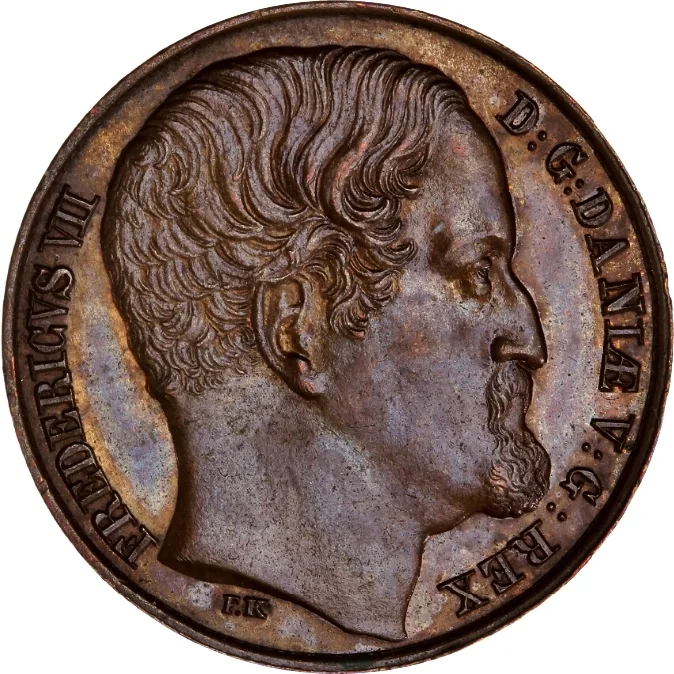
Obverse
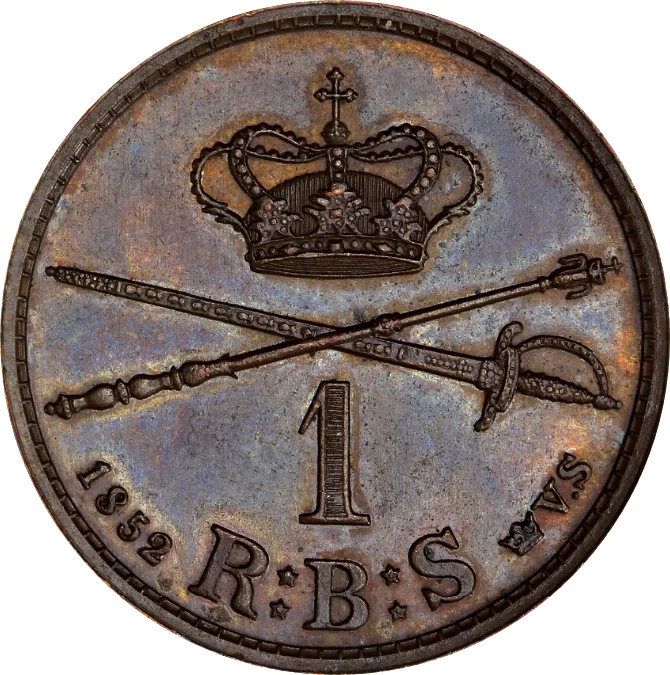
Reverse
Description:
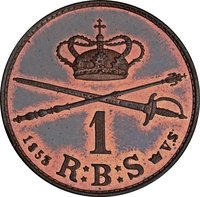
Crown above crossed sword and scepter; value and date left, mintmarks right.
Inscription:
1
1852 R:B:S ♔ V.S
1852 R:B:S ♔ V.S
Script: Latin
Edge
Mints
| Name | Mark |
|---|---|
| Royal Danish Mint | ♔ |
Mintings
| Year | Mint Mark | Mintage | Quality | Collection |
|---|---|---|---|---|
| 1852 | ♔ | — |
Historical background
In 1852, Denmark’s currency system was in a state of transition, caught between the old and the emerging European monetary order. The country was part of the Scandinavian Monetary Union in spirit but not yet in law, as the formal union with Sweden and Norway would not be established until 1873. Domestically, Denmark operated on a silver standard, with the rigsdaler as the primary unit of account. However, the system was complex and fragmented, using both rigsdaler courant (for domestic paper money) and rigsdaler specie (for silver coin), with a fixed but cumbersome exchange rate between them.
This period was marked by significant monetary instability. The First Schleswig War (1848-1851) had just concluded, leaving the Danish state with substantial debt and a reliance on inconvertible paper money (rigsdaler courant), which had depreciated significantly against silver. This created practical difficulties for trade and finance, as the public lacked confidence in the paper currency. Furthermore, the discovery of large gold reserves in California and Australia in the late 1840s was beginning to disrupt the global silver standard, putting indirect pressure on Denmark’s silver-based system and hinting at the future shift to gold.
Consequently, the early 1850s were a formative prelude to major reform. Danish policymakers and economists were actively debating the need for a stable, unified, and modern currency system to facilitate economic recovery and integration with key trading partners. The discussions and experiments of this era, including attempts to stabilize the relationship between paper and silver, laid the essential groundwork for the far-reaching reforms that would culminate two decades later with Denmark’s entry into the Scandinavian Monetary Union based on a new gold standard and the introduction of the krone.
This period was marked by significant monetary instability. The First Schleswig War (1848-1851) had just concluded, leaving the Danish state with substantial debt and a reliance on inconvertible paper money (rigsdaler courant), which had depreciated significantly against silver. This created practical difficulties for trade and finance, as the public lacked confidence in the paper currency. Furthermore, the discovery of large gold reserves in California and Australia in the late 1840s was beginning to disrupt the global silver standard, putting indirect pressure on Denmark’s silver-based system and hinting at the future shift to gold.
Consequently, the early 1850s were a formative prelude to major reform. Danish policymakers and economists were actively debating the need for a stable, unified, and modern currency system to facilitate economic recovery and integration with key trading partners. The discussions and experiments of this era, including attempts to stabilize the relationship between paper and silver, laid the essential groundwork for the far-reaching reforms that would culminate two decades later with Denmark’s entry into the Scandinavian Monetary Union based on a new gold standard and the introduction of the krone.
🌟 Limited