

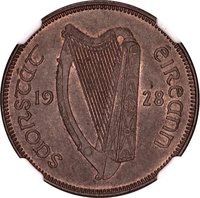
Obverse
Description:
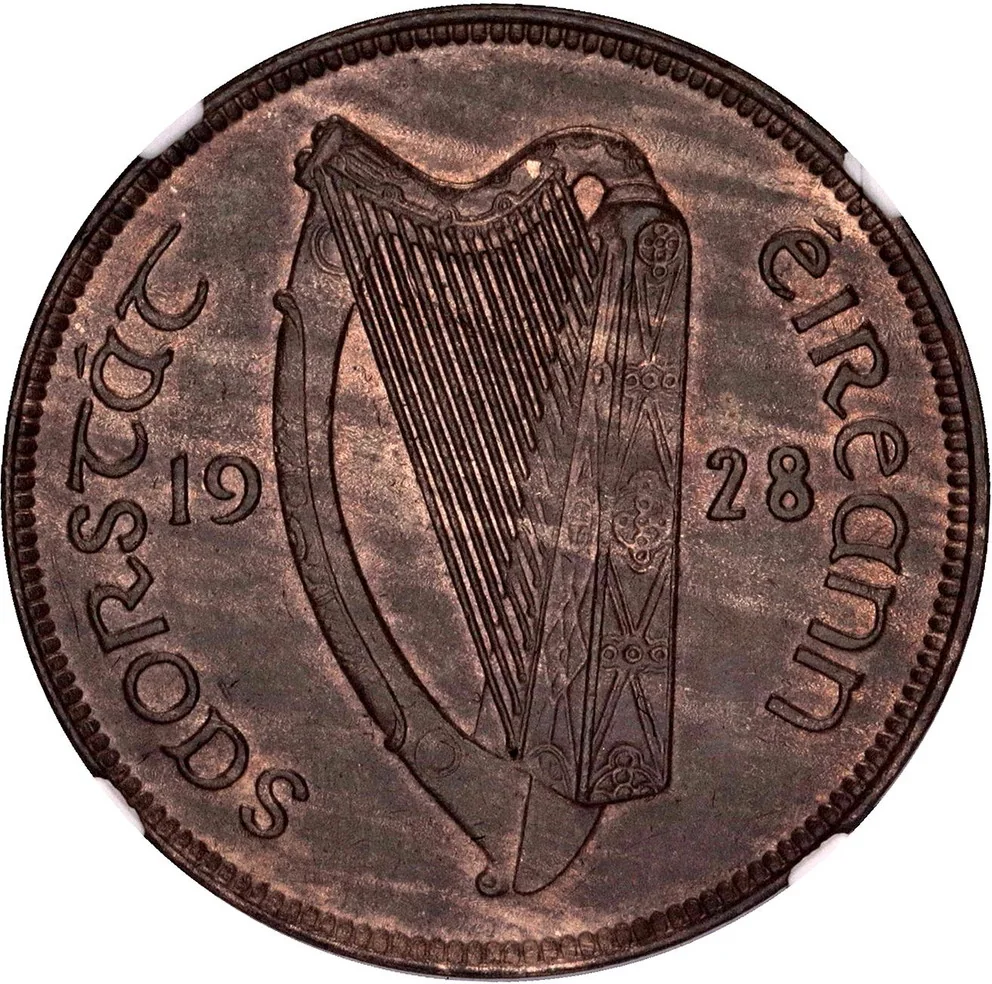
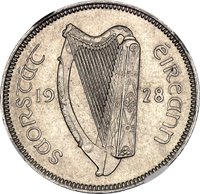
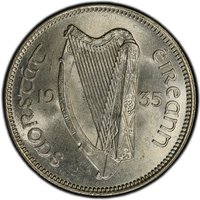
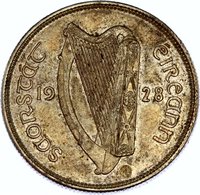
Gaelic harp
Inscription:
saorstát
éireann
1928
éireann
1928
Translation:
Free State
of Ireland
1928
of Ireland
1928
Script: Latin (Gaelic)
Language: Irish
Engraver: Percy Metcalfe
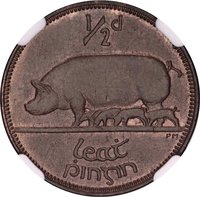
Reverse
Description:
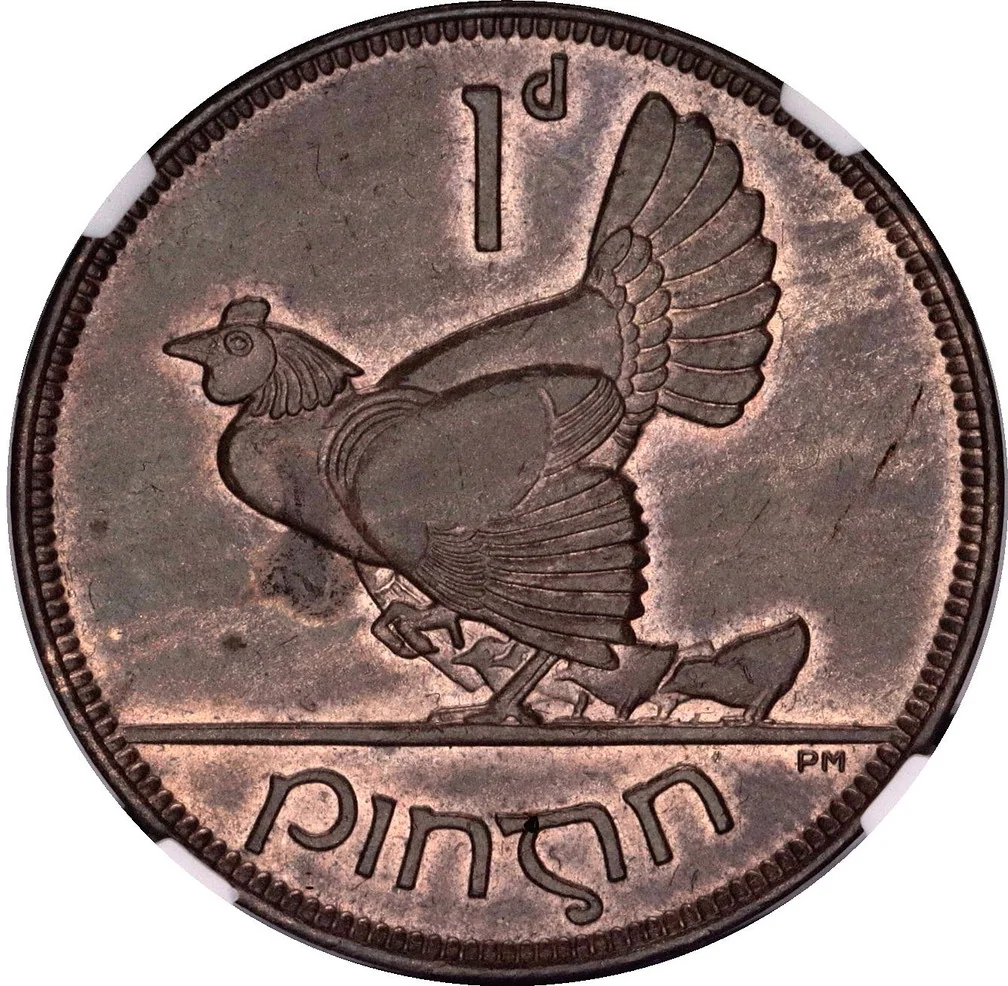
Hen and chicks facing left.
Inscription:
1d
pingin
pingin
Script: Latin (Gaelic)
Engraver: Percy Metcalfe
Edge
Plain
Mints
| Name | Mark |
|---|---|
| Royal Mint (Tower Hill) | — |
Mintings
| Year | Mint Mark | Mintage | Quality | Collection |
|---|---|---|---|---|
| 1928 | — | 6,001 | Proof | |
| 1928 | — | 9,000,000 | ||
| 1931 | — | 2,400,000 | ||
| 1931 | — | — | Proof | |
| 1933 | — | 1,680,000 | ||
| 1933 | — | — | Proof | |
| 1935 | — | — | Proof | |
| 1935 | — | 5,472,000 | ||
| 1937 | — | 5,400,000 | ||
| 1937 | — | — | Proof |
Historical background
In 1928, the currency situation in Ireland was one of transition and consolidation following the foundation of the Irish Free State. Although politically independent since 1922, the country remained within the British monetary sphere, with the Irish pound (or punt) pegged at par with the British pound sterling. British banknotes and coins continued to circulate freely alongside notes issued by Irish commercial banks, creating a de facto shared currency area. This arrangement provided stability but was a visible reminder of continued economic dependence on Britain.
The state was actively laying the groundwork for greater monetary sovereignty. The Currency Act of 1927 was the pivotal piece of legislation, coming into full effect in 1928. It established a new, distinct Irish currency called the Saorstát pound (Free State pound) and created the Currency Commission to manage it. The Act introduced a new legal tender backed by a pound-for-pound reserve of gold and British securities held in London, ensuring the parity with sterling was legally and securely maintained. This "sterling link" was a deliberate choice to avoid exchange risk with Ireland's largest trading partner.
Consequently, 1928 saw the first issuance of the Free State's own consolidated banknotes, which began to replace the heterogeneous notes of the private banks. However, this was a gradual process, and British currency remained legally acceptable. Thus, the situation was characterised by a careful duality: the creation of a symbolic national currency that asserted identity, while a conservative, stability-focused policy explicitly tethering it to sterling dominated the economic reality. The system established in 1928 would define Irish monetary policy for the next fifty years until the break with sterling in 1979.
The state was actively laying the groundwork for greater monetary sovereignty. The Currency Act of 1927 was the pivotal piece of legislation, coming into full effect in 1928. It established a new, distinct Irish currency called the Saorstát pound (Free State pound) and created the Currency Commission to manage it. The Act introduced a new legal tender backed by a pound-for-pound reserve of gold and British securities held in London, ensuring the parity with sterling was legally and securely maintained. This "sterling link" was a deliberate choice to avoid exchange risk with Ireland's largest trading partner.
Consequently, 1928 saw the first issuance of the Free State's own consolidated banknotes, which began to replace the heterogeneous notes of the private banks. However, this was a gradual process, and British currency remained legally acceptable. Thus, the situation was characterised by a careful duality: the creation of a symbolic national currency that asserted identity, while a conservative, stability-focused policy explicitly tethering it to sterling dominated the economic reality. The system established in 1928 would define Irish monetary policy for the next fifty years until the break with sterling in 1979.
Series: 1928 Ireland circulation coins
🌱 Very Common