

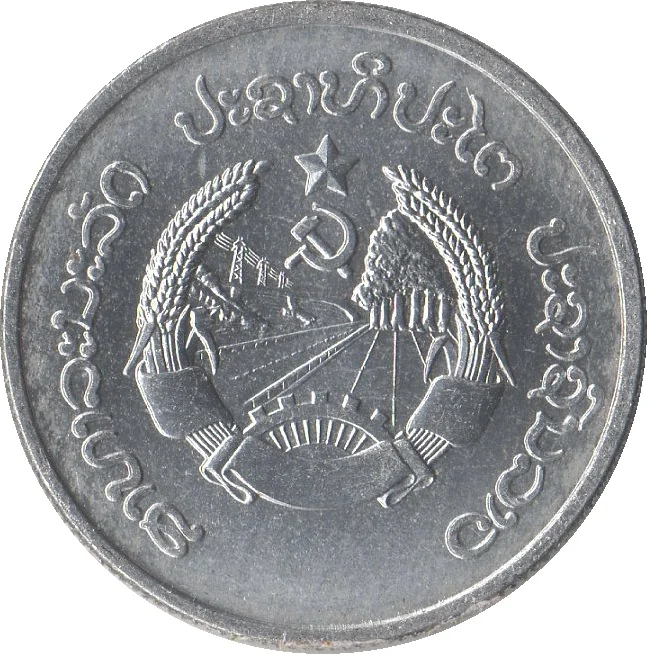
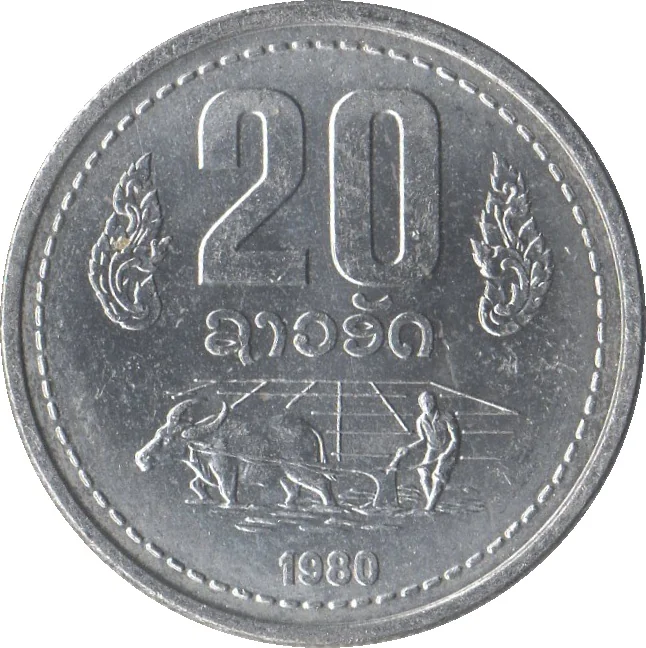
20 Att – Laos
Laos
Context

Material
Diameter: 23 mm
Weight: 1.55 g
Thickness: 1.8 mm
Shape: Round
Composition: Aluminium
Standard: Gold twentieth ounce
Magnetic: No
Technique: Milled
Alignment: Medal alignment
flip
References
KM: #Click to copy to clipboard23
Numista: #4319
Value
Exchange value: 0.20 LAK
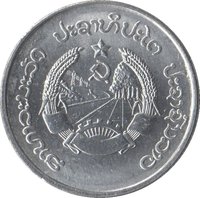
Obverse
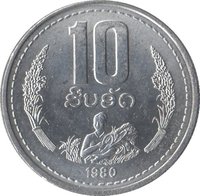
Reverse
Edge
Milled
Categories
| Animal> Cow |
| Symbols> Coat of Arms |
| Agriculture |
| Symbol> Hammer and sickle |
Mintings
| Year | Mint Mark | Mintage | Quality | Collection |
|---|---|---|---|---|
| 1980 | — | — |
Historical background
In 1980, the Lao economy and its currency, the Kip (LAK), were in a state of severe crisis, deeply entangled with the country's political transformation and socialist restructuring. Following the Pathet Lao's victory in 1975, the new Lao People's Democratic Republic (LPDR) government embarked on a rapid and poorly planned collectivization of agriculture and nationalization of industry, which crippled production and led to widespread shortages. This economic collapse, combined with the government's practice of financing its budget deficits by printing money, triggered hyperinflation, rendering the Kip nearly worthless for everyday transactions.
The currency situation was characterized by a complex and ineffective multi-tier exchange rate system. The government maintained an official fixed rate, which was vastly overvalued and used only for state planning and a limited number of government transactions. Alongside this existed a more realistic "free market" rate in Vientiane and other urban centers, where the Kip traded at a fraction of its official value, and a thriving black market where most real commerce took place. This fragmentation created massive distortions, encouraged corruption, and severely hampered both domestic trade and any potential for foreign investment, as the state struggled to control the economy through administrative fiat rather than market mechanisms.
Internationally, Laos remained isolated, with limited access to hard currency reserves. The government's primary response to the monetary chaos was a series of abrupt and confidence-eroding currency reforms, notably in 1976 and 1979, where old Kip notes were replaced with new ones at unfavourable rates, effectively confiscating private savings. By 1980, these measures had failed to stabilize the situation, and the Kip's precipitous decline continued. This dire economic backdrop set the stage for the hesitant, initial shifts toward economic liberalization that would begin in the mid-1980s with the announcement of the "New Economic Mechanism."
The currency situation was characterized by a complex and ineffective multi-tier exchange rate system. The government maintained an official fixed rate, which was vastly overvalued and used only for state planning and a limited number of government transactions. Alongside this existed a more realistic "free market" rate in Vientiane and other urban centers, where the Kip traded at a fraction of its official value, and a thriving black market where most real commerce took place. This fragmentation created massive distortions, encouraged corruption, and severely hampered both domestic trade and any potential for foreign investment, as the state struggled to control the economy through administrative fiat rather than market mechanisms.
Internationally, Laos remained isolated, with limited access to hard currency reserves. The government's primary response to the monetary chaos was a series of abrupt and confidence-eroding currency reforms, notably in 1976 and 1979, where old Kip notes were replaced with new ones at unfavourable rates, effectively confiscating private savings. By 1980, these measures had failed to stabilize the situation, and the Kip's precipitous decline continued. This dire economic backdrop set the stage for the hesitant, initial shifts toward economic liberalization that would begin in the mid-1980s with the announcement of the "New Economic Mechanism."
🌱 Very Common