

5 kroner – Greenland
Add to wishlist
Denmark
Context
Year: 1944
Country: Denmark
Issuer: Greenland
Ruler: Christian X
Currency:
(since 1873)
Demonetized: Yes
Total mintage: 100,000
Material
References
KM: #
Numista: #4289
Value
Exchange value: 5 DKK
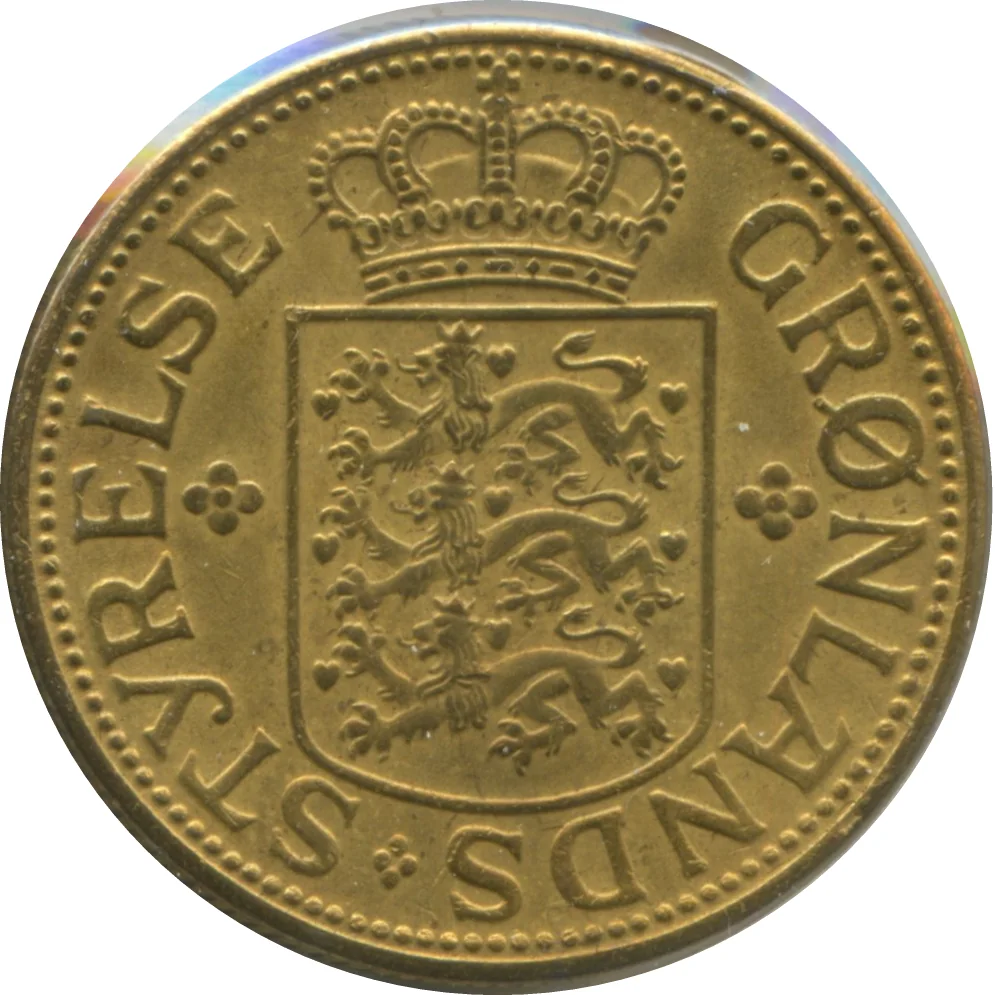
Obverse
Reverse
Description:
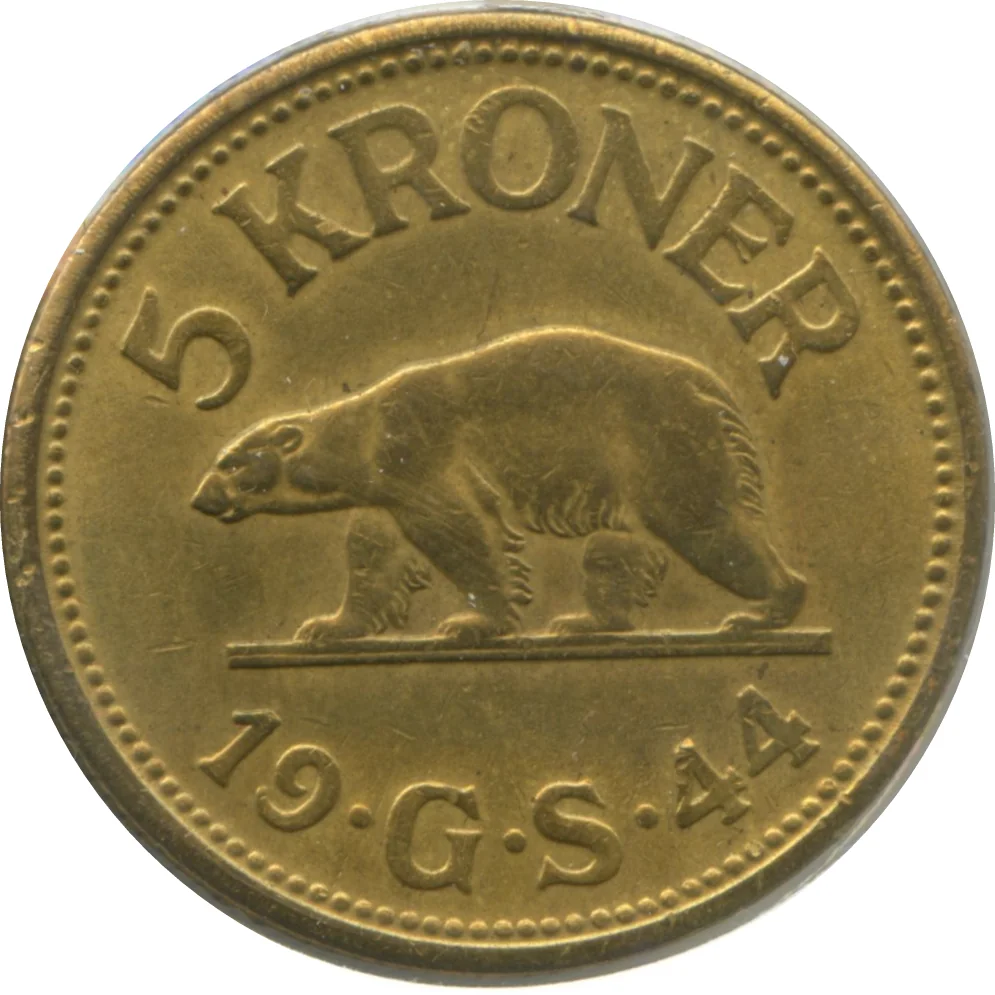
Polar bear walking left. Value above, date and initials below.
Inscription:
5 KRONER
19·G·S·44
19·G·S·44
Script: Latin
Engraver: G. Roberts
Edge
Reeded
Mints
| Name | Mark |
|---|---|
| United States Mint of Philadelphia | — |
Mintings
| Year | Mint Mark | Mintage | Quality | Collection |
|---|---|---|---|---|
| 1944 | — | 100,000 |
Historical background
In 1944, Greenland’s currency situation was defined by its unique wartime status as a de facto American protectorate. Following the Nazi occupation of Denmark in 1940, the Danish government-in-exile, with U.S. and Canadian agreement, placed Greenland under American protection to secure its strategic location and cryolite mines vital for aluminum production. This political separation from occupied Denmark created an immediate monetary problem, as the traditional Danish krone was no longer practically accessible, leading to a risk of cash shortages and economic disruption on the island.
To resolve this, a special emergency currency, the Greenlandic krone, was unilaterally introduced by the Danish authorities in 1944. These notes, distinct from mainland Danish kroner, were printed in the United States and served as the sole legal tender on the island. This measure was essential to facilitate local transactions, pay workers (including those at American installations), and prevent economic paralysis, while also deliberately isolating Greenland's monetary system from potential German influence or inflation in occupied Europe.
Thus, the currency situation in 1944 reflected Greenland's paradoxical position: it was symbolically under Danish sovereignty but functionally within the American economic sphere. The Greenlandic krone was a pragmatic solution to an extraordinary circumstance, ensuring monetary stability during the war. It remained in circulation until 1953, when a gradual return to the standard Danish krone was completed, reintegrating Greenland’s economy with Denmark’s in the postwar era.
To resolve this, a special emergency currency, the Greenlandic krone, was unilaterally introduced by the Danish authorities in 1944. These notes, distinct from mainland Danish kroner, were printed in the United States and served as the sole legal tender on the island. This measure was essential to facilitate local transactions, pay workers (including those at American installations), and prevent economic paralysis, while also deliberately isolating Greenland's monetary system from potential German influence or inflation in occupied Europe.
Thus, the currency situation in 1944 reflected Greenland's paradoxical position: it was symbolically under Danish sovereignty but functionally within the American economic sphere. The Greenlandic krone was a pragmatic solution to an extraordinary circumstance, ensuring monetary stability during the war. It remained in circulation until 1953, when a gradual return to the standard Danish krone was completed, reintegrating Greenland’s economy with Denmark’s in the postwar era.
🌟 Uncommon