

5 francs – New Caledonia
Add to wishlist
France
Context
Years: 1983–2019
Country: France
Issuer: New Caledonia
Issuing organization: Overseas Institution of Issue
Period:
(since 1958)
Currency:
(since 1945)
Demonetization: 30 November 2022
Total mintage: 24,031,400
Material
References
KM: #
Numista: #1458
Value
Exchange value: 5 XPF
Inflation-adjusted value: 13.23 XPF
Obverse
Description:
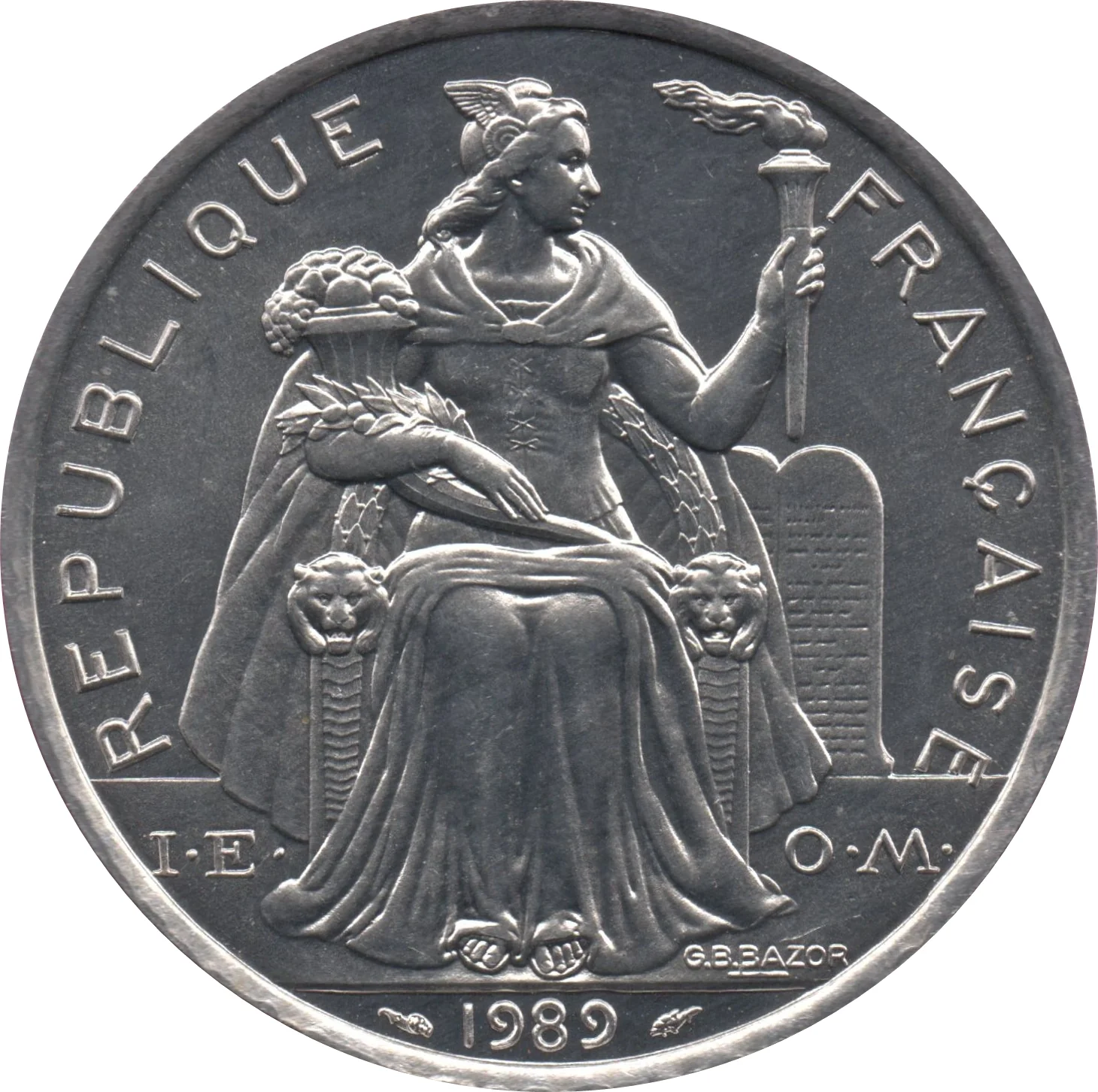
Liberty seated left on throne, holding a lit torch in her left hand and a cornucopia of fruit in her right arm.
Inscription:
REPUBLIQUE FRANÇAISE
I·E· O·M·
G.B.BAZOR
1989
I·E· O·M·
G.B.BAZOR
1989
Translation:
FRENCH REPUBLIC
JESUS, SAVIOUR OF MANKIND
G.B.BAZOR
1989
JESUS, SAVIOUR OF MANKIND
G.B.BAZOR
1989
Script: Latin
Engraver: Lucien Georges Bazor
Reverse
Description:
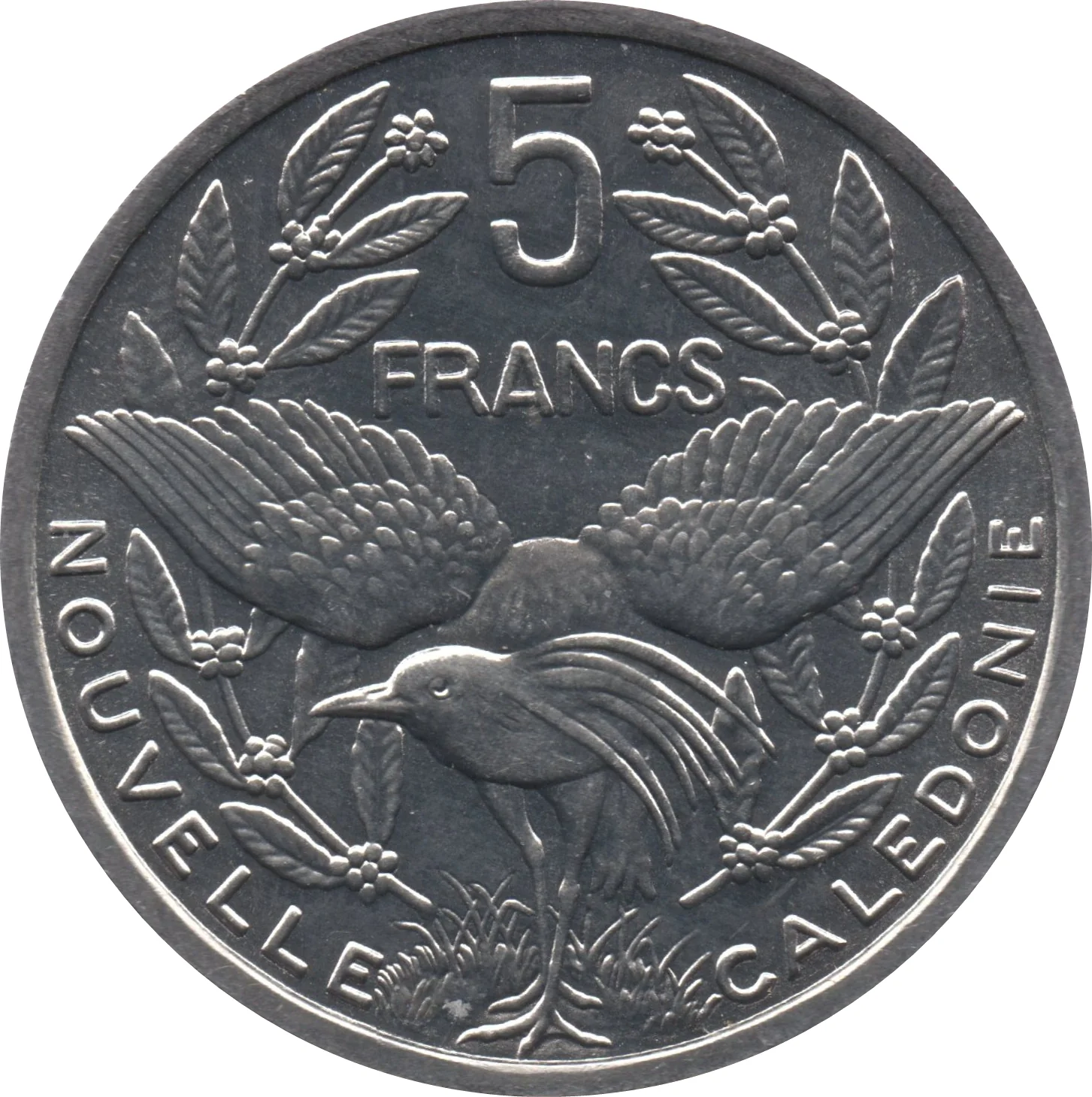
Kagu bird amid sprigs below value.
Inscription:
5
FRANCS
NOUVELLE CALEDONIE
FRANCS
NOUVELLE CALEDONIE
Translation:
5 Francs
New Caledonia
New Caledonia
Script: Latin
Language: French
Engraver: Lucien Georges Bazor
Edge
Plain
Mints
| Name | Mark |
|---|---|
| Monnaie de Paris | — |
Mintings
| Year | Mint Mark | Mintage | Quality | Collection |
|---|---|---|---|---|
| 1983 | — | 500,200 | ||
| 1986 | — | 1,000,000 | ||
| 1989 | — | 500,000 | ||
| 1990 | — | 501,600 | ||
| 1991 | — | 480,000 | ||
| 1992 | — | 480,000 | ||
| 1994 | — | 1,200,000 | ||
| 1996 | — | — | ||
| 1997 | — | 240,000 | ||
| 1998 | — | 120,000 | ||
| 1999 | — | 480,000 | ||
| 2000 | — | 400,800 | ||
| 2001 | — | 600,000 | ||
| 2002 | — | 480,000 | ||
| 2003 | — | 720,000 | ||
| 2004 | — | 960,000 | ||
| 2005 | — | 360,000 | ||
| 2006 | — | 480,000 | ||
| 2007 | — | 960,000 | ||
| 2008 | — | 1,680,000 | ||
| 2009 | — | 1,404,000 | ||
| 2010 | — | 1,620,000 | ||
| 2011 | — | 1,425,600 | ||
| 2012 | — | 316,800 | ||
| 2013 | — | 915,200 | ||
| 2014 | — | 1,126,400 | ||
| 2015 | — | 1,126,400 | ||
| 2016 | — | 1,126,400 | ||
| 2017 | — | 1,267,200 | ||
| 2018 | — | 1,560,800 | ||
| 2019 | — | — |
Historical background
In 1983, New Caledonia's currency situation was intrinsically linked to its political status as a French Overseas Territory (TOM). The sole legal tender was the French Pacific Franc, officially the CFP Franc (Franc des Colonies Françaises du Pacifique, later changed to Change Franc Pacifique). This currency was not independent but part of a broader monetary union, issued by the Institut d’émission d’outre-mer (IEOM), and was pegged at a fixed rate to the French Franc. This arrangement guaranteed monetary stability and facilitated trade with France, the territory's dominant economic partner, but it also symbolized and reinforced New Caledonia's deep economic dependence on the metropole.
Economically, the period was dominated by the boom-and-bust cycle of the nickel industry. The early 1980s followed the crash of the "nickel boom" of the late 1960s and 1970s, leading to a severe recession, high unemployment, and significant social tension. The fixed CFP Franc peg, while ensuring stability, also meant New Caledonia had no autonomous monetary policy to devalue its currency and stimulate exports or tourism during this downturn. The economic hardship disproportionately affected the indigenous Kanak population and migrant workers, exacerbating long-standing grievances over land, inequality, and political representation.
Crucially, the currency issue in 1983 cannot be separated from the escalating political conflict over independence. That year was a pivotal moment, with rising militancy from pro-independence Kanak groups and a hardening of loyalist opposition. The CFP Franc became a point of symbolic contention; for loyalists, it represented secure ties to France and economic modernity, while for many independence supporters, it was a tool of continued colonial control. The debate over a potential independent currency was a subtext in the broader negotiations, foreshadowing the profound political violence of the mid-1980s and underscoring how monetary sovereignty was viewed as inseparable from national sovereignty.
Economically, the period was dominated by the boom-and-bust cycle of the nickel industry. The early 1980s followed the crash of the "nickel boom" of the late 1960s and 1970s, leading to a severe recession, high unemployment, and significant social tension. The fixed CFP Franc peg, while ensuring stability, also meant New Caledonia had no autonomous monetary policy to devalue its currency and stimulate exports or tourism during this downturn. The economic hardship disproportionately affected the indigenous Kanak population and migrant workers, exacerbating long-standing grievances over land, inequality, and political representation.
Crucially, the currency issue in 1983 cannot be separated from the escalating political conflict over independence. That year was a pivotal moment, with rising militancy from pro-independence Kanak groups and a hardening of loyalist opposition. The CFP Franc became a point of symbolic contention; for loyalists, it represented secure ties to France and economic modernity, while for many independence supporters, it was a tool of continued colonial control. The debate over a potential independent currency was a subtext in the broader negotiations, foreshadowing the profound political violence of the mid-1980s and underscoring how monetary sovereignty was viewed as inseparable from national sovereignty.
🌱 Very Common