

Obverse
Description:
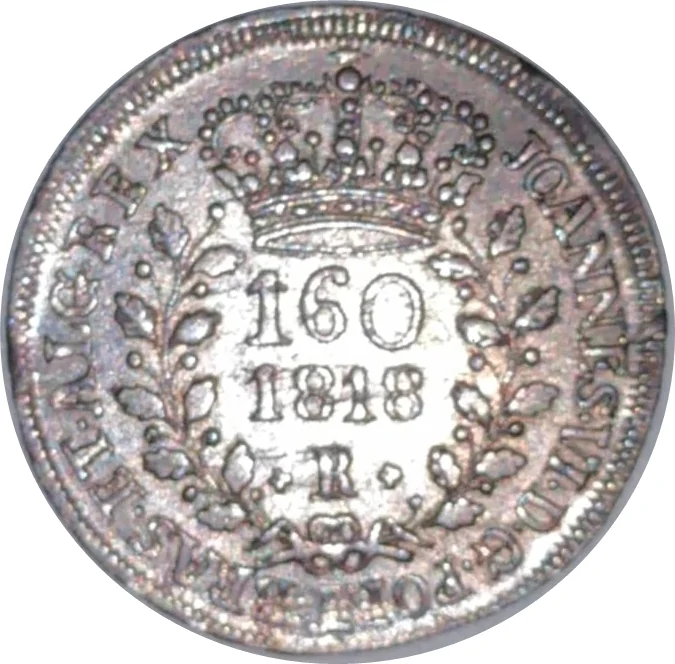
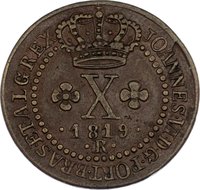
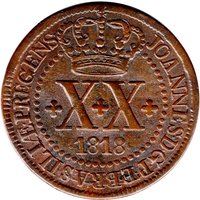
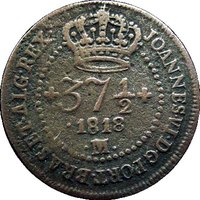
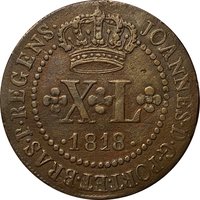
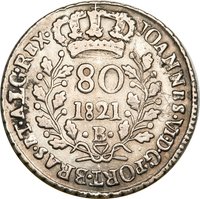
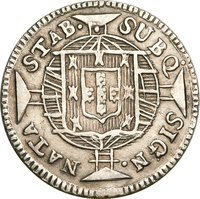
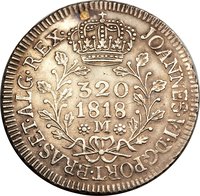
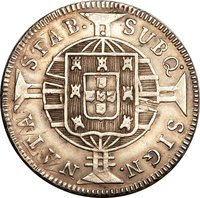
JOANNES VI D.G. PORT. BRAS. ET ALG. REX legend around edge. Center: 160 under crown, date 1818 above, mint letter R between flowering trees, flanked by coffee branches.
Inscription:
JOANNES•VI•D•G•PORT•BRAS•ET•ALG•REX•
160
1818
* R *
160
1818
* R *
Translation:
John VI, by the Grace of God, King of Portugal, Brazil, and the Algarves.
160
1818
* R *
160
1818
* R *
Script: Latin
Language: Latin
Reverse
Edge
Reeded
Categories
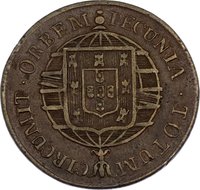
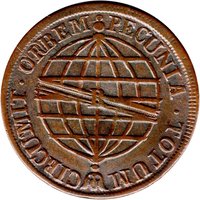
| Symbols> Coat of Arms |
Mints
| Name | Mark |
|---|---|
| Bahia | B |
| Casa da Moeda do Brasil | R |
Historical background
In 1818, Brazil's currency situation was characterized by scarcity, complexity, and the lingering effects of its colonial economic structure. The official currency was the real (plural: réis), a system inherited from Portugal. However, a severe shortage of minted coinage plagued the economy, leading to widespread use of a confusing array of foreign coins—primarily Spanish-American pesos and Portuguese réis—which circulated alongside locally produced tokens and even commodity money in remote regions. This monetary fragmentation hindered commerce and created constant difficulties in exchange and pricing.
The underlying cause of this scarcity was Brazil's position within the Portuguese Empire. For centuries, Lisbon had enforced a mercantilist policy, draining gold and other resources to the metropole while limiting local minting capacity. Although the arrival of the Portuguese Royal Court in 1808 had opened Brazilian ports and elevated the colony to a kingdom united with Portugal in 1815, it did not immediately resolve the deep-seated monetary issues. The Banco do Brasil, founded in 1808 to help finance the state, began issuing paper notes, but these were not yet a trusted or dominant medium for everyday transactions.
Consequently, the monetary landscape in 1818 was one of transition and strain. The economy was expanding, especially with the booming coffee sector, but it was stifled by an inadequate and chaotic currency system. This instability reflected the broader political tensions of the era, as Brazil stood on the cusp of its independence movement (achieved in 1822), which would soon force the new nation to confront and eventually reform its fragile financial foundations.
The underlying cause of this scarcity was Brazil's position within the Portuguese Empire. For centuries, Lisbon had enforced a mercantilist policy, draining gold and other resources to the metropole while limiting local minting capacity. Although the arrival of the Portuguese Royal Court in 1808 had opened Brazilian ports and elevated the colony to a kingdom united with Portugal in 1815, it did not immediately resolve the deep-seated monetary issues. The Banco do Brasil, founded in 1808 to help finance the state, began issuing paper notes, but these were not yet a trusted or dominant medium for everyday transactions.
Consequently, the monetary landscape in 1818 was one of transition and strain. The economy was expanding, especially with the booming coffee sector, but it was stifled by an inadequate and chaotic currency system. This instability reflected the broader political tensions of the era, as Brazil stood on the cusp of its independence movement (achieved in 1822), which would soon force the new nation to confront and eventually reform its fragile financial foundations.
Series: 1818 Brazil circulation coins
💎 Extremely Rare