

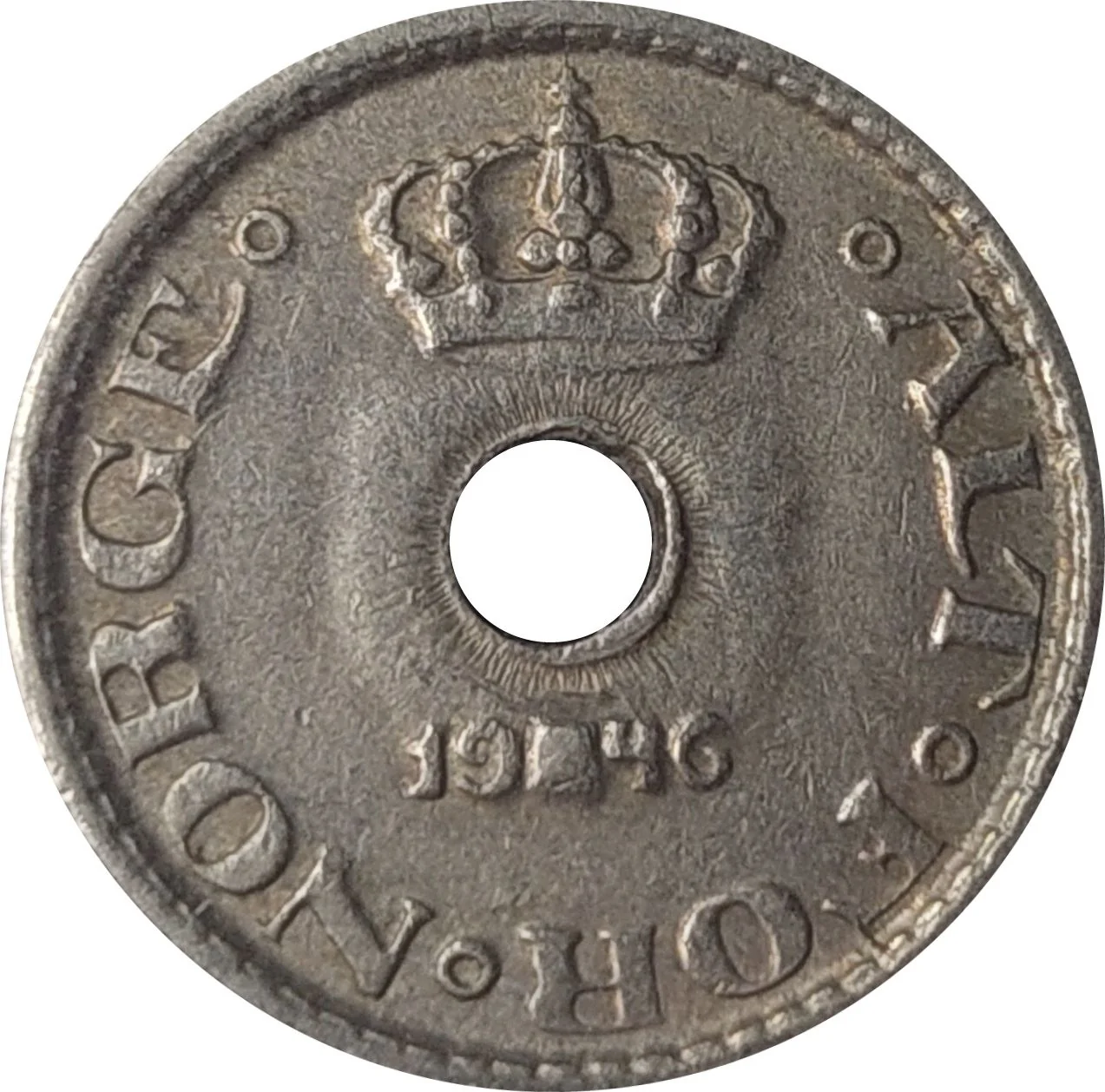
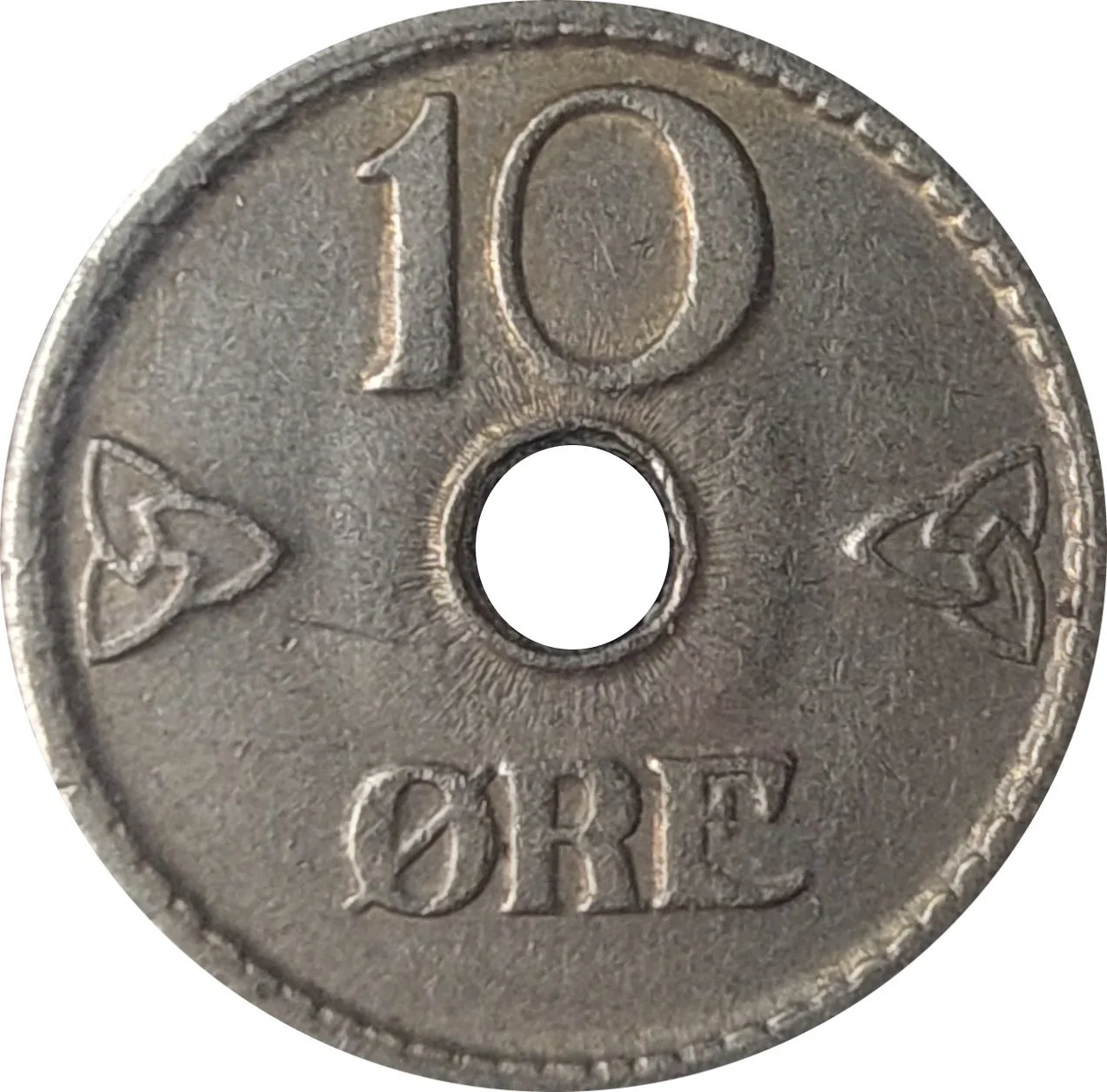
10 øre – Norway
Add to wishlist
Norway
Context
Years: 1924–1951
Issuer: Norway
Ruler: Haakon VII
Currency:
(since 1875)
Demonetized: Yes
Total mintage: 88,818,900
Material
Diameter: 15 mm
Weight: 1.5 g
Thickness: 1.25 mm
Shape: Round with a round hole
Composition: Copper-nickel
Technique: Milled
Alignment: Medal alignment
flip
References
KM: #
Numista: #1456
Value
Exchange value: 0.1 NOK
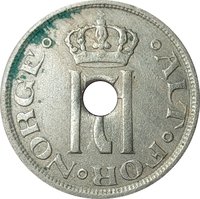
Obverse
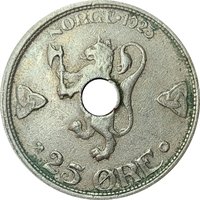
Reverse
Edge
Plain
Mints
| Name | Mark |
|---|---|
| Norwegian Mint | — |
Mintings
| Year | Mint Mark | Mintage | Quality | Collection |
|---|---|---|---|---|
| 1924 | — | 12,079,100 | ||
| 1925 | — | 7,050,700 | ||
| 1926 | — | 11,764,200 | ||
| 1927 | — | 526,000 | ||
| 1937 | — | 5,000,000 | ||
| 1938 | — | 3,412,600 | ||
| 1939 | — | 1,538,400 | ||
| 1940 | — | 4,800,000 | ||
| 1941 | — | 10,150,000 | ||
| 1945 | — | 1,718,000 | ||
| 1946 | — | 3,723,200 | ||
| 1947 | — | 7,256,700 | ||
| 1948 | — | 3,104,500 | ||
| 1949 | — | 11,545,500 | ||
| 1951 | — | 5,150,000 |
Historical background
In 1924, Norway's currency situation was defined by its recent return to the gold standard, a move completed in May 1924 after a period of wartime and post-war suspension. During World War I, like many nations, Norway had abandoned gold convertibility to print money for financing, leading to inflation and currency instability. The post-war years saw a deliberate policy, led by Finance Minister Abraham Berge, to restore the pre-war gold parity of the krone, a process known as deflasjonpolitikken (the deflation policy). This involved maintaining high interest rates and tight monetary policy to increase the krone's value back to its 1914 level, a goal achieved in 1924.
This successful but painful restoration came at a significant economic cost. The high-interest-rate policy stifled investment and contributed to persistent unemployment and banking sector stress throughout the early 1920s, particularly hurting debt-heavy industries like forestry and agriculture. While the return to gold established monetary stability and international credibility, it locked Norway into a fixed exchange rate regime that limited its ability to respond to domestic economic downturns with independent monetary policy.
Consequently, the currency situation in 1924 was one of achieved stability at the expense of economic flexibility. The krone was now firmly anchored to gold at its pre-war parity, which facilitated trade and financial flows. However, the economy was left vulnerable to external shocks, a weakness that would be severely tested later in the decade and during the Great Depression. The period thus represents a pivotal moment where Norway prioritized orthodox monetary discipline over domestic economic stimulus, setting the stage for the challenges of the late 1920s and 1930s.
This successful but painful restoration came at a significant economic cost. The high-interest-rate policy stifled investment and contributed to persistent unemployment and banking sector stress throughout the early 1920s, particularly hurting debt-heavy industries like forestry and agriculture. While the return to gold established monetary stability and international credibility, it locked Norway into a fixed exchange rate regime that limited its ability to respond to domestic economic downturns with independent monetary policy.
Consequently, the currency situation in 1924 was one of achieved stability at the expense of economic flexibility. The krone was now firmly anchored to gold at its pre-war parity, which facilitated trade and financial flows. However, the economy was left vulnerable to external shocks, a weakness that would be severely tested later in the decade and during the Great Depression. The period thus represents a pivotal moment where Norway prioritized orthodox monetary discipline over domestic economic stimulus, setting the stage for the challenges of the late 1920s and 1930s.
🌱 Very Common