

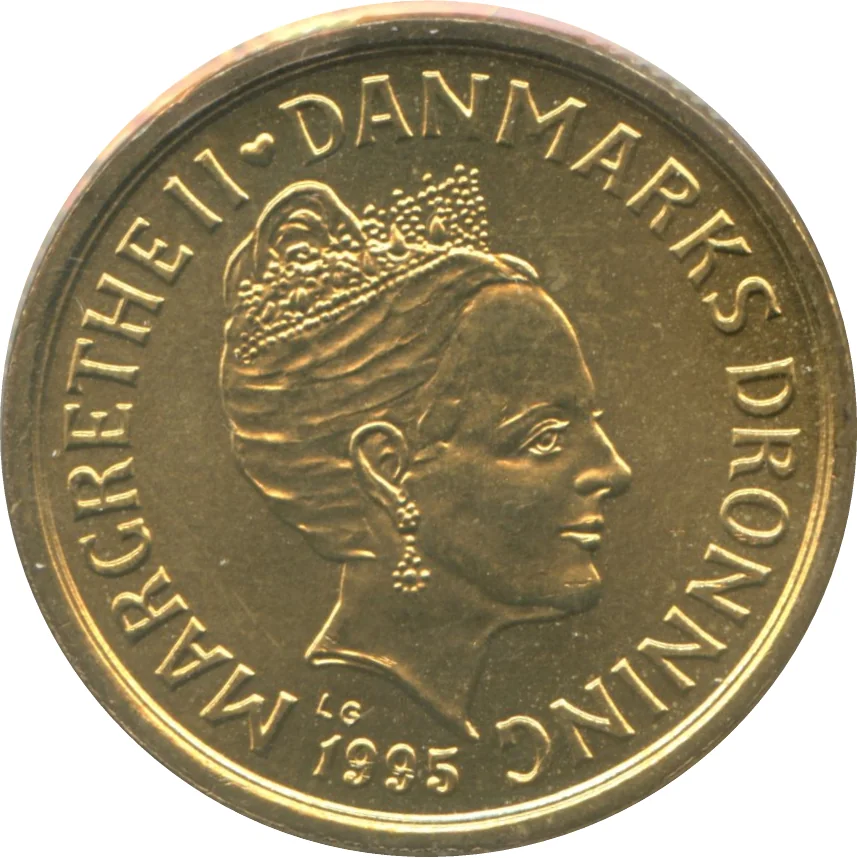
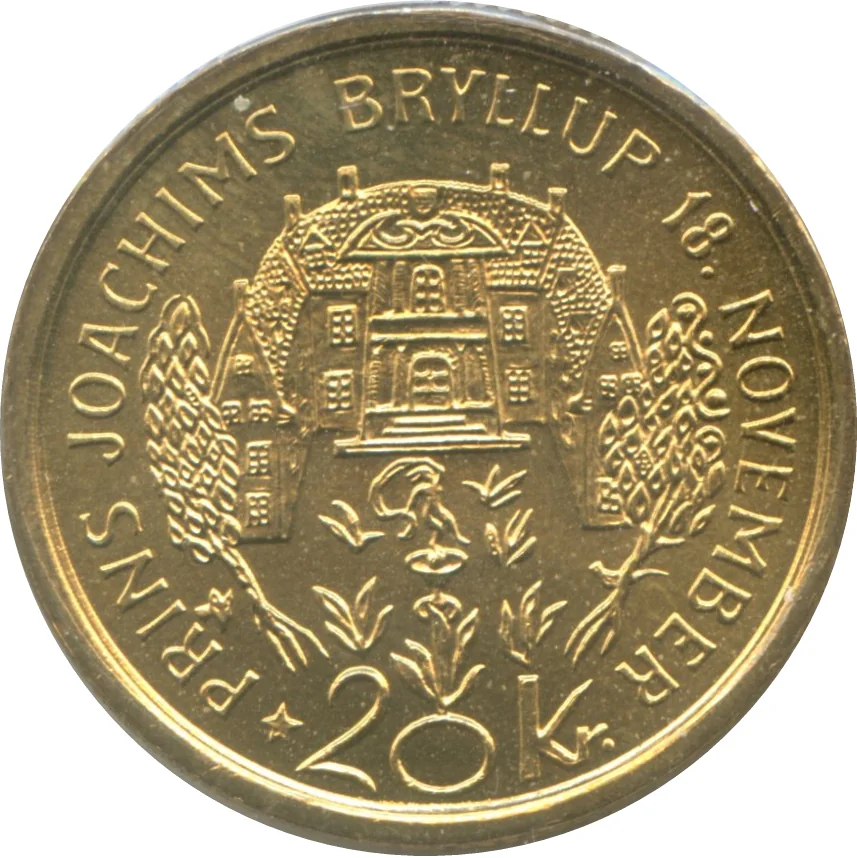
20 kroner – Denmark
Add to wishlist
Circulating commemorative coins
Commemoration: Wedding of Prince Joachim
Denmark
Context
Material
Diameter: 27 mm
Weight: 9.3 g
Thickness: 2.35 mm
Shape: Round
Composition: Aluminium bronze
Magnetic: No
Technique: Milled
Alignment: Medal alignment
flip
References
KM: #
Numista: #14557
Value
Exchange value: 20 DKK
Inflation-adjusted value: 35.76 DKK
Obverse
Reverse
Description:
A 3-winged palace between two trees.
Inscription:
PRINCE JOACHIMS BRYLLUP 18. NOVEMBER 20 KR.
Script: Latin
Edge
Alternating smooth and reeded segments
Categories
| Marriage |
Mints
| Name | Mark |
|---|---|
| Royal Danish Mint | — |
Mintings
| Year | Mint Mark | Mintage | Quality | Collection |
|---|---|---|---|---|
| 1995 | LG | 1,000,000 |
Historical background
In 1995, Denmark's currency situation was defined by its unique position within the European Union. The country was a member of the EU, having joined in 1973, and had participated in the European Exchange Rate Mechanism (ERM) for over a decade. However, following the traumatic exit of the British pound and Italian lira from the ERM during the 1992-93 crises, Denmark had secured a narrower fluctuation band of ±2.25% for its krone (DKK) against the Deutsche Mark, a arrangement known as "ERM II." This link to the strong German currency provided stability and low inflation, anchoring Danish monetary policy.
Domestically, this stability came at the cost of ceding control over interest rates to the German Bundesbank. Danish rates were effectively set to shadow German rates to maintain the peg. This was generally accepted as a successful policy, fostering economic confidence and low borrowing costs. However, a significant political shadow loomed over this arrangement: the 1992 Danish rejection of the Maastricht Treaty, which had established the roadmap for Economic and Monetary Union (EMU) and the future euro. A second referendum was scheduled for 1993, which ultimately approved the treaty with opt-outs.
Consequently, by 1995, Denmark had formally secured an opt-out from the euro's third stage, meaning it was not obligated to adopt the single currency when it launched. The Danish krone's participation in the revised ERM was therefore voluntary and seen as a permanent, rather than transitional, arrangement. The economy in 1995 was in a strong upswing, benefiting from the fixed exchange rate's credibility while the nation watched its EU partners prepare for monetary union from a deliberate and politically settled distance.
Domestically, this stability came at the cost of ceding control over interest rates to the German Bundesbank. Danish rates were effectively set to shadow German rates to maintain the peg. This was generally accepted as a successful policy, fostering economic confidence and low borrowing costs. However, a significant political shadow loomed over this arrangement: the 1992 Danish rejection of the Maastricht Treaty, which had established the roadmap for Economic and Monetary Union (EMU) and the future euro. A second referendum was scheduled for 1993, which ultimately approved the treaty with opt-outs.
Consequently, by 1995, Denmark had formally secured an opt-out from the euro's third stage, meaning it was not obligated to adopt the single currency when it launched. The Danish krone's participation in the revised ERM was therefore voluntary and seen as a permanent, rather than transitional, arrangement. The economy in 1995 was in a strong upswing, benefiting from the fixed exchange rate's credibility while the nation watched its EU partners prepare for monetary union from a deliberate and politically settled distance.
🌱 Fairly Common