

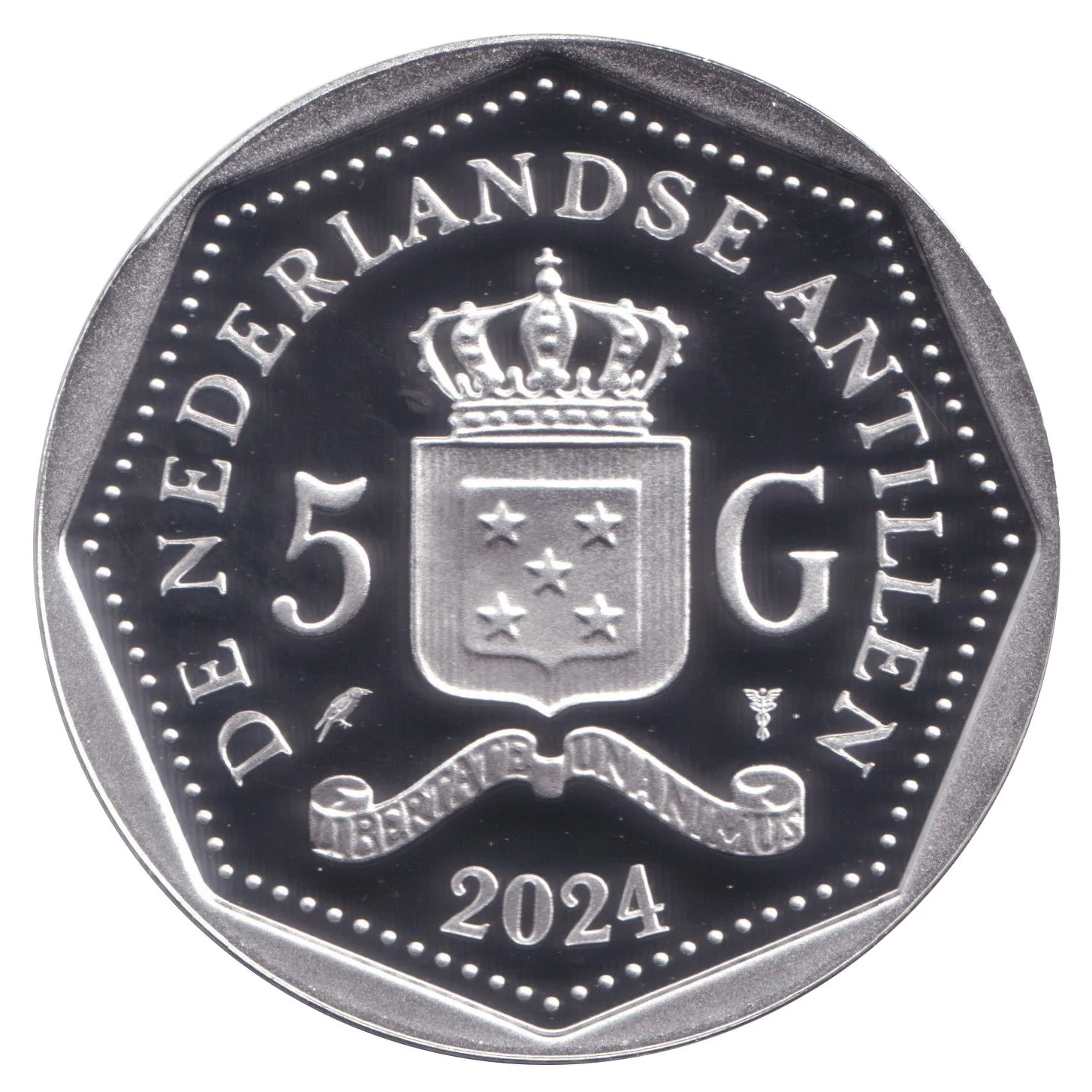
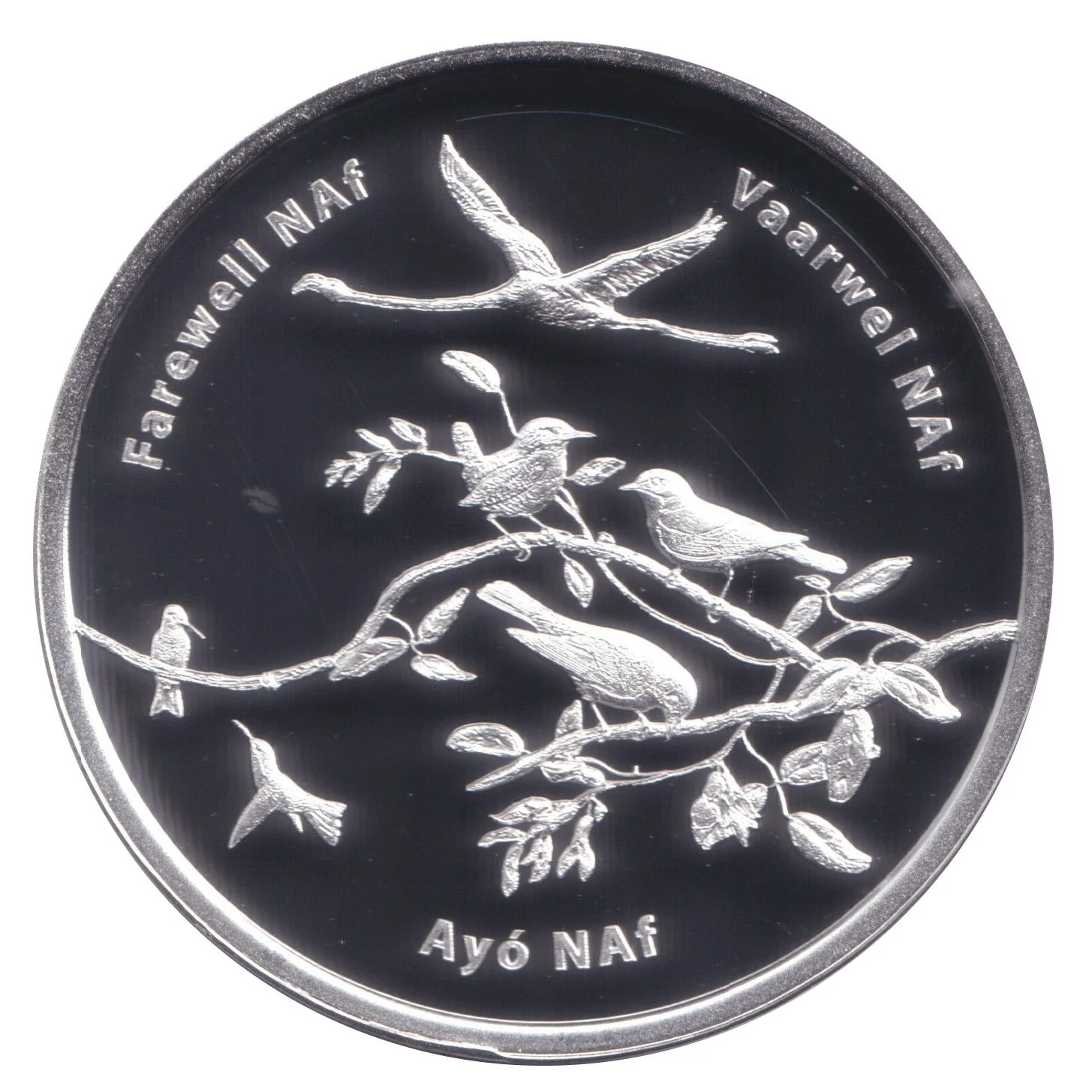
5 gulden – Netherlands Antilles
Add to wishlist
Netherlands
Context
Year: 2024
Country: Netherlands
Issuer: Netherlands Antilles
Issuing organization: Bank van De Nederlandse Antillen
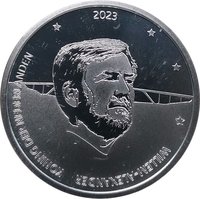
Ruler: Willem-Alexander
Currency:
(since 1828)
Demonetization: 31 March 2025
Total mintage: 1,000
Material
References
Numista: #425453
Value
Exchange value: 5 ANG
Bullion value: $26.79
Inflation-adjusted value: 5.07 ANG
Obverse
Reverse
Edge
Categories
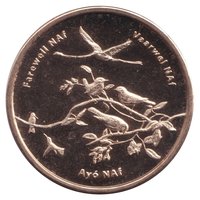
| Animal> Bird |
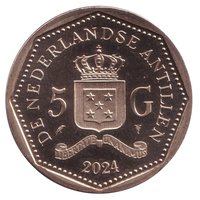
| Symbols> Coat of Arms |
Mints
| Name | Mark |
|---|---|
| Royal Dutch Mint | — |
Mintings
| Year | Mint Mark | Mintage | Quality | Collection |
|---|---|---|---|---|
| 2024 | — | 1,000 | Proof |
Historical background
As of 2024, the currency situation in the former Netherlands Antilles remains complex and fragmented, a direct legacy of the dissolution of the federation in 2010. The islands are divided between two different currencies and monetary authorities. Curaçao and Sint Maarten, as constituent countries within the Kingdom of the Netherlands, continue to use the Antillean guilder (ANG), which is pegged to the US dollar at a fixed rate of 1.79 ANG = 1 USD. This currency is managed by the Central Bank of Curaçao and Sint Maarten (CBCS), which faces ongoing challenges in maintaining financial stability and overseeing monetary policy for two separate island economies.
The other three special municipalities of the Netherlands—Bonaire, Sint Eustatius, and Saba (the BES islands)—adopted the US dollar as their official currency in 2011. This move was intended to provide economic stability, reduce transaction costs, and deepen integration with the European Netherlands. Consequently, the Caribbean guilder, a planned new currency intended to replace the Antillean guilder for Curaçao and Sint Maarten, has been repeatedly delayed. Its introduction, once slated for 2021, remains uncertain due to technical hurdles, political negotiations, and the need for strong fiscal discipline from the participating governments.
Therefore, the monetary landscape is characterized by this dual-system status quo. The key issue for 2024 remains the long-stalled transition to the Caribbean guilder in Curaçao and Sint Maarten, a project requiring consensus and significant institutional preparation. Meanwhile, the BES islands continue their dollarized operation, creating a region with two distinct currency zones under the overarching Dutch kingdom, each with its own economic implications and policy constraints.
The other three special municipalities of the Netherlands—Bonaire, Sint Eustatius, and Saba (the BES islands)—adopted the US dollar as their official currency in 2011. This move was intended to provide economic stability, reduce transaction costs, and deepen integration with the European Netherlands. Consequently, the Caribbean guilder, a planned new currency intended to replace the Antillean guilder for Curaçao and Sint Maarten, has been repeatedly delayed. Its introduction, once slated for 2021, remains uncertain due to technical hurdles, political negotiations, and the need for strong fiscal discipline from the participating governments.
Therefore, the monetary landscape is characterized by this dual-system status quo. The key issue for 2024 remains the long-stalled transition to the Caribbean guilder in Curaçao and Sint Maarten, a project requiring consensus and significant institutional preparation. Meanwhile, the BES islands continue their dollarized operation, creating a region with two distinct currency zones under the overarching Dutch kingdom, each with its own economic implications and policy constraints.
✨ Legendary