

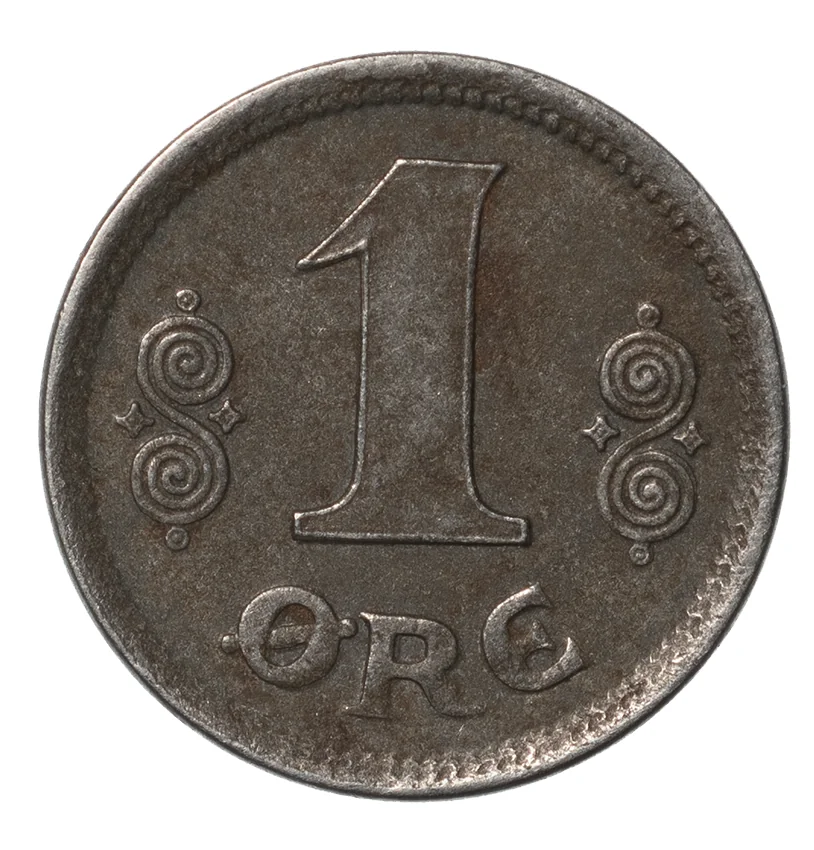
1 øre – Denmark
Add to wishlist
Denmark
Context
Years: 1918–1919
Issuer: Denmark
Ruler: Christian X
Currency:
(since 1873)
Demonetization: 31 March 1973
Total mintage: 7,707,000
Material
References
KM: #
Numista: #14551
Value
Exchange value: 0.01 DKK
Obverse
Description:
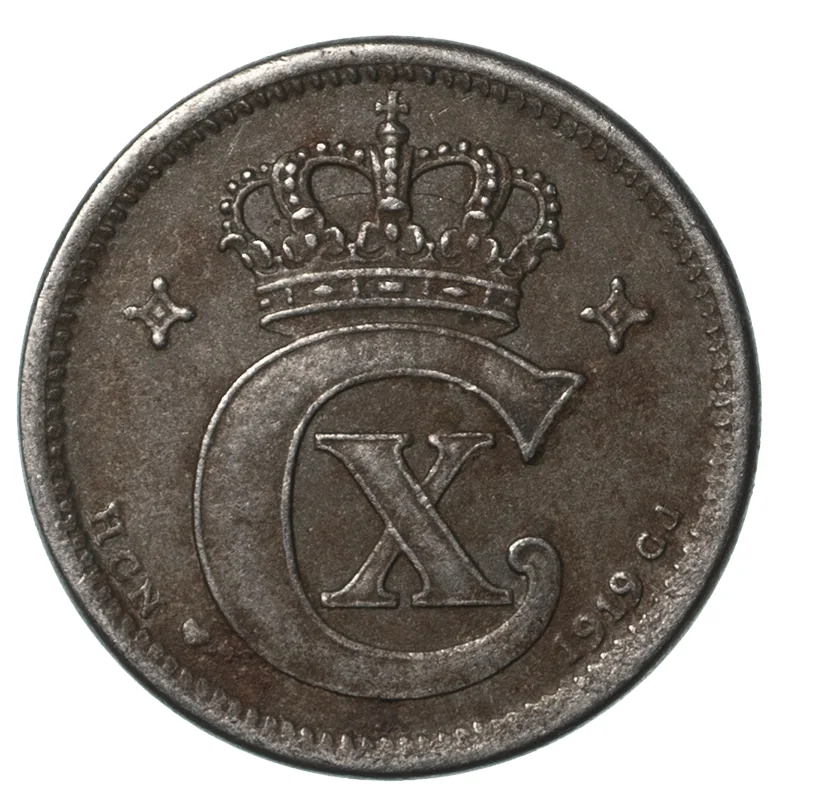
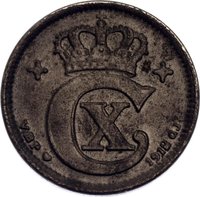
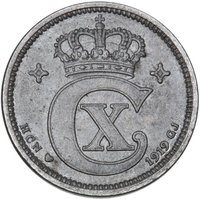
Crowned CX monogram, flanked by initials (HCN/VBP) and date with GJ.
Inscription:
CX
HCN ♥ 1919 GJ
HCN ♥ 1919 GJ
Translation:
Hollandia Christiana Nostra (Our Christian Holland) ♥ 1919 God zij met ons (God be with us)
Script: Latin
Reverse
Edge
Plain
Mints
| Name | Mark |
|---|---|
| Royal Danish Mint | — |
Mintings
| Year | Mint Mark | Mintage | Quality | Collection |
|---|---|---|---|---|
| 1918 | VBP♥; | 6,776,000 | ||
| 1919 | HCN♥; | 931,000 |
Historical background
In 1918, Denmark’s currency situation was defined by its adherence to the classical gold standard, a system it had maintained with notable stability since the 1870s. The Danish krone was legally convertible into gold at a fixed rate, providing a bedrock of monetary credibility and facilitating international trade. However, the pressures of World War I, despite Denmark's neutrality, had led to significant practical modifications. Like other neutral nations, Denmark suspended gold convertibility in practice in 1914 to prevent the physical export of its gold reserves and to retain greater control over its money supply in a turbulent economic environment.
The wartime economy brought inflation, driven by high demand for Danish agricultural exports from the warring nations and supply chain disruptions. To manage this, the Nationalbanken (the central bank) operated under an "emergency law," which gave it greater latitude to issue banknotes not fully backed by gold. This resulted in a period of a "paper currency standard," where the krone's value was more directly influenced by the balance of payments and government policy than by a direct link to bullion. Consequently, the external value of the krone fluctuated, particularly against currencies like the Swedish krona, leading to occasional interventions to stabilize exchange rates.
By the end of 1918, with the war concluding, the fundamental question facing Danish monetary authorities was whether and how to return to the pre-war gold standard at the traditional parity. This would require deflationary policies to reverse the accumulated wartime inflation, a prospect fraught with social and economic difficulty. Thus, the currency situation was in a state of precarious transition, caught between the legacy of a stable metallic past and the uncertain realities of a post-war world that would ultimately challenge the restored gold standard of the 1920s.
The wartime economy brought inflation, driven by high demand for Danish agricultural exports from the warring nations and supply chain disruptions. To manage this, the Nationalbanken (the central bank) operated under an "emergency law," which gave it greater latitude to issue banknotes not fully backed by gold. This resulted in a period of a "paper currency standard," where the krone's value was more directly influenced by the balance of payments and government policy than by a direct link to bullion. Consequently, the external value of the krone fluctuated, particularly against currencies like the Swedish krona, leading to occasional interventions to stabilize exchange rates.
By the end of 1918, with the war concluding, the fundamental question facing Danish monetary authorities was whether and how to return to the pre-war gold standard at the traditional parity. This would require deflationary policies to reverse the accumulated wartime inflation, a prospect fraught with social and economic difficulty. Thus, the currency situation was in a state of precarious transition, caught between the legacy of a stable metallic past and the uncertain realities of a post-war world that would ultimately challenge the restored gold standard of the 1920s.
🌱 Common