

20 cash – Hunan Province
Add to wishlist
China
Context
Year: 1919
Country: China
Issuer: Hunan Province
Period:
(1912—1949)
Currency:
(1897—1949)
Demonetized: Yes
Material
References
Y: #
Numista: #42437
Obverse
Description:
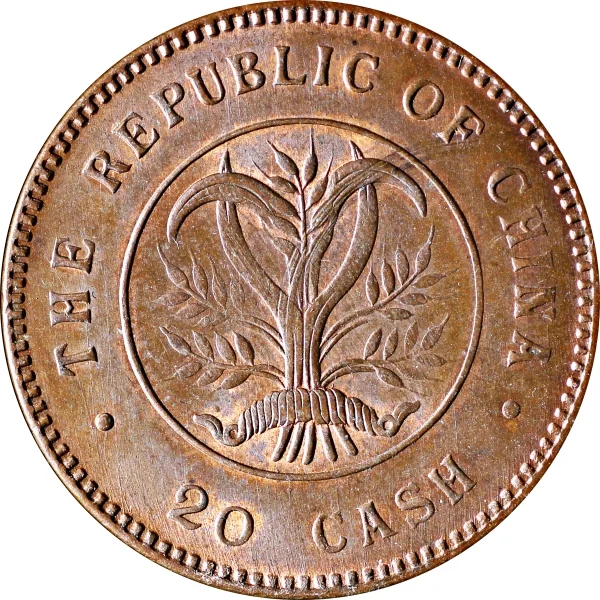
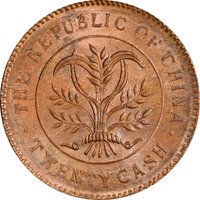
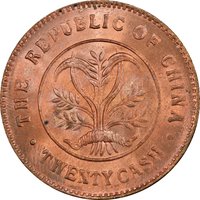
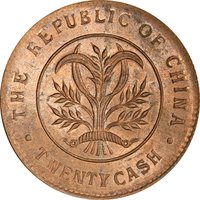
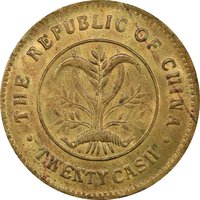
Rice plant with five ears and a ribbon, encircled by English text.
Inscription:
THE REPUBLIC OF CHINA
20 CASH
20 CASH
Reverse
Description:
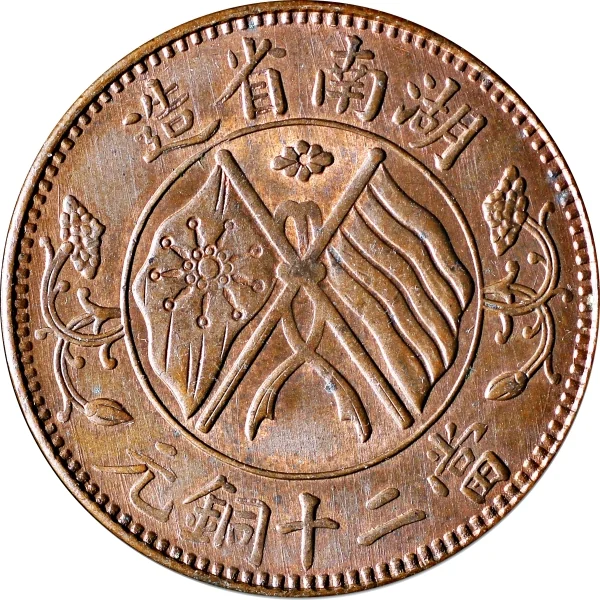
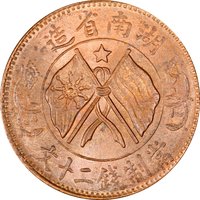
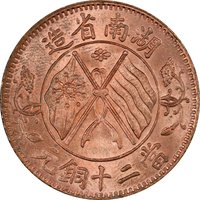
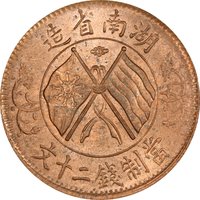
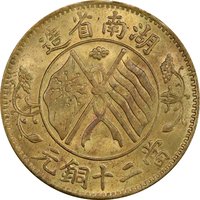
Crossed flags with a flower above and flanked by florals, all accompanied by Chinese characters.
Inscription:
造省南湖
元銅十二當
元銅十二當
Translation:
Made in Nanhu by the Provincial Mint;
Twelve Yuan copper coins equal one.
Twelve Yuan copper coins equal one.
Language: Classical Chinese
Edge
Plain
Mintings
| Year | Mint Mark | Mintage | Quality | Collection |
|---|---|---|---|---|
| 1919 | — | — |
Historical background
In 1919, the currency situation in Hunan Province was one of profound chaos and fragmentation, a direct reflection of the wider political disintegration of China during the Warlord Era. Following the death of Yuan Shikai in 1916, Hunan became a fiercely contested battleground between northern warlord factions and southern revolutionary forces, with control of the provincial capital, Changsha, changing hands multiple times. Each successive military regime, facing urgent financial demands to fund its armies and administration, resorted to issuing its own paper currency and coercing its circulation. This resulted in a bewildering mix of notes from the Provincial Bank of Hunan, military scrip from various commanders, and notes from local merchant guilds, all competing and depreciating at different rates.
The primary consequence was hyperinflation and a severe loss of public trust. With no central authority to guarantee redemption or regulate volume, these currencies were massively over-issued, leading to rapid devaluation. Shopkeepers and peasants were often forced to accept worthless paper, causing widespread hardship and market disruption. The value of money could collapse overnight with a military defeat or the flight of a warlord, rendering people's savings obsolete. This environment fostered a retreat to more stable value stores, with silver yuan coins (both foreign and domestic) and even copper cash becoming the preferred mediums for significant transactions and savings, despite their scarcity.
This monetary anarchy severely hampered economic life and fueled social resentment. Trade and commerce were stifled as merchants struggled to assess real prices and hedge against currency risk. The situation epitomized the breakdown of unified state sovereignty, where the power to issue money—a core function of the state—was usurped by local militarists. It created a tangible daily grievance among Hunan's population, who associated warlord rule with economic ruin. This context of instability and crisis would soon make Hunan fertile ground for the radical political movements, including the Marxist study groups that a young Mao Zedong participated in, which sought to overturn the entire old order.
The primary consequence was hyperinflation and a severe loss of public trust. With no central authority to guarantee redemption or regulate volume, these currencies were massively over-issued, leading to rapid devaluation. Shopkeepers and peasants were often forced to accept worthless paper, causing widespread hardship and market disruption. The value of money could collapse overnight with a military defeat or the flight of a warlord, rendering people's savings obsolete. This environment fostered a retreat to more stable value stores, with silver yuan coins (both foreign and domestic) and even copper cash becoming the preferred mediums for significant transactions and savings, despite their scarcity.
This monetary anarchy severely hampered economic life and fueled social resentment. Trade and commerce were stifled as merchants struggled to assess real prices and hedge against currency risk. The situation epitomized the breakdown of unified state sovereignty, where the power to issue money—a core function of the state—was usurped by local militarists. It created a tangible daily grievance among Hunan's population, who associated warlord rule with economic ruin. This context of instability and crisis would soon make Hunan fertile ground for the radical political movements, including the Marxist study groups that a young Mao Zedong participated in, which sought to overturn the entire old order.

⭐ Rare