

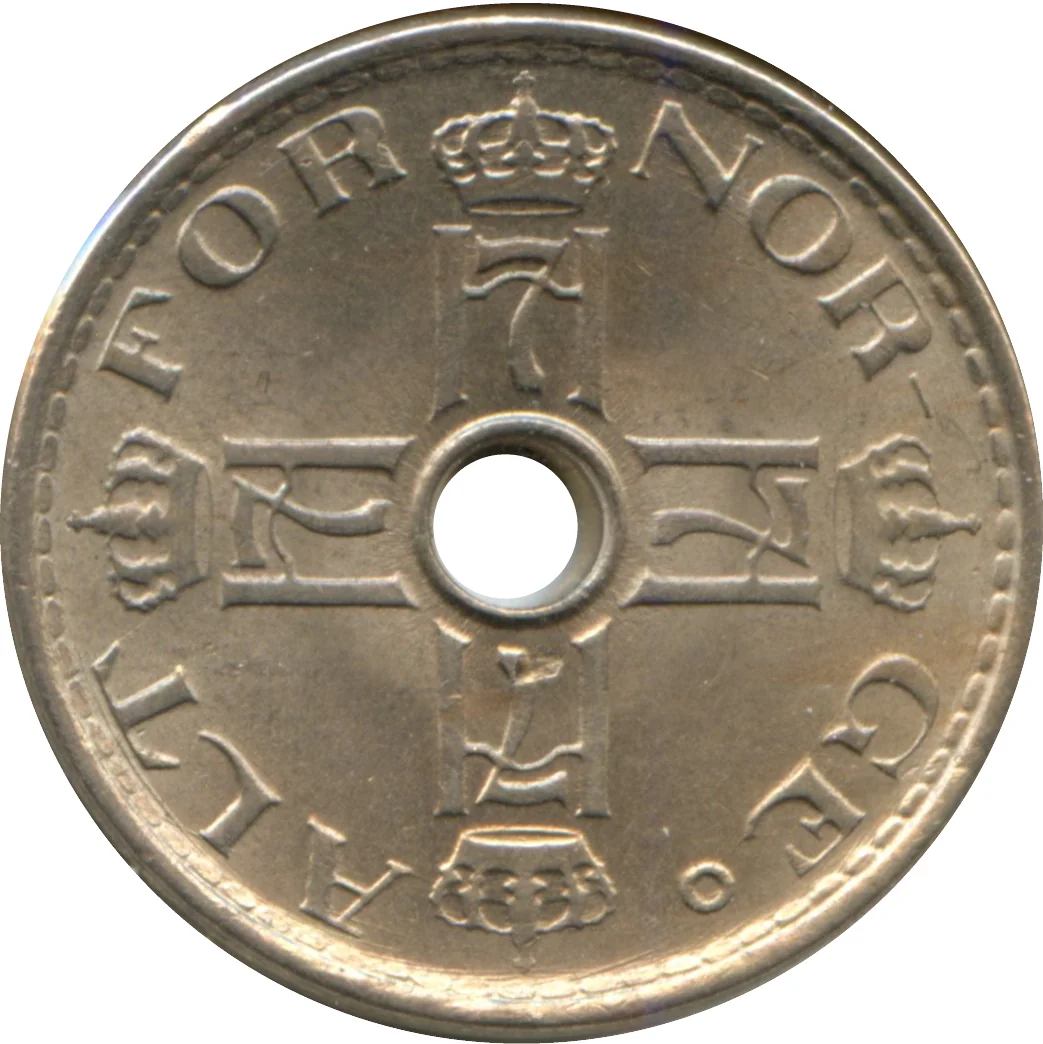
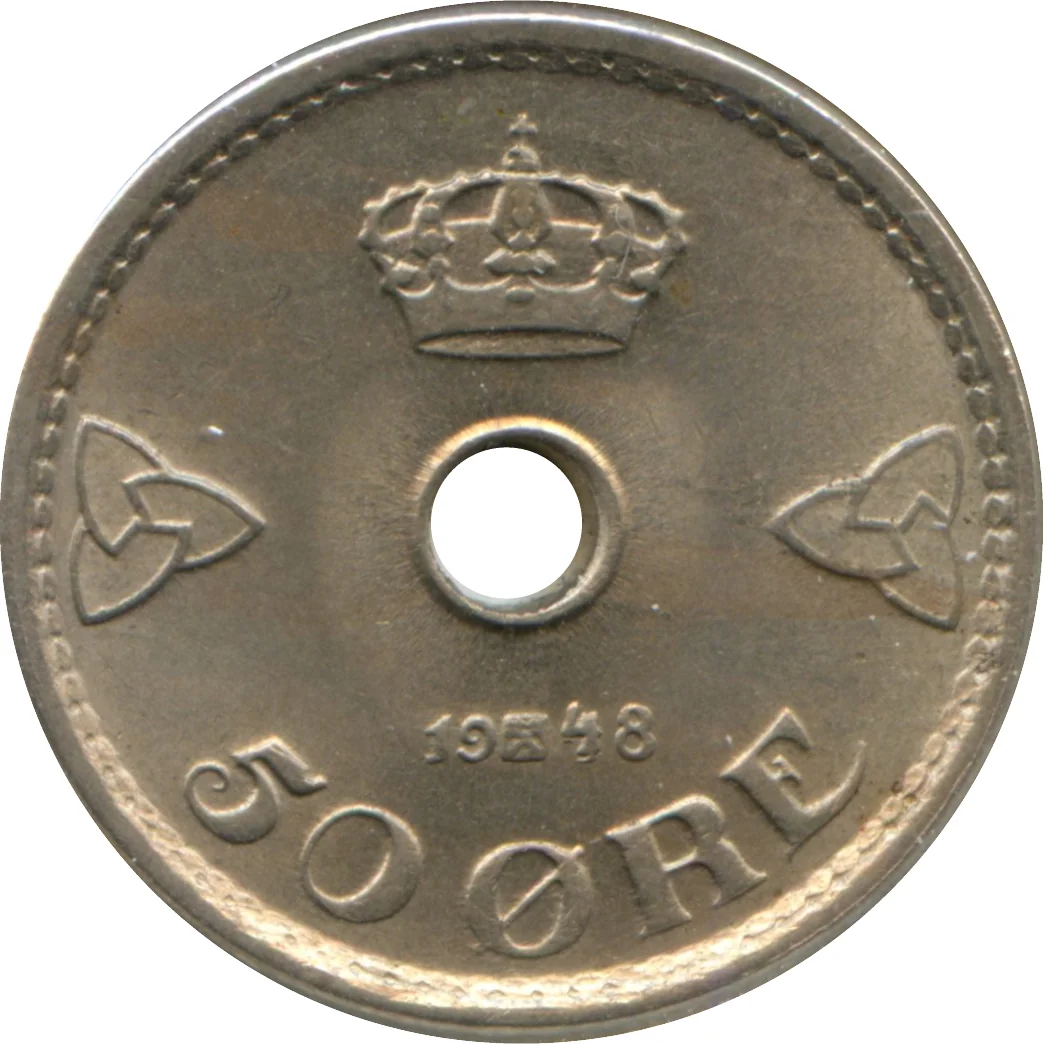
50 øre – Norway
Add to wishlist
Norway
Context
Years: 1926–1949
Issuer: Norway
Ruler: Haakon VII
Currency:
(since 1875)
Demonetized: Yes
Total mintage: 24,319,100
Material
Diameter: 22 mm
Weight: 4.8 g
Thickness: 1.9 mm
Shape: Round with a round hole
Composition: Copper-nickel
Technique: Milled
Alignment: Medal alignment
flip
References
KM: #
Numista: #1454
Value
Exchange value: 0.50 NOK
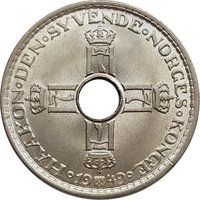
Obverse
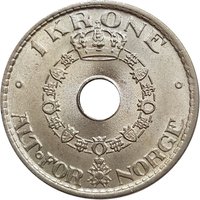
Reverse
Edge
Plain
Mints
| Name | Mark |
|---|---|
| Norwegian Mint | — |
Mintings
| Year | Mint Mark | Mintage | Quality | Collection |
|---|---|---|---|---|
| 1926 | — | 2,000,000 | ||
| 1927 | — | 2,502,100 | ||
| 1928 | — | 1,458,200 | ||
| 1929 | — | 600,000 | ||
| 1939 | — | 900,000 | ||
| 1940 | — | 2,193,000 | ||
| 1941 | — | 2,373,000 | ||
| 1945 | — | 1,354,000 | ||
| 1946 | — | 1,532,500 | ||
| 1947 | — | 2,465,300 | ||
| 1948 | — | 5,911,400 | ||
| 1949 | — | 1,029,600 |
Historical background
In 1926, Norway was in the final stages of a prolonged and challenging period of monetary transition following the First World War. Like many nations, Norway had abandoned the classical gold standard during the war, leading to inflation and currency instability. In the early 1920s, the country made a firm policy decision to return to gold at the pre-war parity, a demanding goal that required a period of tight monetary policy and deflation to bring the value of the krone back to its 1914 level. This process, known as parirestaurasjonen (the parity restoration), placed significant strain on the economy, particularly on debtors and the agricultural sector.
The year itself was a critical juncture, as the Storting (Norwegian parliament) had passed the necessary legislation in 1924 and the gold standard was formally reinstated on 1 May 1924. By 1926, the system was in effect, with Norges Bank legally obligated to exchange notes for gold on demand. The krone was now stable internationally, but this stability came at a cost. The preceding deflation had contributed to a banking crisis in 1923-24, and the economy in 1926 was still grappling with the aftermath, characterized by relatively high unemployment and sluggish growth compared to the pre-war era.
Therefore, the currency situation in 1926 was one of achieved stability but underlying economic fragility. The primary goal of restoring the gold parity was accomplished, securing Norway's place in the reconstructed international financial system. However, the nation was operating under a strict monetary regime that limited policy flexibility, and the real economy was yet to fully recover from the harsh measures required to reach that goal. This set the stage for the economic debates of the late 1920s and the severe challenges that would follow with the Great Depression and the eventual abandonment of the gold standard in 1931.
The year itself was a critical juncture, as the Storting (Norwegian parliament) had passed the necessary legislation in 1924 and the gold standard was formally reinstated on 1 May 1924. By 1926, the system was in effect, with Norges Bank legally obligated to exchange notes for gold on demand. The krone was now stable internationally, but this stability came at a cost. The preceding deflation had contributed to a banking crisis in 1923-24, and the economy in 1926 was still grappling with the aftermath, characterized by relatively high unemployment and sluggish growth compared to the pre-war era.
Therefore, the currency situation in 1926 was one of achieved stability but underlying economic fragility. The primary goal of restoring the gold parity was accomplished, securing Norway's place in the reconstructed international financial system. However, the nation was operating under a strict monetary regime that limited policy flexibility, and the real economy was yet to fully recover from the harsh measures required to reach that goal. This set the stage for the economic debates of the late 1920s and the severe challenges that would follow with the Great Depression and the eventual abandonment of the gold standard in 1931.
🌱 Very Common