

1 krone – Norway
Add to wishlist
Norway
Context
Years: 1925–1951
Issuer: Norway
Ruler: Haakon VII
Currency:
(since 1875)
Demonetized: Yes
Total mintage: 49,289,500
Material
Diameter: 25 mm
Weight: 7 g
Thickness: 2.07 mm
Shape: Round with a round hole
Composition: Copper-nickel
Technique: Milled
Alignment: Medal alignment
flip
References
KM: #
Numista: #1440
Value
Exchange value: 1 NOK
Obverse
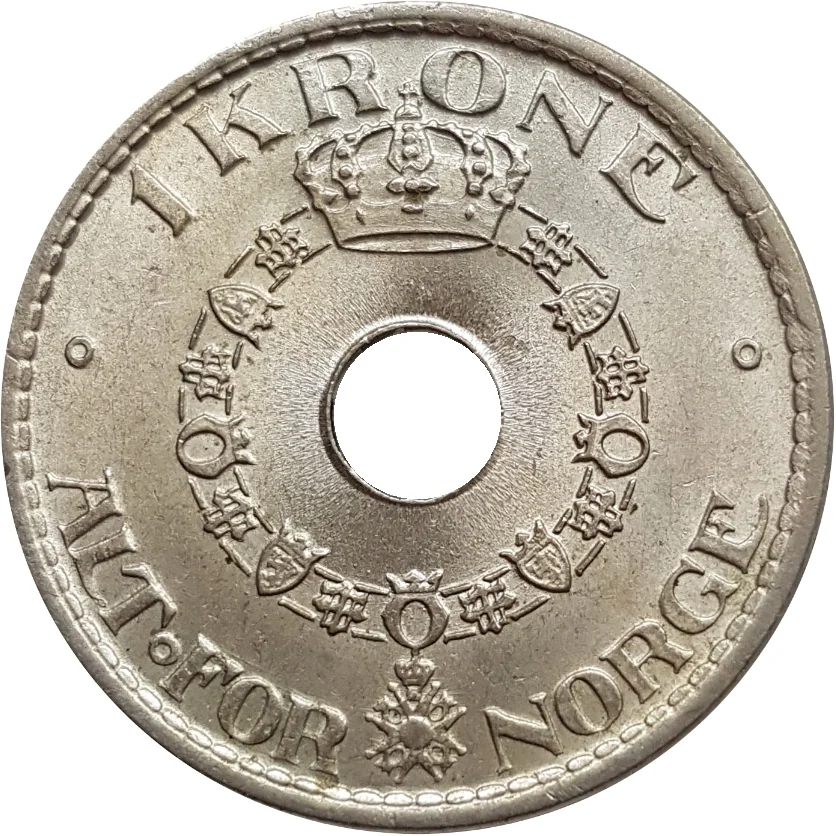
Description:
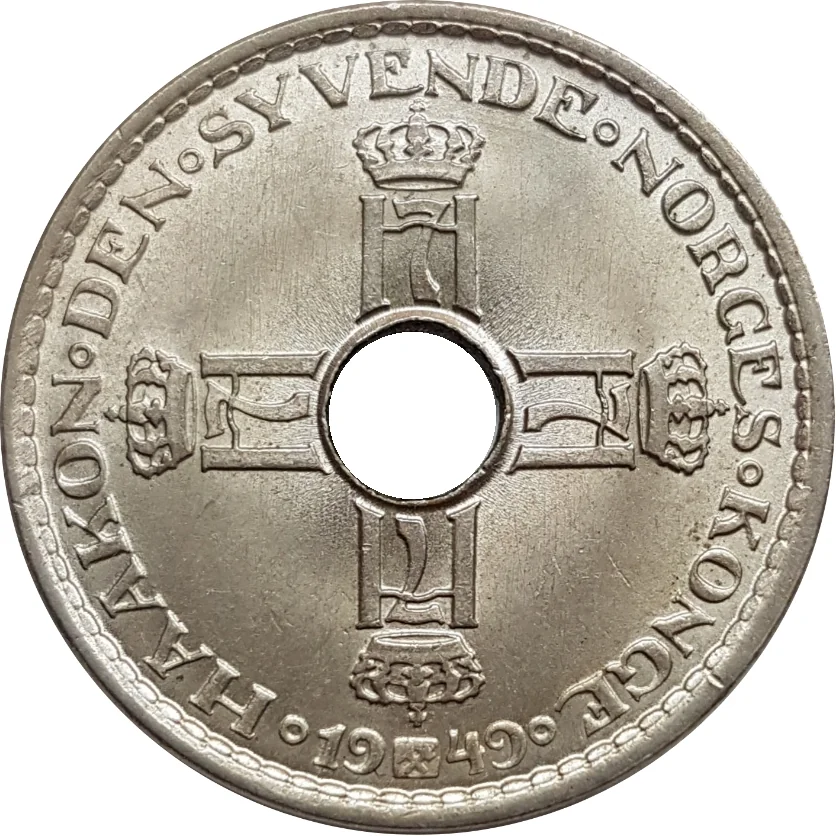
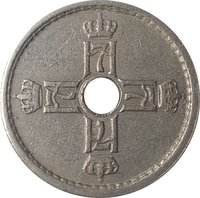
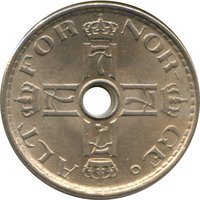
Cross of four crowned Haakon VII monograms around a central hole. Inscription surrounds, date divided by mintmark on a shield below. Beaded rim.
Inscription:
HAAKON⸰DEN⸰SYVENDE⸰NORGES⸰KONGE
H7 H7 H7 H7
⸰19 ⚒ 49⸰
H7 H7 H7 H7
⸰19 ⚒ 49⸰
Translation:
Haakon the Seventh, Norway's King
H7 H7 H7 H7
1949
H7 H7 H7 H7
1949
Script: Latin
Language: Norwegian
Reverse
Edge
Plain
Mints
| Name | Mark |
|---|---|
| Norwegian Mint | — |
Mintings
| Year | Mint Mark | Mintage | Quality | Collection |
|---|---|---|---|---|
| 1925 | — | 8,686,400 | ||
| 1926 | — | 1,983,800 | ||
| 1927 | — | 1,000,000 | ||
| 1936 | — | 700,000 | ||
| 1937 | — | 1,000,000 | ||
| 1938 | — | 926,300 | ||
| 1939 | — | 2,253,200 | ||
| 1940 | — | 3,890,000 | ||
| 1946 | — | 5,498,600 | ||
| 1947 | — | 802,300 | ||
| 1949 | — | 7,846,000 | ||
| 1950 | — | 9,941,800 | ||
| 1951 | — | 4,761,100 |
Historical background
In 1925, Norway stood at a pivotal moment in its monetary history, preparing to formally join the international gold standard after a prolonged period of instability. The nation had been forced to suspend gold convertibility at the outbreak of World War I in 1914, leading to a period of fluctuating paper currency value and inflation. The post-war years were marked by debate and preparation, as Norway, like many other nations, sought to return to the perceived stability and discipline of the gold standard, which would tie the value of the krone directly to a fixed quantity of gold.
The decision to return was formalized by the Kroneloven (the Krone Act) of April 17, 1924, which set the stage for the legal transition. The act established a new gold parity for the Norwegian krone, but the actual return to a fully operational gold standard was scheduled for 1928, allowing a multi-year adjustment period. Therefore, in 1925, the country was in a transitional phase, implementing policies to stabilize the currency and build necessary gold reserves to ensure confidence upon the final return.
This move was part of a broader European trend to restore pre-war financial systems, but it came with significant challenges. The chosen parity valued the krone higher than its prevailing market rate, which required a tight monetary policy to achieve. This contributed to economic strain, including deflationary pressure and high interest rates, which would later exacerbate the difficulties of the Great Depression. Thus, while 1925 represented a year of committed action toward monetary orthodoxy, the foundations laid would soon be tested by global economic forces.
The decision to return was formalized by the Kroneloven (the Krone Act) of April 17, 1924, which set the stage for the legal transition. The act established a new gold parity for the Norwegian krone, but the actual return to a fully operational gold standard was scheduled for 1928, allowing a multi-year adjustment period. Therefore, in 1925, the country was in a transitional phase, implementing policies to stabilize the currency and build necessary gold reserves to ensure confidence upon the final return.
This move was part of a broader European trend to restore pre-war financial systems, but it came with significant challenges. The chosen parity valued the krone higher than its prevailing market rate, which required a tight monetary policy to achieve. This contributed to economic strain, including deflationary pressure and high interest rates, which would later exacerbate the difficulties of the Great Depression. Thus, while 1925 represented a year of committed action toward monetary orthodoxy, the foundations laid would soon be tested by global economic forces.
🌱 Very Common