

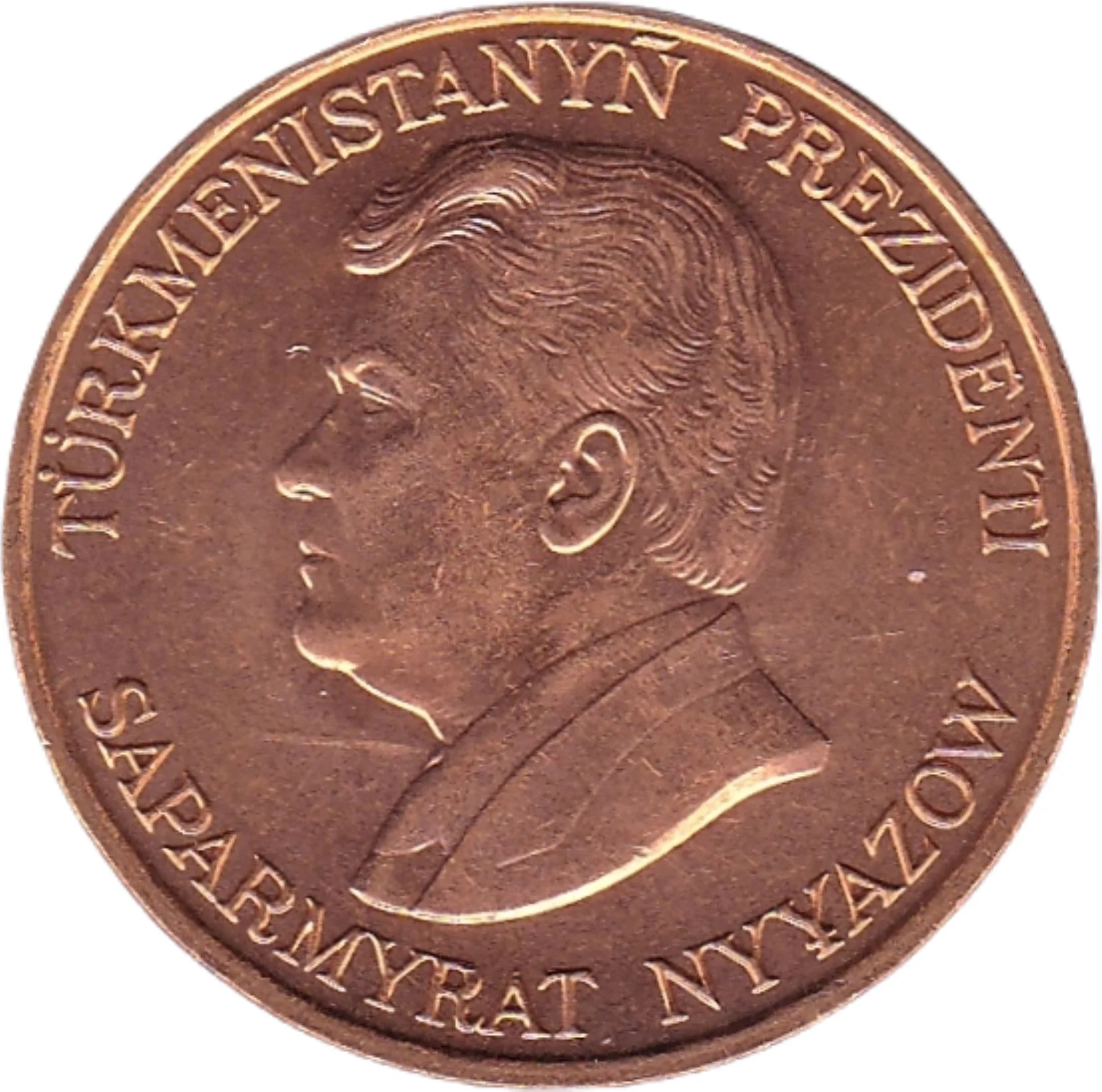
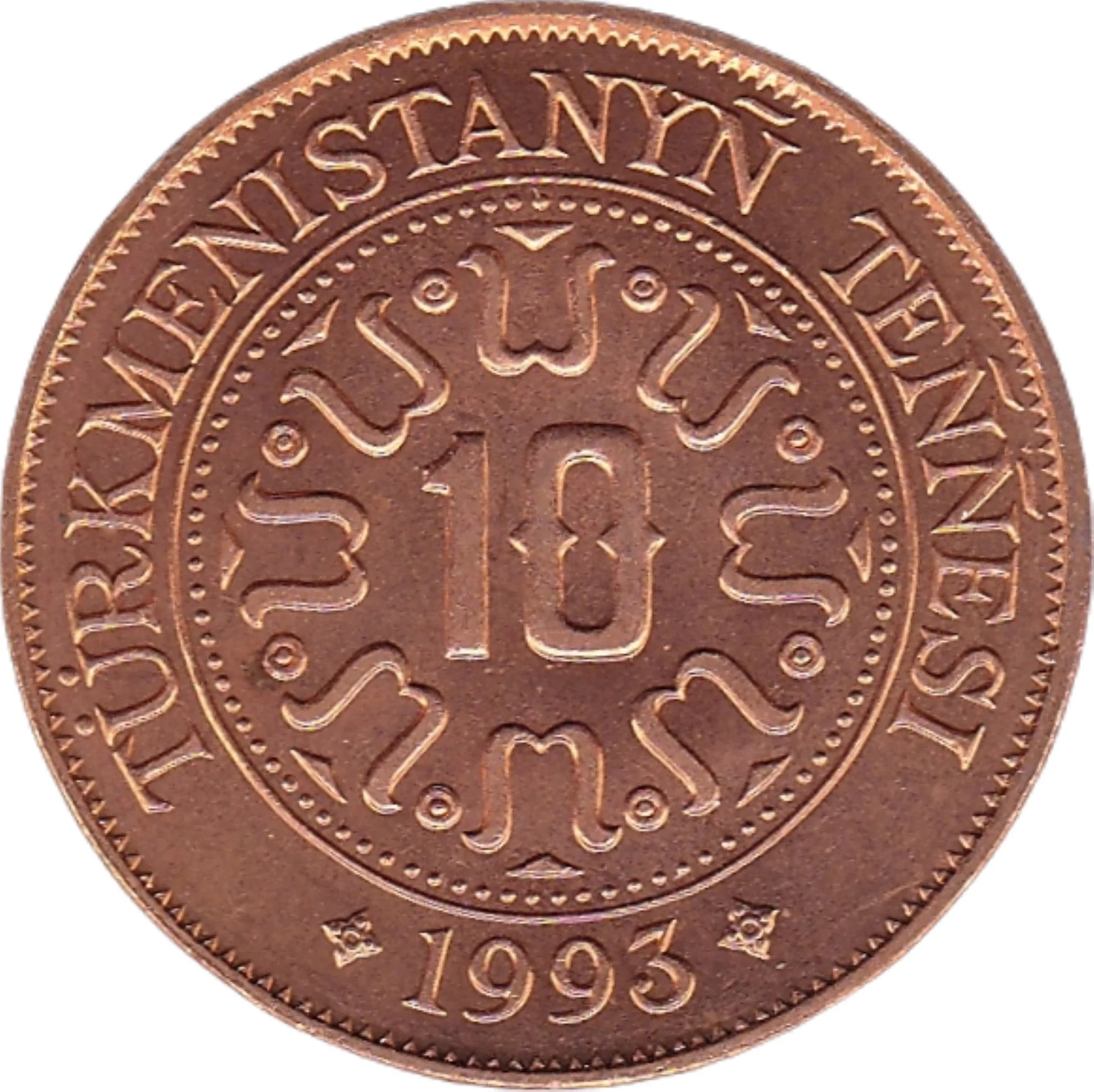
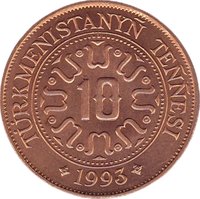
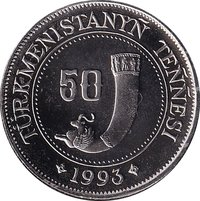
10 Teňňe – Turkmenistan
Turkmenistan
Context
Year: 1993
Issuer: Turkmenistan 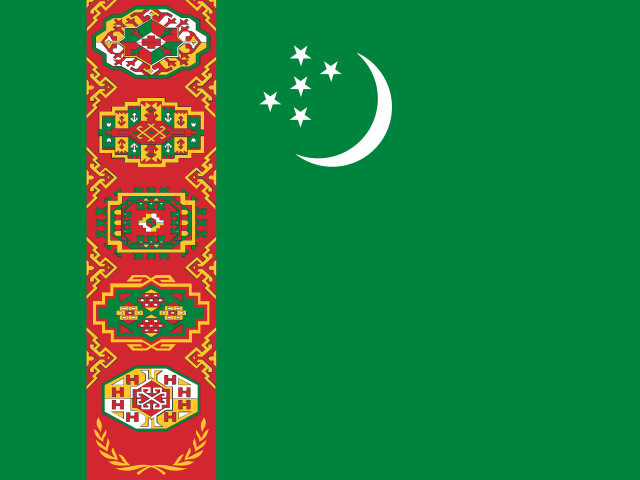
Period:
(since 1991)
Currency:
(1993—2009)
Demonetization: 31 December 2009
Total mintage: 75,000,000
Material
References
KM: #Click to copy to clipboard3
Numista: #4234
Value
Exchange value: 0.10 TMM
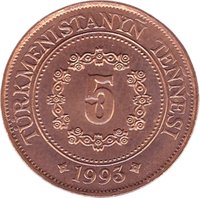
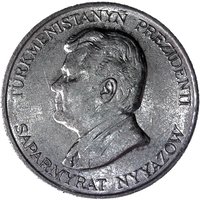
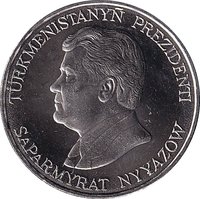
Obverse
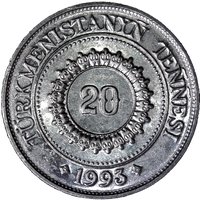
Reverse
Edge
Plain
Categories
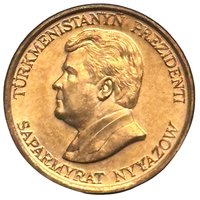
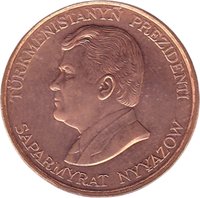
| Person> Politician |
Mints
| Name | Mark |
|---|---|
| Royal Mint | — |
Mintings
| Year | Mint Mark | Mintage | Quality | Collection |
|---|---|---|---|---|
| 1993 | — | 75,000,000 |
Historical background
In 1993, Turkmenistan, like other former Soviet republics, faced the profound challenge of establishing monetary sovereignty following the dissolution of the USSR. The initial period was characterized by the continued use of the Soviet ruble within the ruble zone, a system that quickly proved unsustainable. Russia's control over the money supply led to hyperinflation across the zone, and Turkmenistan, with its fragile, commodity-dependent economy, suffered severely from this imported economic instability. The lack of control over its own currency severely hampered the government's ability to pursue independent economic policies or stabilize its financial system.
President Saparmurat Niyazov's government responded by taking a decisive step toward economic independence. On November 1, 1993, Turkmenistan introduced its national currency, the Turkmenistan manat, replacing the Soviet and Russian rubles at a rate of 1 manat to 500 rubles. This move was part of a broader wave of exits from the ruble zone that year, as republics sought to escape Russia's inflationary spiral and assert national control. The introduction was executed with a high degree of secrecy and speed to prevent capital flight and speculative attacks, a tactic employed by several Central Asian states during this turbulent transition.
The immediate aftermath of the currency reform was economically difficult for the population. While it granted Ashgabat formal control over monetary policy, the new manat was not convertible and entered circulation amidst ongoing economic dislocation. The government coupled its introduction with extensive, Soviet-style subsidies for basic goods and utilities, attempting to shield citizens from the worst effects of the transition. Thus, the 1993 currency change was a foundational but painful step in Turkmenistan's path to a nominal economic independence, setting the stage for the highly centralized, state-controlled economic model that would define Niyazov's subsequent decades of rule.
President Saparmurat Niyazov's government responded by taking a decisive step toward economic independence. On November 1, 1993, Turkmenistan introduced its national currency, the Turkmenistan manat, replacing the Soviet and Russian rubles at a rate of 1 manat to 500 rubles. This move was part of a broader wave of exits from the ruble zone that year, as republics sought to escape Russia's inflationary spiral and assert national control. The introduction was executed with a high degree of secrecy and speed to prevent capital flight and speculative attacks, a tactic employed by several Central Asian states during this turbulent transition.
The immediate aftermath of the currency reform was economically difficult for the population. While it granted Ashgabat formal control over monetary policy, the new manat was not convertible and entered circulation amidst ongoing economic dislocation. The government coupled its introduction with extensive, Soviet-style subsidies for basic goods and utilities, attempting to shield citizens from the worst effects of the transition. Thus, the 1993 currency change was a foundational but painful step in Turkmenistan's path to a nominal economic independence, setting the stage for the highly centralized, state-controlled economic model that would define Niyazov's subsequent decades of rule.
🌱 Very Common