

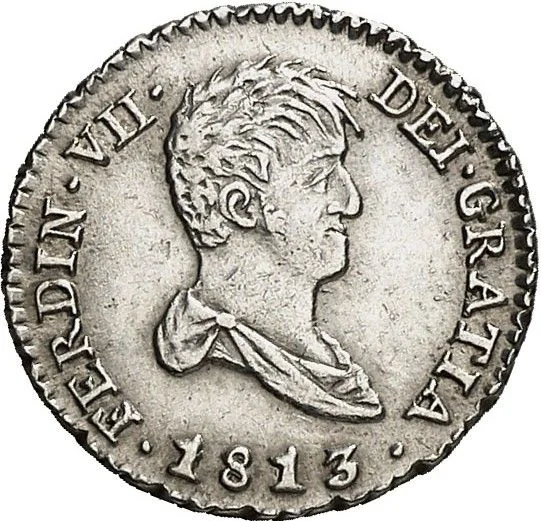
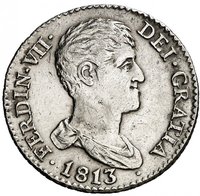
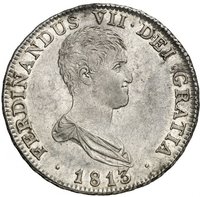
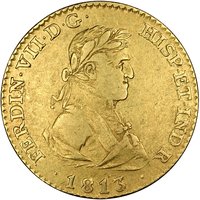
Obverse
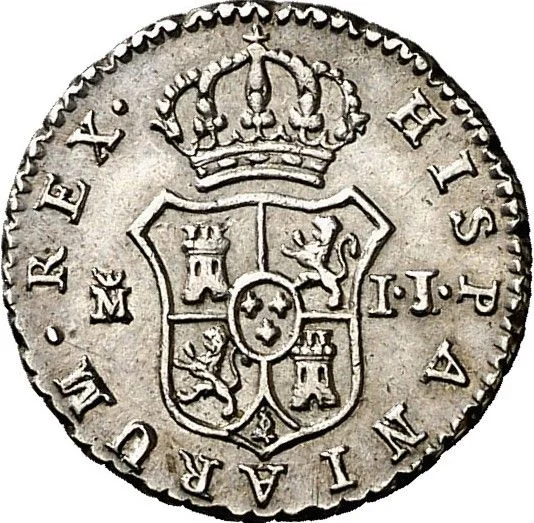
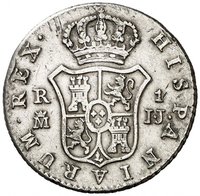
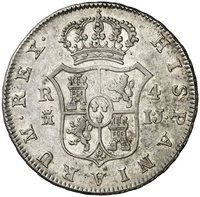
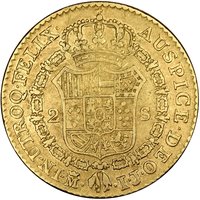
Reverse
Description:
Royal arms of Spain.
Inscription:
HISPANIARIUM · REX ·
M I·J·
M I·J·
Translation:
King of the Spains
Script: Latin
Language: Latin
Engraver: Félix Sagau y Dalmau de Galcerán
Edge
Categories
| Symbols> Coat of Arms |
Mints
| Name | Mark |
|---|---|
| Royal Mint of Madrid | (M) |
Mintings
| Year | Mint Mark | Mintage | Quality | Collection |
|---|---|---|---|---|
| 1813 | MIJ | — | ||
| 1813 | MGJ | — | ||
| 1814 | MGJ | — |
Historical background
In 1813, Spain was embroiled in the Peninsular War (1808-1814), a brutal conflict against Napoleon's occupying forces. This war had catastrophic effects on the Spanish economy and its currency system. The state treasury was exhausted, and traditional revenue streams had collapsed. To finance the war effort, the Spanish resistance government, the Cortes of Cádiz, resorted to extreme measures, including confiscating church property and issuing vast amounts of government debt. However, the most direct impact on currency was the proliferation of paper money, known as vales reales (royal vouchers), which had been in circulation since 1780 but were now printed in excessive quantities to cover deficits, leading to severe depreciation and a loss of public confidence.
The monetary landscape was one of chaos and fragmentation. Alongside the devalued vales reales, a wide variety of coins circulated. These included pre-war Spanish coins (like the real and peso), French coins brought by the invaders, and Portuguese and British coins used by the Allied armies. Furthermore, many local Spanish authorities, both patriotic juntas and French-controlled administrations, issued their own emergency copper or silver coinage to facilitate local trade, creating a bewildering patchwork of currencies with fluctuating values. The scarcity of precious metals, hoarded by the populace, exacerbated the problem, pushing the economy toward a de facto system of barter in many regions.
This monetary instability reflected the profound political crisis of a nation divided. With King Ferdinand VII imprisoned in France and competing sovereignties—French rule, the Cádiz Cortes, and local juntas—there was no central authority capable of enforcing a unified monetary policy. The currency disorder of 1813 was therefore a direct symptom of the war's devastation and the collapse of the old Bourbon state. It set the stage for the immense economic challenges that would confront Spain following the war's end in 1814, including a massive sovereign debt and a currency system in need of complete overhaul.
The monetary landscape was one of chaos and fragmentation. Alongside the devalued vales reales, a wide variety of coins circulated. These included pre-war Spanish coins (like the real and peso), French coins brought by the invaders, and Portuguese and British coins used by the Allied armies. Furthermore, many local Spanish authorities, both patriotic juntas and French-controlled administrations, issued their own emergency copper or silver coinage to facilitate local trade, creating a bewildering patchwork of currencies with fluctuating values. The scarcity of precious metals, hoarded by the populace, exacerbated the problem, pushing the economy toward a de facto system of barter in many regions.
This monetary instability reflected the profound political crisis of a nation divided. With King Ferdinand VII imprisoned in France and competing sovereignties—French rule, the Cádiz Cortes, and local juntas—there was no central authority capable of enforcing a unified monetary policy. The currency disorder of 1813 was therefore a direct symptom of the war's devastation and the collapse of the old Bourbon state. It set the stage for the immense economic challenges that would confront Spain following the war's end in 1814, including a massive sovereign debt and a currency system in need of complete overhaul.
Series: 1813 Spain circulation coins
✨ Legendary