

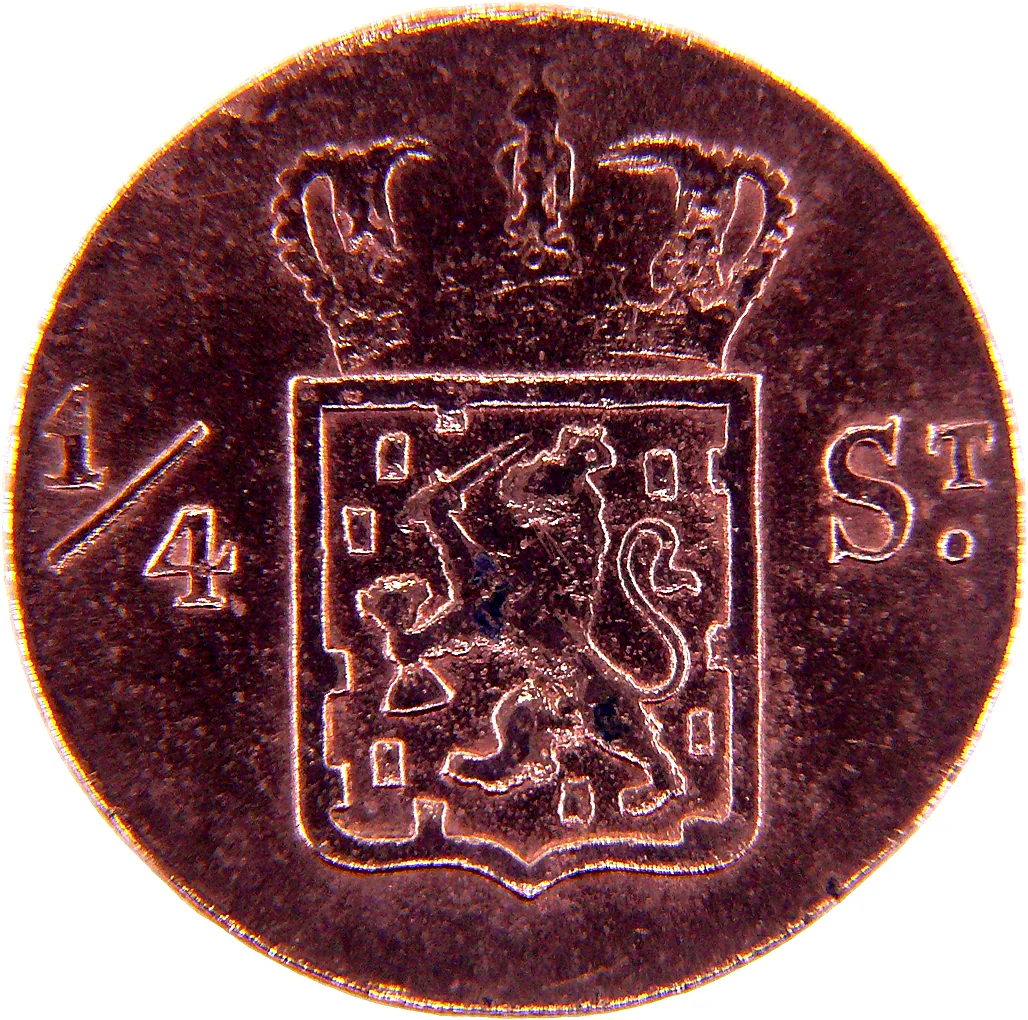
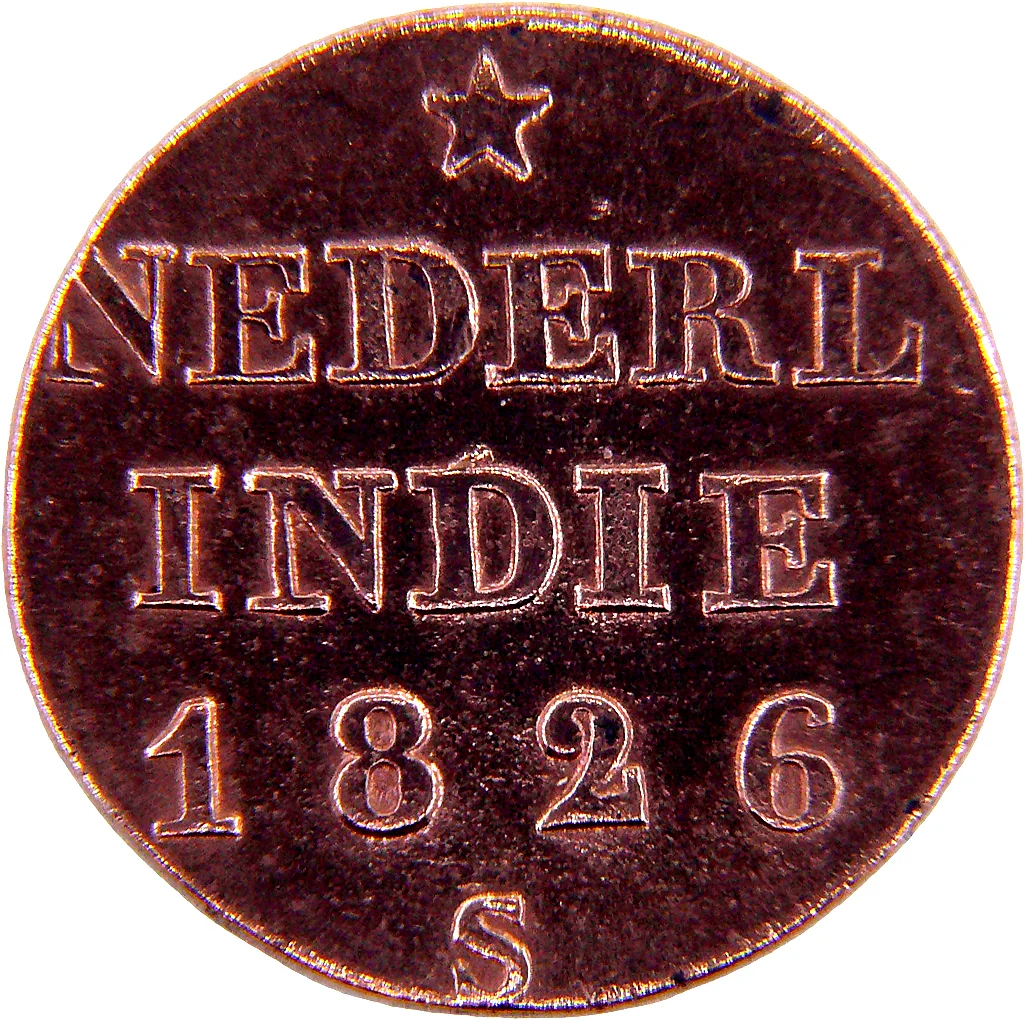
¼ stuiver – Netherlands East Indies
Add to wishlist
Indonesia
Context
Year: 1826
Country: Indonesia
Issuer: Netherlands East Indies
Ruler: William I
Currency:
(1726—1854)
Demonetized: Yes
Material
References
KM: #
Numista: #42173
Mintings
| Year | Mint Mark | Mintage | Quality | Collection |
|---|---|---|---|---|
| 1826 | S | — |
Historical background
In 1826, the currency system of the Netherlands East Indies (NEI) was in a state of profound disorder and transition, a legacy of the preceding decades of war and economic upheaval. The British interregnum (1811-1816) had introduced the Spanish silver dollar (real) as the primary coin, but the restored Dutch colonial administration struggled to reassert monetary control. The circulation was a chaotic mix of Spanish, Dutch, and other foreign silver coins, alongside a vast quantity of devalued copper duit coins, leading to wildly fluctuating exchange rates between different forms of money and crippling uncertainty for daily trade.
The Dutch response was the introduction of the Nederlandsch-Indisch gulden (guilder) by royal decree in 1826, aiming to create a unified, decimal-based currency system. This reform legally established the silver guilder, subdivided into 100 cents, as the sole standard. However, the decree of 1826 was more an assertion of intent than an immediate solution. The colonial government lacked the necessary silver reserves to mint enough coins to replace the entrenched Spanish dollars, meaning the older, heterogeneous coinage remained in widespread practical use for years.
Consequently, the monetary landscape in 1826 was defined by this tense duality: a new, official currency framework existed on paper, while the daily economy continued to operate on a messy, multi-currency reality. This disconnect hampered government finances and commerce, as merchants and the Javanese population had to navigate complex calculations. The year thus marks a pivotal, but incomplete, beginning of a decades-long process to impose a uniform currency, a effort driven by the colonial state's need for fiscal stability and control as it implemented the coercive Cultivation System.
The Dutch response was the introduction of the Nederlandsch-Indisch gulden (guilder) by royal decree in 1826, aiming to create a unified, decimal-based currency system. This reform legally established the silver guilder, subdivided into 100 cents, as the sole standard. However, the decree of 1826 was more an assertion of intent than an immediate solution. The colonial government lacked the necessary silver reserves to mint enough coins to replace the entrenched Spanish dollars, meaning the older, heterogeneous coinage remained in widespread practical use for years.
Consequently, the monetary landscape in 1826 was defined by this tense duality: a new, official currency framework existed on paper, while the daily economy continued to operate on a messy, multi-currency reality. This disconnect hampered government finances and commerce, as merchants and the Javanese population had to navigate complex calculations. The year thus marks a pivotal, but incomplete, beginning of a decades-long process to impose a uniform currency, a effort driven by the colonial state's need for fiscal stability and control as it implemented the coercive Cultivation System.

🌟 Limited