


Obverse
Description:
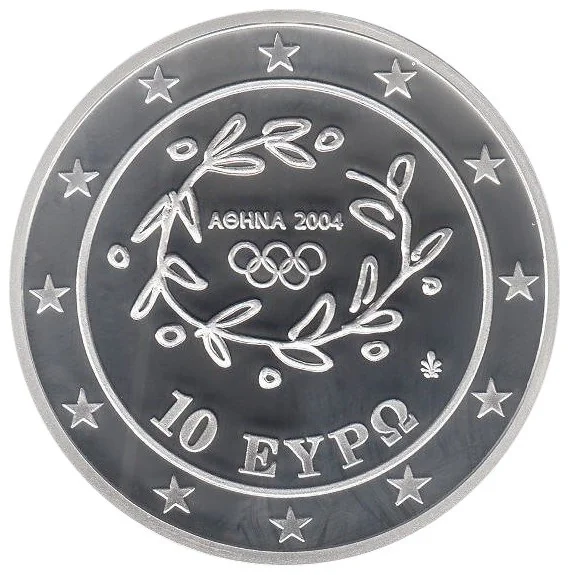
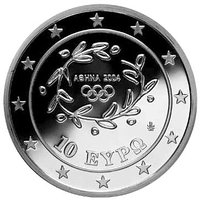
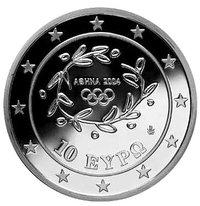
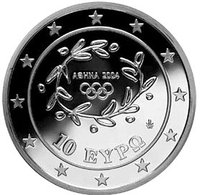
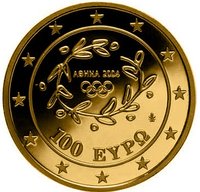
The design features the Athens 2004 emblem: a kotinos (olive wreath) encircling the Olympic rings, all enclosed within a ring of 12 stars.
Inscription:
ΑΘΗΝΑ 2004
10 ΕΥΡΩ
10 ΕΥΡΩ
Translation:
ATHENS 2004
10 EURO
10 EURO
Script: Greek
Language: Greek
Engraver: Panagiotis Gravvalos
Reverse
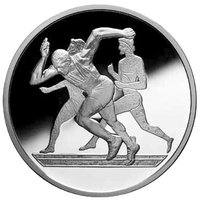
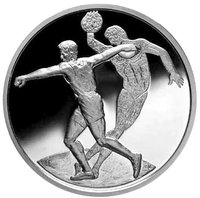
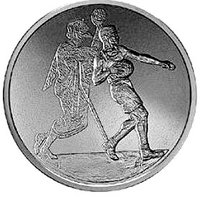
Description:
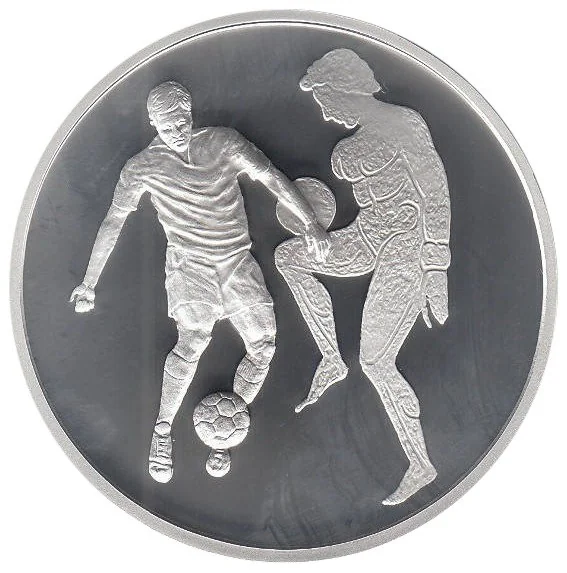
Footballers through the ages.
Engraver: Panagiotis Gravvalos
Edge
Plain
Categories
| Sport> Football |
| Symbols> Coat of Arms |
| Sport> Summer Olympic Games |
Mints
| Name | Mark |
|---|---|
| National Mint of the Bank of Greece | — |
Mintings
| Year | Mint Mark | Mintage | Quality | Collection |
|---|---|---|---|---|
| 2004 | — | 68,000 | Proof |
Historical background
In 2004, Greece's currency situation was defined by its recent and transformative membership in the Eurozone. The country had adopted the euro as its physical currency just three years prior, in January 2001 (for accounting) and January 2002 (for cash), replacing the historic drachma. This move was celebrated as a milestone of national modernization and a firm anchoring within the European core, promising lower interest rates, eliminated exchange risk, and greater economic stability. The 2004 Athens Olympics, in particular, stood as a symbol of this new era, funded by significant public and European investment under the assumption that euro membership would guarantee sustained growth and access to cheap credit.
Beneath the surface, however, the foundations of Greece's euro membership were already showing serious cracks. The convergence criteria required to join the euro had been met with the help of financial engineering and questionable data, masking underlying structural weaknesses. Crucially, the loss of monetary policy autonomy meant Greece could no longer devalue its currency to regain competitiveness. Instead, it experienced a sharp rise in unit labor costs and a widening current account deficit, as cheaper credit fueled a consumption and import boom rather than productive investment. Public debt, though temporarily lowered for euro entry, remained stubbornly high above 100% of GDP.
Consequently, 2004 existed in a paradoxical space: it was the peak of optimistic euro integration, yet also the calm before the storm. The benefits of the common currency—low interest rates and abundant liquidity—were actively fueling the imbalances that would later trigger the sovereign debt crisis. While the government of Costas Karamanlis, elected that year, faced growing budget deficits, the full scale of the fiscal misreporting and the impending global financial crisis were not yet apparent. The year thus represents a pivotal point where the short-term euphoria of euro membership coexisted with, and inadvertently accelerated, the long-term vulnerabilities that would unravel after 2009.
Beneath the surface, however, the foundations of Greece's euro membership were already showing serious cracks. The convergence criteria required to join the euro had been met with the help of financial engineering and questionable data, masking underlying structural weaknesses. Crucially, the loss of monetary policy autonomy meant Greece could no longer devalue its currency to regain competitiveness. Instead, it experienced a sharp rise in unit labor costs and a widening current account deficit, as cheaper credit fueled a consumption and import boom rather than productive investment. Public debt, though temporarily lowered for euro entry, remained stubbornly high above 100% of GDP.
Consequently, 2004 existed in a paradoxical space: it was the peak of optimistic euro integration, yet also the calm before the storm. The benefits of the common currency—low interest rates and abundant liquidity—were actively fueling the imbalances that would later trigger the sovereign debt crisis. While the government of Costas Karamanlis, elected that year, faced growing budget deficits, the full scale of the fiscal misreporting and the impending global financial crisis were not yet apparent. The year thus represents a pivotal point where the short-term euphoria of euro membership coexisted with, and inadvertently accelerated, the long-term vulnerabilities that would unravel after 2009.
Series: 2004 Summer Olympics, Athens
⭐ Somewhat Rare