

1000 Pesos – Argentina
Argentina
Obverse
Description:
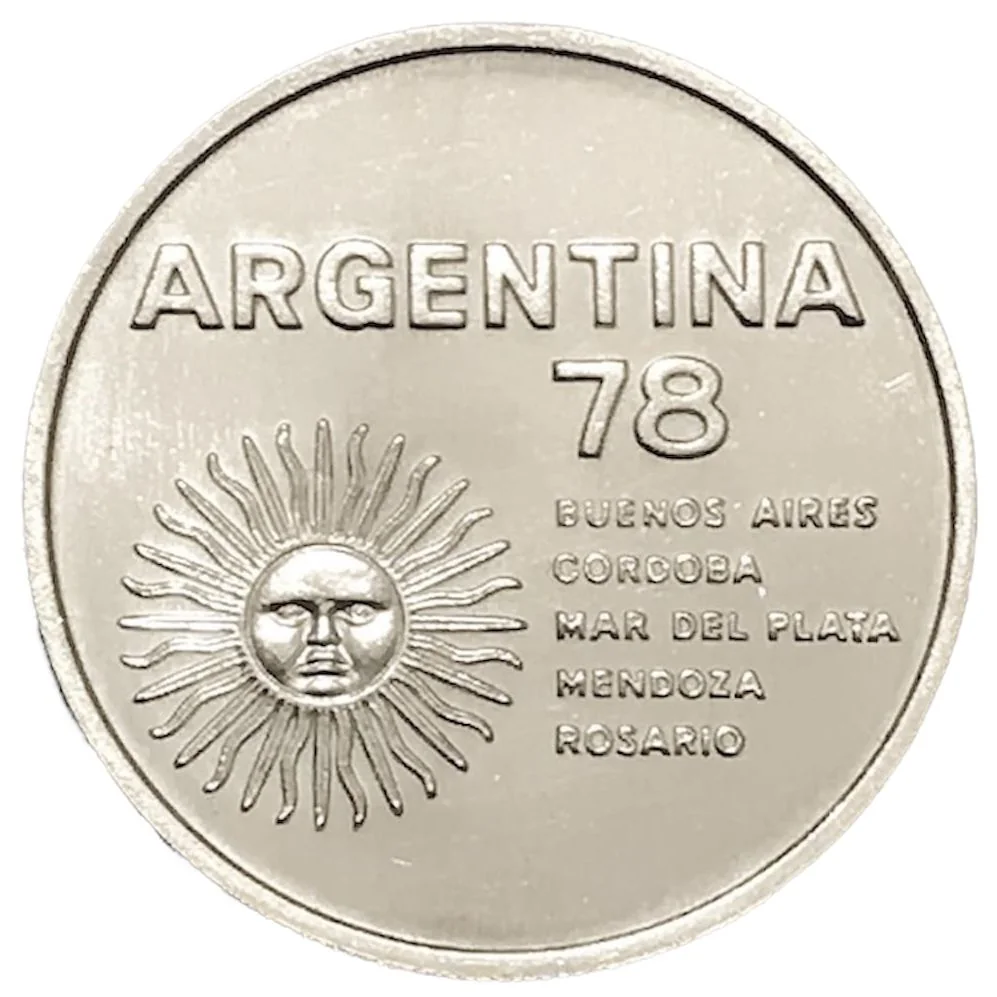
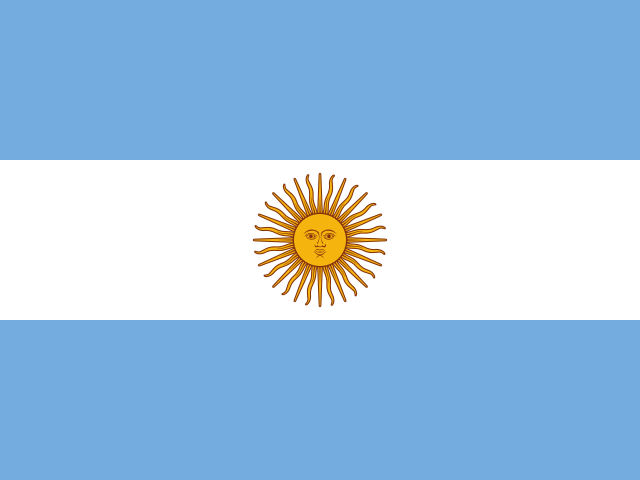
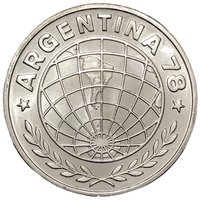
Upstairs: "ARGENTINA 78" over two lines. Below: 16 straight and 16 flaming rays around a sun. Right side lists five host cities. Linear beading.
Inscription:
ARGENTINA
78
BUENOS AIRES
CORDOBA
MAR DEL PLATA
MENDOZA
ROSARIO
78
BUENOS AIRES
CORDOBA
MAR DEL PLATA
MENDOZA
ROSARIO
Translation:
ARGENTINA
78
BUENOS AIRES
CORDOBA
MAR DEL PLATA
MENDOZA
ROSARIO
78
BUENOS AIRES
CORDOBA
MAR DEL PLATA
MENDOZA
ROSARIO
Script: Latin
Reverse
Description:
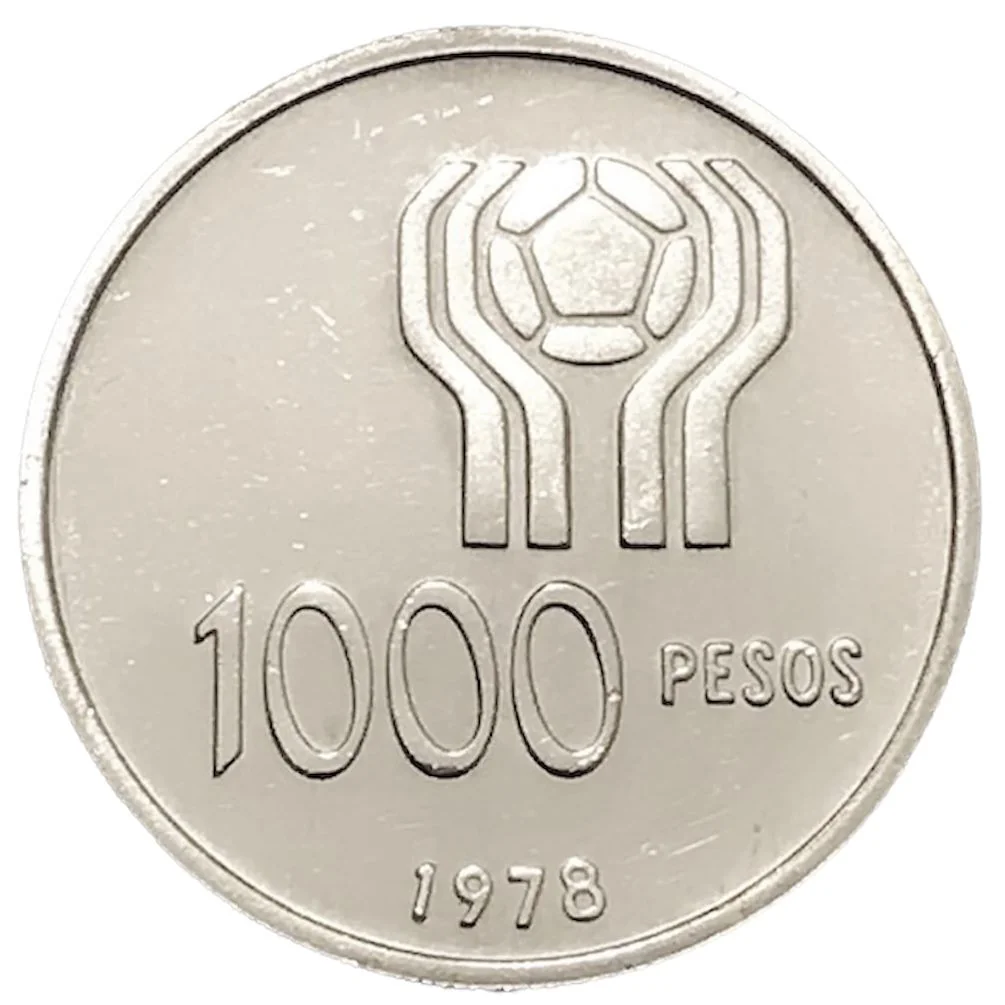
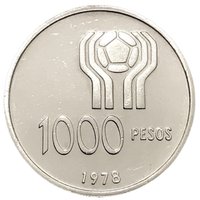
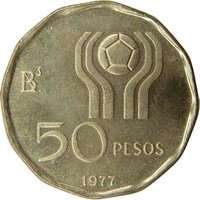
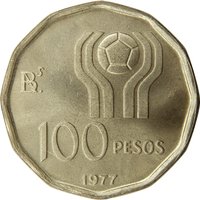
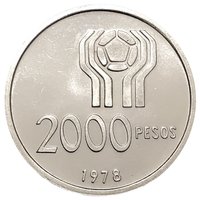
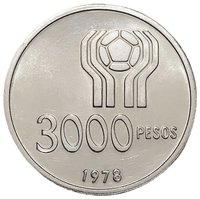
World Cup emblem top right. Below, value and "PESOS". Exergue: minting year. Linear beading.
Inscription:
1000 PESOS
1978
1978
Script: Latin
Edge
Reeded
Categories
| Sport> Football> FIFA World Cup |
| Symbol> Sun |
Mints
| Name | Mark |
|---|---|
| Casa de Moneda de Chile | — |
Mintings
| Year | Mint Mark | Mintage | Quality | Collection |
|---|---|---|---|---|
| 1977 | — | 98,837 | ||
| 1977 | — | 1,163 | Proof | |
| 1978 | — | 187,383 | ||
| 1978 | — | 1,912 | Proof |
Historical background
In 1977, Argentina was under the rule of the military junta led by General Jorge Rafael Videla, which had seized power the previous year. The economic policy, orchestrated by Minister José Alfredo Martínez de Hoz, was characterized by a radical shift toward financial liberalization and monetarist principles. A central pillar was the "Law of Financial Entities," which deregulated the banking sector and removed restrictions on interest rates and foreign capital flows. This period saw the aggressive promotion of foreign debt accumulation, as the regime opened the economy to international finance in an attempt to modernize industry and curb inflation, which nevertheless remained stubbornly high.
The currency situation was defined by a dual exchange rate system: a fixed official rate for trade and essential transactions, and a floating financial rate for most capital movements. This created a significant gap, with the financial peso (the "financial dollar") consistently trading at a premium, reflecting market distrust and capital flight pressures. Despite strict controls, a thriving black market for U.S. dollars operated, as Argentines sought a safe haven from peso devaluation and the political repression of the "Dirty War." The overvalued official peso, maintained to fight inflation, began to severely hurt export competitiveness, widening the trade deficit.
By the end of 1977, the foundations of a profound crisis were being laid. The economic "sweet spot" of initial stability provided by massive foreign borrowing and high interest rates was starting to fade. The overvalued currency, combined with the lifting of tariffs, led to a flood of imports that devastated local industry, while exports stagnated. This unsustainable model, reliant on volatile short-term capital, would culminate in the catastrophic collapse of 1980-81, including a massive devaluation, banking crisis, and the default on Argentina's external debt, leaving a legacy of economic devastation that lasted for years.
The currency situation was defined by a dual exchange rate system: a fixed official rate for trade and essential transactions, and a floating financial rate for most capital movements. This created a significant gap, with the financial peso (the "financial dollar") consistently trading at a premium, reflecting market distrust and capital flight pressures. Despite strict controls, a thriving black market for U.S. dollars operated, as Argentines sought a safe haven from peso devaluation and the political repression of the "Dirty War." The overvalued official peso, maintained to fight inflation, began to severely hurt export competitiveness, widening the trade deficit.
By the end of 1977, the foundations of a profound crisis were being laid. The economic "sweet spot" of initial stability provided by massive foreign borrowing and high interest rates was starting to fade. The overvalued currency, combined with the lifting of tariffs, led to a flood of imports that devastated local industry, while exports stagnated. This unsustainable model, reliant on volatile short-term capital, would culminate in the catastrophic collapse of 1980-81, including a massive devaluation, banking crisis, and the default on Argentina's external debt, leaving a legacy of economic devastation that lasted for years.
Series: 1978 FIFA World Cup
🌱 Common